151515 Career Planning Model: Three 15-Year Stages
The 151515 Career Planning Model helps you match this year's effort to one of three 15-year stages: Learn and Build the Foundation, Mastery and Distinction, then Influence and Legacy. Age bands are a teaching mnemonic, not a required birthday schedule.
Framework Card
- Name:
- 151515 Career Planning Model
- Goal:
- Match current career effort to one of three 15-year stages: build a foundation, develop mastery, or use influence.
- Flow:
- Learn and Build the Foundation → Mastery and Distinction → Influence and Legacy
- Best For:
- Early-career over-focus on title or pay; Mid-career stuckness about whether to deepen or broaden; Later-career questions about mentoring versus still competing as a beginner
Why it matters
When every year looks like a sprint for title and pay, a 28-year-old and a 48-year-old can make the same kind of move for the same kind of reason. That is how people collect credentials they will not use, or keep competing as generalists after the work has already asked them to be distinctive.
The mismatch is often quiet. You are busy. You are comparing yourself to a peer who got a director title two years earlier. You are not asking which kind of investment this decade is for: skills and relationships, a recognizable sweet spot, or influence that other people can use.
The 151515 model is a way to make that horizon visible, then change what you optimize. It is not a promise that a 45-year plan will prevent burnout. It is a habit of asking: given the skills I have and the shape of my role, which stage am I actually in, and what should I stop treating as the main scoreboard?
What it is
The 151515 model (also written 15-15-15) comes from Brian Fetherstonhaugh's book *The Long View*. It divides a long working life into three successive stages of about 15 years each. Each stage has a purpose (WHY), a focus (WHAT), a method (HOW), and a working identity (WHO).
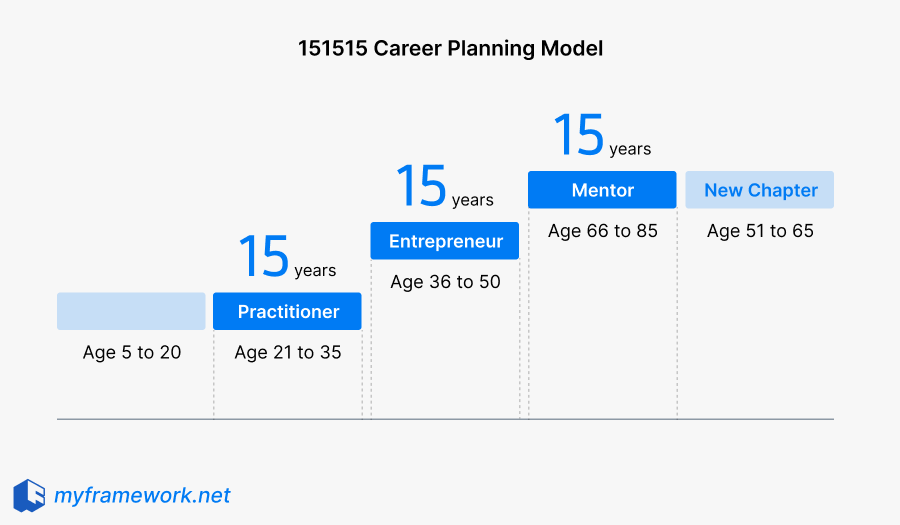
Stage 1, Learn and Build the Foundation, is often taught as roughly ages 21 to 35: fill skill gaps, gather varied experience, form relationships that last.
Stage 2, Mastery and Distinction, is often taught as roughly ages 36 to 50: find a sweet spot where interests, strengths, and paid opportunity meet.
Stage 3, Influence and Legacy, is often taught as roughly ages 51 to 65 and later: pass on experience, protect the network, renew energy.
The numbers 15, 15, and 15 are a teaching split. A career change, a caregiving gap, or a late start can put you in Stage 1 priorities at 42. The method still holds: name the working stage from evidence, then set priorities for that stage.
The model does not write SMART goals, does not run a coaching session, and does not pick between two offers this week. It diagnoses which kind of effort belongs to this period.
How it works
A useful 151515 pass is a stage reading plus stage priorities, not a poster that says “think long term.”
1. Locate the working stage from evidence
Use role shape, skill depth, and what you are currently optimizing, not birthday alone. A 40-year-old in a new field may still be in foundation work. A 32-year-old with a narrow, paid sweet spot may already be doing Stage 2 work. Say which signals you used.
2. Check for stage mismatch
Ask whether this year's projects match the stage. Foundation years spent only chasing title are a mismatch. Mastery years spent only collecting unrelated skills are a mismatch. Influence years spent pretending you are still unknown are a mismatch.
3. Set WHY, WHAT, HOW, and WHO for that stage
Write the purpose, the focus, the method, and the working identity for the next period. In Stage 1 that often means marketable skills, varied experience, and relationships. In Stage 2 that often means a sweet spot (interests, strengths, opportunity) and a recognizable body of work. In Stage 3 that often means mentoring, network care, and energy renewal.
4. Choose a next period of work, not a life rewrite
Name what you will start, protect, or stop treating as the main scoreboard in the next quarter or year. Without that move, you still have a diagram of decades, not a 151515 decision.
Review the reading when the role changes (new industry, new country, a long pause). The stage is a snapshot of fit, not a permanent label.
How it compares
When another lens fits better, or when you need a complementary view, these frameworks do different jobs. They are not interchangeable labels for the same question.
| Framework | What it helps you see | How it differs from 151515 |
|---|---|---|
| SMART Goal Framework | Whether a goal is specific and checkable | Goal quality, not which decade of effort |
| GROW Model | A coaching sequence (Goal, Reality, Options, Will) | A conversation structure. 151515 is a career horizon. |
| Ikigai | Overlap of love, skill, need, and pay | Purpose fit, not stage timing |
| Three Zones of Learning | Comfort, stretch, and panic in a task | Task difficulty, not career stage |
| Deliberate Practice | How to improve a defined skill | Training method, not which career job to train for |
| 888 Rule | Splitting a day among work, sleep, and life | Daily balance, not a 15-year horizon |
The 151515 model is the lens for which kind of career effort belongs to this period. Other methods help when the question is goal wording, a coaching session, purpose fit, or how to practice.
When to Use This Framework
- Early-career over-focus on title or pay. Too much comparison, too little compounding skill and relationship depth.
- Mid-career stuckness. The work is familiar, but it is unclear whether to deepen a sweet spot or keep collecting generalist experience.
- Later-career identity drift. The calendar still looks like Stage 1 competition when the useful job has shifted toward mentoring, network care, and energy renewal.
Example
A concrete example makes the structure easier to reuse when you are under uncertainty.
Example: A 34-year-old marketing manager comparing titles
A marketing manager feels behind because a peer became a director at 32. Calendar is full of campaigns. Learning is whatever the next brief requires.
She names the working stage from evidence: still broadening skills and senior relationships, not yet a distinctive practice. That is Stage 1 work even though the birthday is near the teaching edge of the band.
Implication: Protect one rotational assignment that teaches a new business type. Protect a quarterly review of strengths and gaps. Stop using the peer's title as the scoreboard. The model did not prove she must wait until 36 to lead. It showed that this year's useful job is still foundation, and that title chase was crowding it out.
Takeaway
What the 151515 model can help with
- Making the working career stage visible from skills and role shape
- Separating foundation work, mastery work, and influence work
- Deciding what to protect or stop treating as the main scoreboard this period
- Catching the habit of using someone else's title timeline as your plan
What the 151515 model cannot replace
- Goal quality. SMART checks whether a goal is specific and checkable. 151515 does not write the goal.
- A coaching conversation. GROW is a session structure. 151515 is a horizon, not a weekly dialogue.
- Purpose mapping. Ikigai asks what you love, what you are good at, what is needed, and what can be paid. That is fit. 151515 is timing of effort.
- Skill training method. Deliberate Practice is how you improve a skill. 151515 is which career job that skill is for.
- A job-offer scorecard or a burnout clinic. Choosing between two offers this week, or treating clinical exhaustion, is a different job.
Honest scope: 151515 structures a stage reading and a period of priorities. It does not replace the methods above, and it should not be sold as an age law.
Frequently asked questions
No. They are a teaching mnemonic. A career change can put you in Stage 1 priorities at 40. Locate the stage from skills and role shape.
Treat that as Stage 1 work with less calendar time to compound. Be more selective about which skills and relationships you invest in. The model is not a judgment that you missed a bus.
Yes. A new industry, a sabbatical, or a role that resets your skill base can return you to foundation priorities. You do not restart from zero if you already have transferable relationships and habits.
It can, with a tighter loop. You may cycle through foundation, distinction, and influence across niches rather than once in 45 years. The useful question is still which kind of effort this period is for.
Not by itself. It can tell you whether an offer is foundation work, mastery work, or influence work. The offer decision still needs constraints the model does not supply (pay, visa, health, caregiving).