5 Product Levels Model: Core Benefit to Potential Product
The 5 Product Levels Model helps you map an offer from core benefit through basic, expected, and augmented layers to a potential future envelope. It is a placement map, not the 4P marketing mix, and not a product lifecycle.
Framework Card
- Name:
- 5 Product Levels Model
- Goal:
- Map an offer from core benefit through basic, expected, and augmented layers to a potential future envelope.
- Flow:
- Core Benefit → Basic Product → Expected Product → Augmented Product → Potential Product
- Best For:
- Roadmaps that mix table-stakes with claimed differentiators; Competitive reviews that only list features; Deciding what “future product” means versus a backlog dump
Why it matters
Roadmaps often mix three kinds of work in one list: keep the lights on, match the category, and actually differ. When table-stakes sit in the “delight” column, teams argue about taste instead of about level.
Buyers still need the core job done. They still punish missing expected features. They still choose among augmentations. They still hear a future story. Putting those on one undifferentiated backlog hides which fight you are in.
What it is
Philip Kotler describes five concentric levels.
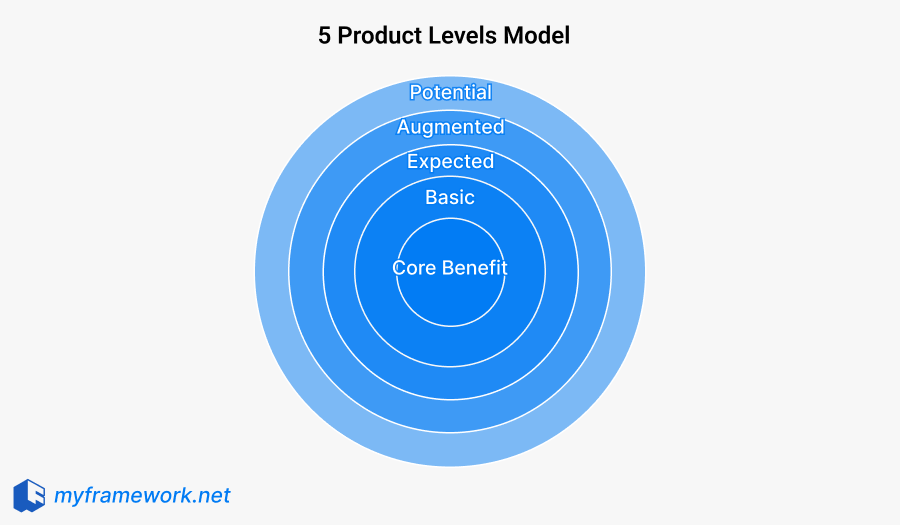
- Core Benefit is the job the buyer is really buying.
- Basic Product is the minimum embodiment (the components that make the offer exist).
- Expected Product is what the category now treats as normal.
- Augmented Product is extras that currently differentiate.
- Potential Product is a plausible future transformation, not a parking lot of ideas.
Teaching examples (a notes tool whose core is organizational clarity, a watch whose expected layer includes battery life) are illustrations of placement, not measurements this page should treat as universal.
The model does not set Price or Place. It does not tell you which lifecycle phase you are in.
How it works
A useful pass places the current offer on all five levels, then names the fight.
1. Core Benefit
State the job in buyer language from the case.
2. Basic Product
List the embodiment without which there is no offer.
3. Expected Product
Name category norms. Missing these is churn, not a missed wow.
4. Augmented Product
Name extras that currently differentiate, with evidence they are not already expected.
5. Potential Product
Describe a future envelope that would change the offer, not a dump of backlog items.
Then say where the next bet sits. If you cannot place it, you do not have a five-level reading yet.
How it compares
When another lens fits better, or when you need a complementary view, these frameworks do different jobs. They are not interchangeable labels for the same question.
| Framework | What it helps you see | How it differs from five levels |
|---|---|---|
| 4P Marketing Mix | Product, Price, Place, Promotion | Mix levers, not concentric layers |
| Product Lifecycle | Introduction through decline | Time phases |
| Value Stick | Who captures value | Economics, not layers |
| Outcome-based roadmap | Outcomes versus output | Planning, not product anatomy |
| Maslow | Human needs | Shape rhyme only |
The five levels are the lens for where an offer competes in concentric value. Other methods help when the question is mix, time, or economics.
When to Use This Framework
- Roadmaps that mix table-stakes with claimed differentiators. Battery life listed as delight when the category already requires it.
- Competitive reviews that only list features. Nobody has named the core job or the expected floor.
- Fuzzy “future product.” A pile of ideas labeled vision without a potential envelope.
Example
A concrete example makes the structure easier to reuse when you are under uncertainty.
Example: A notes app adding “AI organize”
A team calls templates and a block editor “delight,” and puts AI organize on the same list as sync.
A five-level pass (illustrative, not a market study): Core Benefit is making work findable. Basic Product includes the editor. Expected Product includes sync and reliability. Templates may be Augmented if rivals do not already require them. AI organize might be Augmented now and Potential if it becomes the new core job.
Implication: Sync is not a differentiator if the category already expects it. The argument should be “which level is this bet,” not “is AI exciting.”
Takeaway
What the five levels can help with
- Separating core job, embodiment, table-stakes, extras, and future envelope
- Catching expected features mislabeled as delight
- Giving Potential a meaning other than “later”
What the five levels cannot replace
- Seller mix. 4P Marketing Mix sets Product among Price, Place, and Promotion.
- Time in market. Product Lifecycle is phases, not layers.
- Value split. Value Stick is economics of who captures value.
- Outcome planning. Outcome-based roadmap is a planning style.
- Human-need stacks. Maslow is a different hierarchy.
Honest scope: the model structures placement. It does not replace mix, lifecycle, or research.
Frequently asked questions
No. Expected is the category floor. Augmented is extra relative to that floor. The floor moves.
No. Potential is a future envelope that would change the offer. A pile of tickets is not a level.
You must usually clear 1 to 3 to stay in the category. Fights often sit at 4. 5 is directional.
4P mix includes Price, Place, and Promotion. This model only layers the offer.
No. They show placement. Your category’s expected floor is an empirical question.