7-38-55 Rule: Align Words, Tone, and Body for Feelings
The 7-38-55 Rule is a teaching shorthand from Albert Mehrabian's work on feelings and attitudes: when words, tone, and body disagree, people usually trust tone and visible cues more than the sentence. The 7, 38, and 55 figures are a mnemonic, not a meter for every conversation. It is not a claim th…
Framework Card
- Name:
- 7-38-55 Rule
- Goal:
- Check whether words, tone, and body agree when you are sending a feeling or attitude, especially if those channels might conflict.
- Flow:
- Words (taught as 7 percent) → Tone of voice (taught as 38 percent) → Body language (taught as 55 percent)
- Best For:
- Live or video feedback where tone can undo the sentence; Talks where the audience will read face and voice, not only slides; Negotiations and sensitive conversations that carry attitude, not only facts
Why it matters
You can choose careful words and still send a different attitude. "I'm open to this" with a flat voice and crossed arms is two messages. Listeners tend to believe the second.
That mismatch shows up in feedback ("this is just a small note" said through clenched teeth), in talks (a slide that says confident while the speaker looks at the floor), and in negotiation (cooperative sentences with a closed posture).
The 7-38-55 Rule is a habit of checking the three channels when the content is a feeling or an attitude. It is not a reason to ignore words when you are explaining a spec.
What it is
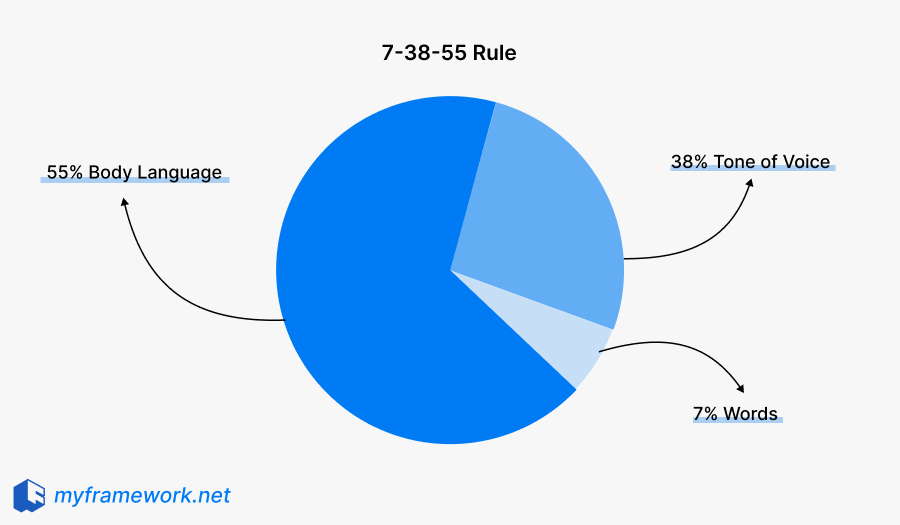
Albert Mehrabian's studies (often dated to the 1960s) are commonly taught as: about 7 percent of the impression of liking or feeling from words, about 38 percent from tone of voice, about 55 percent from face and body.
Those studies were about feelings and attitudes, especially when channels conflict. They were not a census of all human communication.
In practice the rule has two parts:
- For this kind of message, nonverbal cues carry a lot of the attitude.
- If the sentence and the nonverbal disagree, people tend to believe the nonverbal.
The percentages are a memory aid. You cannot read "38 percent tone" off a meeting. Culture and medium change how cues are read. Video keeps tone and much of the face. A phone keeps tone and drops most body. Email keeps words only.
How it works
A useful 7-38-55 pass is an alignment check, not a calculator.
1. Name the feeling or attitude
What are you actually trying to send? Support, firmness, apology, openness, urgency. If the job is a factual spec, stop and use a different method.
2. Check the three channels
Words: does the sentence match that attitude? Tone: pace, pitch, volume, tightness. Body (if visible): face, posture, gesture, where you look.
3. Repair the mismatch
If the sentence says "I'm not upset" and the voice is tight, either change the sentence to what is true or change the delivery until they agree. Performing a smile over a true conflict is still a mixed message.
Do not "add 55 percent body language" as a gimmick. Alignment is the move. The numbers only remind you which channels to inspect.
How it compares
When another lens fits better, or when you need a complementary view, these frameworks do different jobs. They are not interchangeable labels for the same question.
| Framework | What it helps you see | How it differs from 7-38-55 |
|---|---|---|
| PREP Framework | Point, Reason, Example, Point | Verbal argument structure. 7-38-55 is channel alignment for attitude. |
| SBI Model | Situation, Behavior, Impact | Feedback content. 7-38-55 checks how that content is delivered. |
| Active Listening Spiral | How a receiver tracks and reflects | Listening, not sending through three channels. |
| STAR Method | One past incident in order | Story structure for evidence, not Mehrabian weights. |
The 7-38-55 Rule is the lens for mixed messages about feelings and attitudes. Other methods help when the question is argument shape, feedback content, listening, or an incident story.
When to Use This Framework
- Workplace feedback. The sentence can sound supportive while the voice sounds like a verdict.
- Public speaking. Audiences read energy and face along with the claim.
- Negotiation. Cooperation in words with resistance in posture is a mixed message.
- Sensitive personal conversations. People listen for whether it is safe, not only for the dictionary meaning.
Example
A concrete example makes the structure easier to reuse when you are under uncertainty.
Example: "Small piece of feedback" that did not land as small
A manager needs to tell an engineer that a late API change burned the support queue. They open with "This is a tiny thing, I am not worried." Their voice is clipped. They do not look up from the laptop.
The engineer hears the attitude (this is not tiny; you are worried or angry) and discounts the words. A 7-38-55 pass would name the intended attitude (firm, specific, still workable), then align: a sentence that admits the impact, a pace that is not a scold, and facing the person. SBI could still structure the content (yesterday's change, the interruption, the queue delay). 7-38-55 does not replace SBI. It catches the mixed message around it.
Implication: The manager did not need a new percentage. They needed the three channels to say the same thing. Delivering the same clipped tone over a PREP-shaped paragraph would still leak attitude.
Takeaway
What 7-38-55 can help with
- Noticing mixed messages when the content is a feeling or attitude
- Checking words, tone, and body for the same intent
- Explaining why "I'm fine" failed when the face said otherwise
- Planning live or video delivery where those channels are visible
What 7-38-55 cannot replace
- A universal weighting of all meaning. Factual and technical talk is not 7 percent words. Treating it that way is the usual over-quote.
- PREP. PREP structures a verbal argument. Channel alignment is a different job.
- SBI. SBI structures feedback content. You can still mismatch tone around a perfect SBI.
- Active listening. Active Listening Spiral is a receiver skill. 7-38-55 is about what you send.
- Text-only media. Email and chat drop tone and body as live channels. Those need different tools (clarity, tone-in-writing), not 7-38-55 as a formula.
Honest scope: 7-38-55 is a feelings-and-attitudes heuristic when channels can conflict. It should not be sold as a law of all communication.
Frequently asked questions
No. For feelings and attitudes, nonverbal cues often carry the attitude, especially in a mismatch. For facts and instructions, words still do most of the work.
No. They are a teaching split from specific studies. Use them as a reminder to inspect three channels, not as a meter.
Not as the three-channel formula. Email has no live tone or body. Mixed messages there are a wording problem, not Mehrabian weights.
SBI and PREP structure what you say. 7-38-55 asks whether tone and body agree with that content when the message is a feeling or attitude.
Cues are read differently across cultures. Treat 7-38-55 as a heuristic about mismatch, not as a world constant.