ABC Model: Separate the Event from the Belief that Produced the Feeling
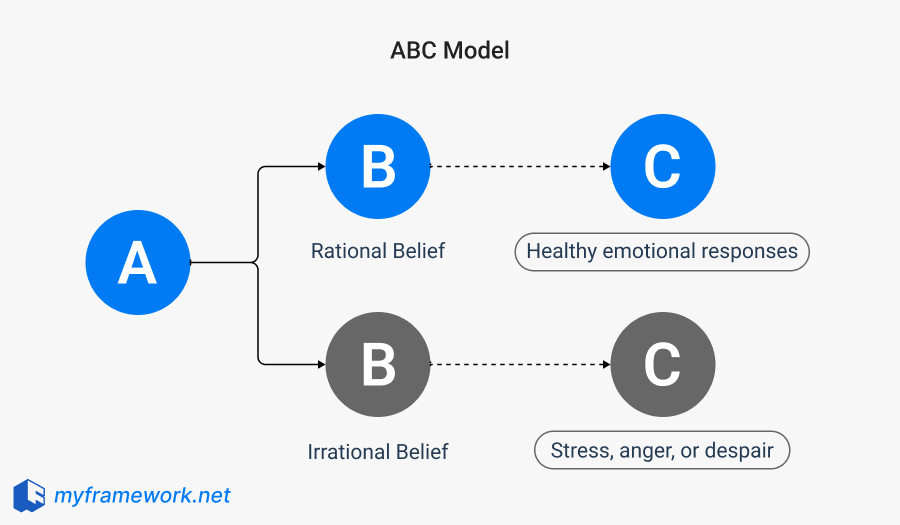
The ABC Model, from Albert Ellis’s Rational Emotive Behavior Therapy, separates an activating event (A) from the belief about it (B) and the feeling or behavior that follows (C). You then dispute a rigid belief. The event is not treated as the sole cause of the feeling.
Framework Card
- Name:
- ABC Model
- Goal:
- Name the activating event, the belief about it, and the consequence, then dispute a rigid belief so the feeling is no longer treated as caused by the event alone.
- Flow:
- Activating event → Belief → Consequence → Dispute the belief
- Best For:
- A spike of anger or anxiety after a specific event; Catching a rigid should about other people or yourself; Separating what happened from the interpretation that produced the reaction
Why it matters
A colleague says no. Traffic is slow. A message is short. The feeling that follows can be anger, shame, or panic that seems to come from the event itself.
If you only try to change the event, you stay stuck when the event will not change. If you only suppress the feeling, the same belief fires next time. ABC makes the middle term visible: the belief, often a rigid should. That is the part you can test.
The model does not promise that a new sentence deletes the feeling. It does not replace clinical care.
What it is
ABC stands for Activating event, Belief, Consequence. Ellis taught that people are disturbed not by events alone but by beliefs about events.
| Letter | Job |
|---|---|
| A | What happened (the trigger) |
| B | The thought or rule you attached to A |
| C | The feeling and behavior that follow B |
| Dispute | Test the rigid belief and state a more flexible alternative |
Dispute is the change move in REBT (D in ABCDE). It is not a fourth letter of the name ABC, and it is not a generic to-do list.
A common B pattern is a should: “people must always help me,” “I must not make mistakes.” A more flexible B might be “they can refuse,” “mistakes happen and I can repair.”
ABC on this page is not a full CBT thought-record protocol. It is not AVP (name, validate, and permit a feeling without disputing a belief).
How it works
A useful ABC pass writes A, B, and C, then disputes B.
1. Write A without the story
What happened, in observable terms. “They said no to the request,” not “they disrespected me.”
2. Write B honestly
The should, the rule, the prediction. If you cannot find B, you do not have ABC yet.
3. Write C
The feeling and what you did or wanted to do.
4. Dispute B
Ask whether the rule must be true, what evidence you have, and what a flexible alternative would be. Keep action after Dispute as ordinary choice, not a hidden ABC letter.
How it compares
When another lens fits better, these frameworks do different jobs.
| Framework | What it helps you see | How it differs from ABC |
|---|---|---|
| CBT Framework | Broader cognitive methods and thought records | A family of methods. This page is Ellis A-B-C. |
| AVP Model | Acknowledge, Validate, Permit | Allows the feeling. ABC disputes a belief. |
The ABC Model is the lens for A, B, C, then dispute. Other methods help when the question is a full CBT protocol or in-the-moment permission to feel.
When to Use This Framework
- Anger after a refusal. The event is no. The belief may be that people must comply.
- Shame after a mistake. The event is the error. The belief may be that you must be flawless.
- Anxiety after an ambiguous message. The event is the text. The belief may be a catastrophe story.
Example
A concrete example makes the structure easier to reuse when you are under uncertainty.
Example: The refused request
A: You asked a colleague for help. They said no.
B: “People should always help me when I ask.”
C: Anger, a sharp message, rumination.
Implication: Dispute B. A flexible alternative: they can refuse; you can ask someone else or reschedule. AVP would permit the anger without testing the should. ABC’s job here is the belief.
Example: The short email
A: A manager replies with one line.
B: “If they respected me, they would write more. This means I am in trouble.”
C: Anxiety, checking the inbox every few minutes.
Implication: A is a short email. B is a mind-read plus a threat story. Dispute the mind-read. A CBT thought record might add more columns; ABC still starts with A, B, C.
Takeaway
What the ABC Model can help with
- Separating event, belief, and consequence
- Finding a rigid should at B
- Disputing that belief
- Seeing that two people can share A and not share C
What the ABC Model cannot replace
- CBT as a full protocol. Broader cognitive methods and records.
- AVP. Allowing a feeling without disputing a belief.
- Clinical treatment. Persistent distress, trauma, or crisis is care, not ABC.
- Changing someone else’s mind as the primary job. ABC is your B, not theirs.
- A control guarantee. A new belief may soften C. It does not delete feeling on command.
Honest scope: ABC structures event, belief, consequence, and dispute. It should not be sold as emotional control.
Frequently asked questions
ABC is Ellis’s REBT sequence and is part of the wider cognitive family. A full CBT protocol often uses more tools than A, B, C. Do not treat this page as a complete CBT course.
A written A, B, and C for one incident, a rigid belief named, and a disputed alternative. If the output only says “change your thoughts,” you do not have ABC yet.
AVP names and permits a feeling. ABC finds the belief that produced C and tests it. You can use them at different moments. They are not the same method.
This page uses Dispute as the change move after C. The public name remains ABC. Do not add a consulting next-step as if it were a fourth ABC letter.
Stay with A and C and label B as unknown. Inventing a should you do not hold is a method error. Clarifying B is part of the work.