Why Time Management is a Myth in the Age of Distraction
Have you ever finished an 8-hour workday feeling exhausted yet realizing you haven't tackled your most important task? In the modern workplace, our attention is the most valuable asset, yet it is under constant attack.
Most people try to solve this with better "Time Management." But time is finite, the real variable you can control is Energy. Productivity isn't about doing more; it’s about doing the right things when your brain is at its highest capacity.
To maximize this, you need a system that minimizes friction and aligns tasks with your biology. Here is the ultimate 3-step framework for deep focus.
The Bio-Logic of Focus (Energy over Time)
Before managing your tasks, you must understand your Circadian Rhythm. According to chronobiology research, our cognitive abilities are not static. They follow a wave.
The Peak–Trough–Recovery Model
This framework suggests that we experience a natural ebb and flow of energy throughout a 24-hour cycle.
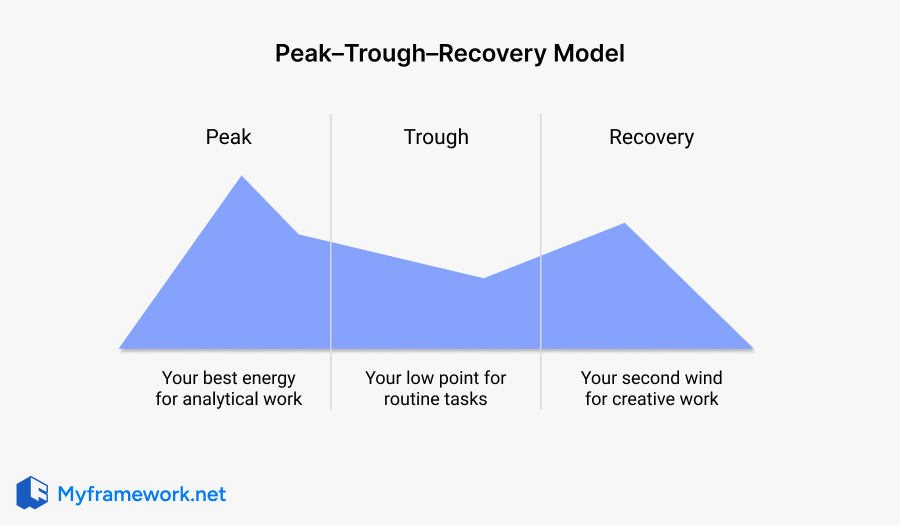
- The Peak (Usually Morning): This is when your logical and analytical powers are at their height. SEO Note: This is the time for Deep Work (#84)—tasks that require intense concentration.
- The Trough (Early Afternoon): Usually after lunch, our alertness dips. This is the "Post-Lunch Slump."
- The Recovery (Late Afternoon/Early Evening): Mood improves, and while logic isn't as sharp as the Peak, creativity often spikes.
The Strategy:
Match your hardest, most complex tasks (like strategy or coding) to your Peak. Delegate administrative tasks (emails, filing) to the Trough. Save brainstorming for the Recovery.
Learn more about this framework:
 Myframework
Defeating Decision Paralysis
The second biggest focus killer is not knowing where to start. This leads to Decision Paralysis, where you spend more energy choosing what to do than actually doing it.
The Ivy Lee Method: The Power of Six
In 1918, Charles M. Schwab, one of the world's richest men, asked consultant Ivy Lee to increase his team's efficiency. The simplicity of Lee's advice remains the gold standard for Prioritization Frameworks.
How to Implement Ivy Lee:
- At the end of each workday, write down the six most important things you need to accomplish tomorrow.
- Rank them in order of true business importance.
- Tomorrow, focus only on the first task. Work until it is finished.
- Move any unfinished tasks to a new list of six for the next day.
Why it works
By choosing exactly six, you eliminate the cognitive load of a 50-item list. You start your day with Momentum, not hesitation.
Learn more about this framework:
 Myframework
Psychological Resilience & Momentum
What happens when your morning is ruined by a fire-drill meeting or a bad personal call? Most people let a bad morning ruin the whole day. This is a failure of Resilience.
The Four Quarters Method
Think of your day like a football game. There are four quarters, and a bad first quarter doesn't mean the game is lost.
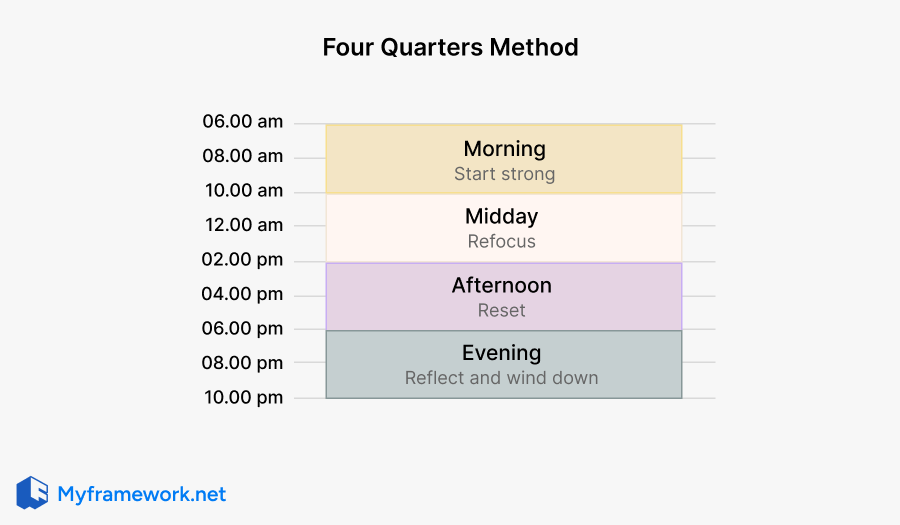
- Q1 (8 am – 11 am): Focus on the #1 Ivy Lee task.
- Q2 (11 am – 2 pm): Focus on execution and secondary tasks.
- Q3 (2 pm – 5 pm): Reset and tackle the "Recovery" energy phase.
- Q4 (5 pm – 8 pm): Wind down, reflect, and set the next day's list.
The Reset Logic:
If Q1 was a disaster, you don't say "Today is a wash." You tell yourself, "Q1 was a loss, but let's win Q2." This prevents the Sunk Cost Fallacy from destroying your total daily output.
Learn more about this framework:
 Myframework
The Productivity Pitfalls (What to Avoid)
To achieve Flow State, you must eliminate these common friction points:
- Context Switching: Jumping between Slack and your main project cost you up to 40% of your productivity.
- Productivity Theater: Doing easy, "busy" work to feel productive while avoiding the "Hard" Peak work.
- Ignoring the Trough: Trying to do complex analysis at 2 PM is a battle against your own biology. You will lose.
The High-Performance Toolkit
Focus is a muscle built with the right tools. Beyond these three, consider linking these strategies from our library:
- Pomodoro Technique: For those struggling with Q1 focus.
- Eisenhower Matrix: To help you filter the 6 tasks for your Ivy Lee list.
- Flow State: The ultimate goal of energy alignment.
Mastering Personal Productivity
Q: What if my "Peak" is at night?
A: Then your biology is a "Night Owl" (Late Chronotype). Shift your Q1 and Q2 to the evening. The framework remains the same; the timing shifts.
Q: Should I use digital tools or paper for my Ivy Lee list?
A: Physical paper reduces digital distraction. However, a structured tool at myframework.net can help you categorize tasks by Thinking Model.
Final Thoughts: Productivity is an Architecture
Charisma and "grind" can only get you so far. Real, sustainable performance is built on Architecture. By aligning your energy (Peak-Trough), your focus (Ivy Lee), and your resilience (Four Quarters), you stop fighting yourself and start working with your brain.
Take the first step. Start your Ivy Lee list tonight, and block out your Peak tomorrow.