Bridges Transition Model: Ending, Neutral Zone, New Beginning
The Bridges Transition Model separates change (the situational event) from transition (the psychological process). People move through Ending, the Neutral Zone, and New Beginning. A go-live date can complete the event and leave the inner process unfinished.
Framework Card
- Name:
- Bridges Transition Model
- Goal:
- Separate the change event from the psychological transition, then locate people in Ending, Neutral Zone, or New Beginning so support matches the stage they are actually in.
- Flow:
- Ending, Losing, and Letting Go → Neutral Zone → New Beginning
- Best For:
- Go-live dates that treat inner transition as optional; Residual talk of "how we used to do it" after a merger or new system; Productivity dips that are not explained by missing skills alone
Why it matters
Leaders often announce that the new system, structure, or boss starts on Monday. Training is booked. The org chart is published. People still talk about “how we used to do it,” stall in confusion, or perform the new steps without owning them. If you treat that as resistance to be crushed, you skip the stage they are actually in.
Bridges is a way to locate Ending, Neutral Zone, or New Beginning, then match support. It does not make grief optional.
What it is
William Bridges taught that change is situational and transition is psychological.
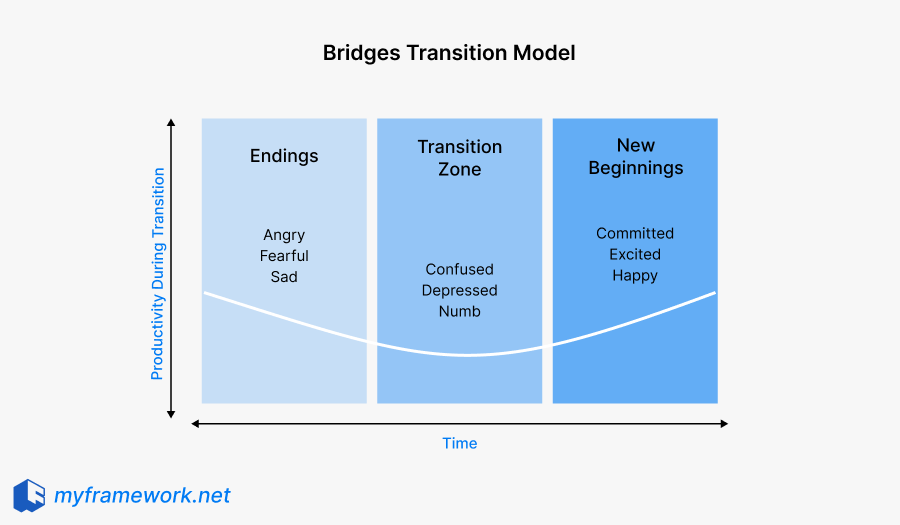
Every transition starts with an ending: loss of routines, status, relationships, or competence stories.
The Neutral Zone is the in-between, where old rules have stopped and new rules are not yet solid. Productivity can dip. Experiments can start. New Beginning is when identity and energy attach to the new situation, usually after roles are clear and small proofs exist.
The Satir Change Model also describes disruption after a foreign element enters a system. Satir is a systemic curve. Bridges is a three-stage inner process tied to a named ending. Kotter-style steps and ADKAR checklists are rollout and enablement tools. They are not the same as locating psychological stage.
Bridges does not replace process design or a technical cutover plan.
How it works
A useful Bridges pass locates the stage from what people say and do, then matches a move.
1. Ending, Losing, and Letting Go
Name what is over. Let people mark it. Rushing past loss does not speed New Beginning. Do not treat Ending as negativity to be corrected in a town hall.
2. Neutral Zone
Expect confusion and mixed performance. Offer temporary structures, experiments, and frequent sense-making. Do not punish the dip as if the old world should still run at full efficiency.
3. New Beginning
Make new roles concrete. Celebrate small proofs that the new way works. Commitment follows clarity more often than slogans.
People can sit in different stages at once. Segment support. One corporate mood is usually a fiction.
How it compares
When another lens fits better, or when you need a complementary view, these frameworks do different jobs. They are not interchangeable labels for the same question.
| Framework | What it helps you see | How it differs from Bridges |
|---|---|---|
| Satir Change Model | System disruption after a foreign element | Systemic curve. Bridges is inner stages after an ending. |
| Kotter eight-step | Transformation sequence | Program steps, not psychological location |
| ADKAR | Awareness through reinforcement | Enablement checklist, not Ending/Neutral/Beginning |
| Training-needs analysis | Skill gaps | Capability, not transition stage |
Bridges is the lens for inner stage after a change event. Other methods help when the question is a system curve, a rollout program, enablement, or skills.
When to Use This Framework
- A dated go-live. The calendar moved. Identity did not.
- Merger or new leader. Comparisons to the old world dominate talk.
- Performance dip after a promotion or new system. Skills training does not explain the stall.
Example
A concrete example makes the structure easier to reuse when you are under uncertainty.
Example: ERP go-live on a Monday
The system is live. Shadow spreadsheets continue. Managers say “just use the new tool.” Tickets mention the old field names.
Implication: Many users are still in Ending or Neutral Zone. A Bridges move is to name what the old spreadsheet did that is not yet trusted, and to run a temporary dual-path with a kill date, rather than a pep talk. Training on clicks may still be needed. It is not the whole diagnosis.
Example: New VP, same team
A leader leaves. The replacement starts. Meetings fill with “she would have…” Performance is uneven. The new VP pushes a vision deck.
Implication: Ending is unfinished. New Beginning content is early. Acknowledge the loss of the old decision style, then define which decisions the new VP actually owns. Vision without Ending work often stays as slides.
Takeaway
What Bridges can help with
- Separating the event from the inner process
- Locating Ending, Neutral Zone, or New Beginning
- Matching communication and support to stage
- Catching “Monday go-live” as a skipped transition
What Bridges cannot replace
- Satir Change Model. A systemic curve with chaos and a new status quo.
- A Kotter-style eight-step program. Rollout sequence, not inner stage.
- ADKAR. Enablement checklist (awareness through reinforcement).
- A training-needs analysis. Skill gaps are a different diagnosis.
- Process and technical cutover plans. Bridges does not design the system.
Honest scope: Bridges structures a psychological-stage read. It does not replace the methods above, and it should not be sold as guaranteed adoption.
Frequently asked questions
Change is the event (new tool, structure, leader). Transition is the inner process of letting go, in-between, and beginning. The event can finish while transition is unfinished.
No. It is a predicted in-between. Treating it as failure often extends it.
A named change event, losses that belong to Ending, signs of Neutral Zone or New Beginning, and support that matches the stage people are actually in. If the output only says “manage change,” you do not have a Bridges read yet.
They can be forced to act. The inner ending still happens, often as cynicism or shadow processes.
No. It tells you how people may be relating to the implementation. Cutover design is a different job.