CARE Customer Experience Framework: Connect, Assist, Resolve, Enhance
The CARE Customer Experience Framework reads service work as Connect, Assist, Resolve, and Enhance. It helps you name which stage is failing when customers feel unseen, blocked, bounced, or unimproved over time. It is a service loop, not a marketing journey.
Framework Card
- Name:
- CARE Customer Experience Framework
- Goal:
- Read a service operation as Connect, Assist, Resolve, and Enhance, then name which stage is failing so the fix matches unseen, blocked, bounced, or unimproved work.
- Flow:
- Connect → Assist → Resolve → Enhance
- Best For:
- Support quality that slips as ticket volume grows; Reviews that blame feeling unseen or handed off, not the product; Service that is reactive and never feeds a learning loop
Why it matters
A support org can add headcount and still collect reviews that say “they did not see me,” “I waited until I was angry,” “I was passed around,” or “the same issue returned.” Those are different failures. A single “be nicer” campaign will not fix a missing escalation path.
CARE is a way to locate the failing stage, then staff a stage-true fix. Production teaching sometimes cites response-time rules. Treat those as illustrations, not universal laws for this page.
What it is
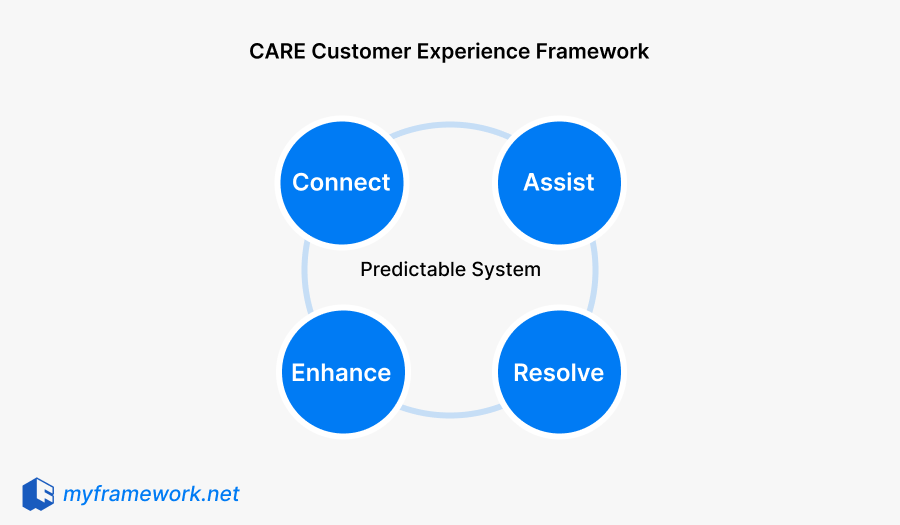
CARE stands for Connect (the person feels recognized), Assist (help arrives before frustration peaks, including self-serve and prompts), Resolve (ownership, speed, and escalation close the issue), Enhance (evidence from the interaction improves the next one).
Customer experience here is operational: tickets, chats, onboarding help, recovery.
AIPL stages a marketing journey through Loyalty. CARE’s Enhance is a learning loop inside service, not a membership program. AISAS Share is publishing. Resolve is closing an issue. They are easy to confuse and they are not the same job.
CARE does not redesign a broken product. It can surface that the product is the real constraint.
How it works
A useful CARE pass reads four stages from tickets, reviews, and handoffs, then names a constraint.
1. Connect
Do people feel recognized (name, context, history) without fake intimacy? A template greeting that ignores the account is a Connect miss.
2. Assist
Is help available before the person is already angry (guides, prompts, error-page help)? Assist is friction reduction, not more macros after the fact.
3. Resolve
Who owns the issue, how long it sits, and when it escalates? Passing the customer around is a Resolve miss. Do not import a 24-hour target unless the case has one.
4. Enhance
Does the interaction change the system (a delayed “did we solve it,” a pattern review, a self-serve fix)? A survey fired at minute zero is often not Enhance.
Close with the constraint stage and a move that belongs to that stage. Ranking all four as important is not a diagnosis.
How it compares
When another lens fits better, or when you need a complementary view, these frameworks do different jobs. They are not interchangeable labels for the same question.
| Framework | What it helps you see | How it differs from CARE |
|---|---|---|
| AIPL Model | Awareness through Loyalty | Growth journey. CARE is service operations. |
| AISAS Model | Search and Share | Purchase path. Share is not Resolve. |
| AARRR Model | Acquisition to Revenue metrics | Metric cascade, not a four-stage service loop |
| Product discovery | What to build | Features, not interaction stages |
CARE is the lens for a service loop: connect, help, close, learn. Other methods help when the question is a marketing journey, pirate metrics, or product definition.
When to Use This Framework
- Scale without a standard. Volume grew. Feeling seen and closed did not.
- Reviews about communication. The product works. The interaction does not.
- Reactive queues. Customers must shout before help appears, and nothing is learned afterward.
Example
A concrete example makes the structure easier to reuse when you are under uncertainty.
Example: CSAT falling as tickets rise
Agents are polite. Customers still report being transferred twice. Frontline has no refund authority.
Implication: Resolve is the leak. Connect training will not fix missing ownership. A CARE move is a named owner, a refund limit, and an escalation path. That is not a product rebuild.
Example: Same how-to tickets every week
The team answers well. The help center never updates. There is no follow-up after 24 hours.
Implication: Assist and Enhance are weak. Proactive guides on the failing screens, plus a later check on whether the article worked, are CARE moves. A loyalty points program (AIPL) would be a different job.
Takeaway
What CARE can help with
- Staging service as Connect, Assist, Resolve, Enhance
- Naming which operational stage is failing
- Separating unseen, blocked, bounced, and unimproved
- Catching “care more” as a substitute for ownership and learning
What CARE cannot replace
- AIPL. Marketing journey through Loyalty.
- AISAS. Search and Share on a purchase path.
- Product discovery. CARE cannot ship missing features.
- A ticket-tool implementation guide. Process diagnosis is not vendor setup.
- A research instrument such as SERVQUAL. Different measurement job.
Honest scope: CARE structures a service-loop diagnosis. It does not replace the methods above, and it should not be sold as a CSAT guarantee.
Frequently asked questions
No. It organizes service interactions. Journey models such as AIPL sit elsewhere.
No. Production teaching uses targets as illustrations. Use the case’s real commitment. Over-promising is a Resolve miss.
A read of each stage from tickets or reviews, a named constraint, and a stage-true move. If the output only says “improve CX,” you do not have CARE yet.
It can show that Resolve keeps bouncing on a product defect. The fix then leaves CARE and enters product work.
Enhance improves the service system from interaction evidence. Loyalty in AIPL is stay and repeat as a journey stage. They can cooperate. They are not the same letter.