CBT Framework: Identify, Test, and Change the Thought
The CBT Framework helps you catch an automatic thought in a specific situation, test it against evidence, then take a small action that matches a more accurate view. Feelings still matter. The method starts with the sentence that showed up, not with a demand to feel better.
Framework Card
- Name:
- CBT Framework
- Goal:
- Catch an automatic thought in a specific situation, test it against evidence, then take a small action that matches a more accurate view.
- Flow:
- Identify the automatic thought → Explore what it rests on → Challenge with evidence → Take a small testing action
- Best For:
- A harsh self-verdict after a miss at work; Anxiety after an ambiguous message; Postponing a task because the thought is "I will fail"
Why it matters
A short reply, a missed deadline, or a blank page can feel like a verdict. The situation is real. The sentence you tell yourself about it is also real, and it often does more work than the facts.
If the sentence is “I am useless,” the next hour is avoidance, rumination, or both. If you only try to suppress the feeling, the sentence stays. CBT is a way to put that sentence on the table, check it, and pick a small action that does not obey the harshest version of the story.
What it is
The CBT Framework on this page is a practical application of Aaron T. Beck’s cognitive model: a situation does not produce a feeling by itself. An automatic thought about the situation sits in between, and that thought shapes what you feel and do next.
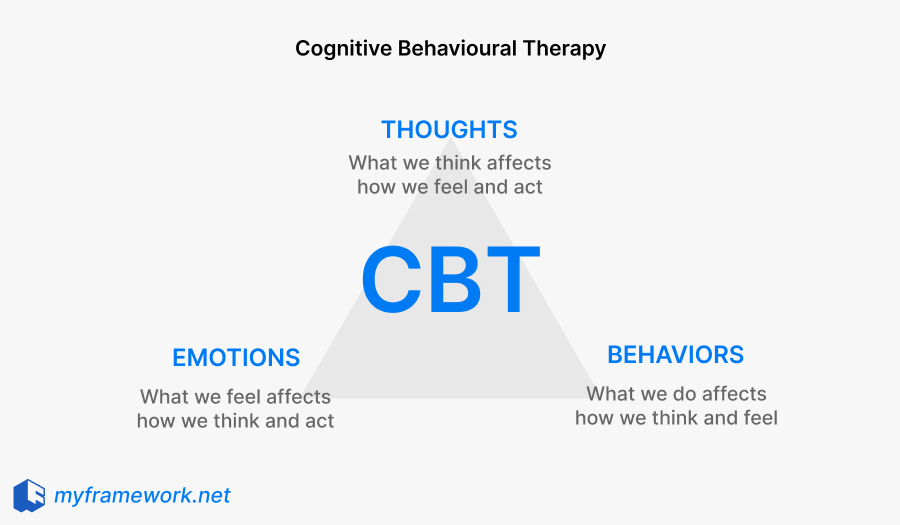
The work is four moves on one episode: name the thought as a sentence, inspect what it rests on, list evidence for and against, then take a small action that tests a more accurate view. The method is not cheerfulness. A revised thought can still be sober (“this draft is weak, and I can write the outline anyway”).
This page is educational self-application. It is not a diagnosis, a therapy contract, or a substitute for professional care.
How it works
A useful CBT pass is one episode, not a personality essay.
1. Identify the automatic thought
Write the sentence that showed up. Prefer “I will look incompetent in the review” over “I have anxiety.” If several sentences appear, pick the one that most tightly follows the situation.
2. Explore what it rests on
Ask what rule or assumption the thought needs. “If I am late once, I am unreliable” is a rule. Naming the rule is not yet disproof. It shows what you are about to test.
3. Challenge the thought with evidence
List facts that support the thought and facts that weaken it, from this episode and a few comparable ones. Do not import motivational quotes. If evidence is thin, say so. A thought can be partly true. The goal is a more accurate sentence, not a flip to its opposite.
4. Take a small testing action
Pick one behavior that matches the revised view (send the outline, ask one clarifying question, sit with the document for fifteen minutes). Without a test, you still have a journal entry, not a CBT pass.
If distress includes safety risk, collapse of daily function, or a need for diagnosis, stop using this page as the plan and seek professional care.
How it compares
When another lens fits better, or when you need a complementary view, these frameworks do different jobs. They are not interchangeable labels for the same question.
| Framework | What it helps you see | How it differs from this CBT page |
|---|---|---|
| ABC Model | Activating event, belief, consequence | Ellis’s map. Belief is the pivot. This page adds an evidence pass and a small behavioral test as four moves. |
| GROW Model | Goal, reality, options, will | A coaching conversation toward a chosen outcome, not a thought worksheet. |
| DEEP Technique | Four refusals in a draining exchange | Receiver-side boundary. CBT works on your appraisal of a situation. |
| Mindfulness practice | Present-moment attention | Reduces fusion with thoughts without requiring an evidence table. |
| AVP Model | Acknowledge, ventilate, process (emotion first) | Emotion regulation sequence. CBT starts from the thought content. |
The CBT Framework is the lens for testing an automatic thought in one episode, then acting small. Other methods help when the question is Ellis ABC, a coaching goal, a baiting conversation, or attention practice.
When to Use This Framework
- A harsh self-verdict after a miss. You sent a draft late and the thought is “I am unreliable,” not “this delivery was late.”
- Anxiety after an ambiguous signal. A one-line email arrives and the thought is “they are done with me.”
- Avoidance after a forecast of failure. The task is finite, but the thought is “I will fail, so starting is pointless.”
Example
A concrete example makes the structure easier to reuse when you are under uncertainty.
Example: Late draft and a global verdict
A product manager sends a spec one day late. The thought is “I am the unreliable one on this team.”
Evidence for: this delivery was late. A similar slip happened last quarter.
Evidence against: eight other specs arrived on time this half. The delay was flagged the day before. The reviewer still used the spec.
Revised thought: “This spec was late. That is a delivery miss, not a character verdict.”
Small action: send a short note with the new date rule you will use, then start the next spec on the calendar block, not after another hour of self-prosecution.
Example: One-line Slack message
A founder reads “let’s talk tomorrow” with no emoji and no agenda. The thought is “they want to kill the project.”
Evidence for: the message is short. A prior project did get cancelled after a similar ping.
Evidence against: this partner often sends one-liners. The last “let’s talk” was a scope increase. You have no content about cancellation.
Revised thought: “I do not know the agenda yet. Short is their style more often than it is a verdict.”
Small action: reply with two proposed times and one question (“anything you want me to prepare?”). Do not write a defense of the project overnight.
Takeaway
What the CBT Framework can help with
- Naming the automatic thought that sits between a situation and a reaction
- Testing that thought against evidence from the case
- Choosing a small action that matches a more accurate view
- Catching the habit of treating a feeling as proof of the thought
What the CBT Framework cannot replace
- Ellis ABC. ABC maps activating event, belief, and consequence. This page’s CBT is a four-move test plus a behavioral check. They share a family. They are not the same worksheet.
- GROW coaching. GROW runs a conversation toward a goal. It does not require an evidence table for an automatic thought.
- DEEP Technique. DEEP refuses defending, engaging, over-explaining, and personalizing in a baiting exchange. CBT inspects your thought, not the other person’s game.
- Mindfulness as a primary practice. Attention to the present can reduce reactivity. It does not, by itself, test a thought’s accuracy.
- Professional care. Crisis, trauma work, medication questions, and diagnosed conditions are outside this page.
Honest scope: CBT here structures a thought test and a small experiment. It does not replace the methods above, and it should not be sold as a cure.
Frequently asked questions
No. The job is a more accurate thought, which can still be uncomfortable. Replacing “I am useless” with “everything is fine” is not an evidence pass.
One situation, the automatic thought as a sentence, evidence for and against, a revised thought, and a small action that tests it. If the output is only “think better,” you do not have a pass yet.
ABC (Ellis) maps event, belief, and consequence. This page’s CBT is four moves: name the thought, inspect its basis, test it, act small. Use ABC when you want that three-part map as the whole method.
No. This page is educational. Distress that includes safety risk, loss of function, or a need for diagnosis belongs to professional care.
No. Work the thought that is currently driving feeling or avoidance. A full inventory of every inner sentence is a different, larger project.