Four Quarters Method: Reset This Day, Not Tomorrow
The Four Quarters Method helps you split a working day into four resettable segments (Morning, Midday, Afternoon, Evening) so a bad stretch can be closed and the next segment started. Clock times in teaching are defaults, not a law. It is not a timer method and not a promise of a perfect day.
Framework Card
- Name:
- Four Quarters Method
- Goal:
- Split a working day into four resettable segments so a bad stretch can be closed and the next segment started without writing off the day.
- Flow:
- Morning → Midday → Afternoon → Evening
- Best For:
- Recovering after a bad morning without waiting for tomorrow; Matching work type to uneven energy across a day; Closing the day with a review instead of an open loop
Why it matters
One rough meeting at 9 a.m. often becomes a story: the day is ruined, real work waits until tomorrow.
That story wastes the remaining hours. It also mixes three different jobs: deep work, replanning, collaboration, and close-out. When they sit in one unmarked pile, a bad first hour contaminates the rest.
Four Quarters is a way to give the day four chances. You finish a quarter, even a poor one, and you start the next with a job.
What it is
Gretchen Rubin’s Four Quarters Method treats a typical working day as four segments, each with a mindset.
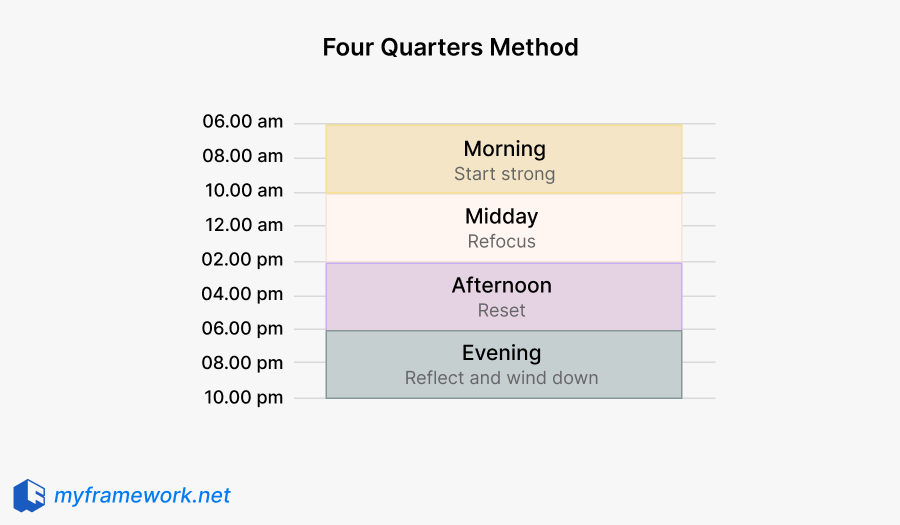
Production teaching uses approximate clocks:
- Morning about 6 AM to 12 PM for the most important and creative work;
- Midday about 12 PM to 2 PM to break, eat, and replan;
- Afternoon about 2 PM to 6 PM for secondary work, meetings, and follow-ups;
- Evening after 6 PM to review, note what to improve, and close.
If your day does not start at 6 AM, keep four segments. Do not fake the clocks.
The method is the reset rule: a failed quarter does not own the next one.
How it works
Morning
Protect a high-energy block for the work that most needs a clear head. If the morning is already damaged, close it honestly at midday instead of pretending it is still morning.
Midday
Take a real break. Re-rank the second half. This is the first reset.
Afternoon
Shift to collaboration, follow-ups, and moderate-energy execution. Do not demand morning-quality deep work if energy is gone. That is a different quarter.
Evening
Review what moved, what slipped, and one preparation item for tomorrow. Then stop. Evening is close-out, not a fourth attempt to save the morning.
If a quarter fails, name it finished and start the next job. Carrying shame into the next block is the failure mode the method is built to interrupt.
How it compares
When another lens fits better, or when you need a complementary view, these frameworks do different jobs.
| Framework | What it helps you see | How it differs from Four Quarters |
|---|---|---|
| Pomodoro Technique | Short timed focus intervals | Timer boxes. Four Quarters is four day segments. |
| Ivy Lee Method | A daily cap of sequenced tasks | Tomorrow’s list. Four Quarters recovers today. |
| Eisenhower Matrix | Urgent vs important | A priority grid. Four Quarters is energy-and-reset segments. |
The Four Quarters Method is the lens for same-day recovery across four jobs. Other methods help when the question is a timer, tomorrow’s sequence, or urgency.
When to Use This Framework
- Recovering from a bad start. A morning miss would otherwise cancel the day.
- Managing uneven energy. Deep work and meetings need different windows.
- Resetting daily focus. You need a close-out, not an open laptop at midnight.
Example
A concrete example makes the structure easier to reuse when you are under uncertainty.
Example: Standup that derailed the morning
A product manager’s 9 a.m. standup turns into a blame session. By 10:30 they have written the day off.
Four Quarters move: Close Morning as damaged. At Midday, eat and pick one afternoon job that is still possible (a spec review with a teammate, not a four-hour design sprint). Evening: note the standup pattern and one process fix for tomorrow. They did not “win the day.” They refused to donate Afternoon and Evening to a 9 a.m. story.
Clock times here follow the teaching default. A night-shift nurse would keep four segments on their clock, not 6 AM.
Takeaway
What the Four Quarters Method can help with
- Stopping a bad stretch from defining the whole day
- Giving each part of the day a job
- Matching work type to energy, roughly
- Closing the day with a review
What the Four Quarters Method cannot replace
- Pomodoro. Short timed focus boxes. Four Quarters is day-scale segments.
- Ivy Lee Method. A cap of sequenced tasks for tomorrow. Four Quarters resets today.
- Eisenhower Matrix. Urgent vs important. Four Quarters does not score a grid.
- A calendar you do not control. If the day is fully external, segments may not be resettable.
- A productivity guarantee. Four chances are not four wins.
Honest scope: Four Quarters structures a same-day reset. It should not be sold as a system that makes every quarter count.
Frequently asked questions
No. Teaching clocks are defaults. Keep four segments with jobs. Shift the hours to the day you actually live.
Each quarter named with a job, a reset after a miss, and an evening close. If the output is “try harder all day,” you do not have the method.
Pomodoro is a short timer. Four Quarters is a day split into four resettable parts.
Yes, if you treat Afternoon as the collaboration quarter on purpose, and you still reset at Midday and Evening. If you have no control at all, the method has less to work with.
No. Evening can prepare tomorrow. Ivy Lee is a different job: a sequenced list for the next day.