Ohmae's 3Cs Model: Balance Customer, Competitor, and Company
Ohmae's 3Cs Model helps you test whether a strategy can be true in three places at once: the customer's need, the competitor's reality, and this company's capability. The strategic triangle is a diagnostic of alignment and imbalance, not a promise that "balance" produces share.
Framework Card
- Name:
- Ohmae's 3Cs Model
- Goal:
- See whether customer needs, competitor reality, and company capability line up, then name which C is dominating or missing before you lock a strategy.
- Flow:
- Customer → Competitor → Company
- Best For:
- Checking a strategy that over-indexes on one C; Market entry or differentiation choices that need three views at once; Finding a capability gap against a real customer job
Why it matters
Plans often sound finished because they are finished from one angle. A customer story with no path to deliver. A competitive attack with no reason a customer would switch. A capability tour with no job worth doing.
Those plans fail late, in the market, when the ignored C shows up. Ohmae's 3Cs is a way to make the missing angle visible before the path is locked.
It is not a claim that every good strategy weights the three Cs equally in every sentence. It is a habit of asking: for this move, can all three be true?
What it is
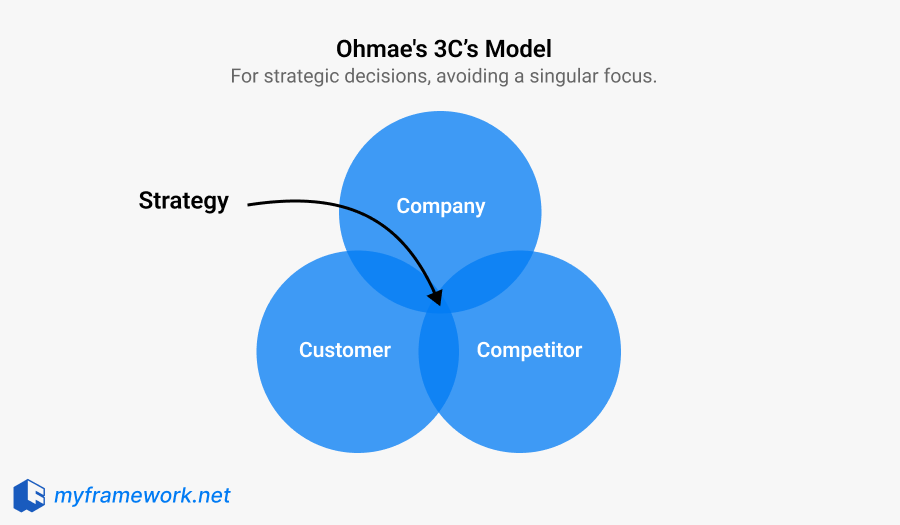
Ohmae's 3Cs Model, from Kenichi Ohmae's strategic triangle, has three interdependent factors:
- Customer. Who is served, what job or need is unmet, what they will actually use or pay for.
- Competitor. Who else can serve that job, where they are strong or weak, what winning would have to beat.
- Company. What this organization can actually do: capabilities, costs, constraints, and gaps that kill the story.
A usable strategy sits where the three overlap. Three disconnected lists are not the method. The work is integration: name which C is thin or over-weighted, then say what must change so the triangle can close.
Ohmae is not a substitute for an industry-structure map or a nine-block business model. It is a three-actor test of a proposed move.
How it works
A useful 3Cs pass is evidence on all three sides, then a synthesis. It is not a triangle slide with adjectives.
1. Frame the move and the customer
Name the proposed path (enter a segment, differentiate an offer, defend a position) and the customer job it claims to serve. Mixing several unrelated jobs in one triangle blurs the test.
2. Evidence competitors on that job
Map who else can serve the same job, including substitutes. State relative strength with case facts. Do not invent a rival's strategy.
3. Evidence company capability and constraints
State what this firm can actually deliver, at what cost and quality, and which gaps would make the customer story false. Company is not a brand paragraph.
4. Synthesize imbalance and a rebalancing move
Name which C is dominating or missing. State what must change (offer, capability, or competitive claim) so all three can be true. Without that implication, you still have three lists.
Review the triangle when a C changes (a new rival, a capability build, a customer shift). Alignment is a snapshot.
How it compares
When another lens fits better, or when you need a complementary view, these frameworks do different jobs. They are not interchangeable labels for the same question.
| Framework | What it helps you see | How it differs from 3Cs |
|---|---|---|
| SWOT Analysis | Internal capability plus external conditions | Four-box snapshot, not Customer/Competitor/Company as three actors |
| Porter's Five Forces | Industry structure and attractiveness | Arena diagnosis, not this firm's triangle |
| Business Model Canvas | How the business creates and captures value | Model mechanics, not three-C alignment |
| VRIO Framework | Whether a resource can sustain advantage | Company-side resource test |
| PEST / PESTEL | Macro environment | External scan of politics, economy, and related forces, not the three actors |
Ohmae's 3Cs is the lens for whether a move can be true for a customer, against alternatives, with this company's capability. Other methods help when the question is industry structure, a business model, or a resource.
When to Use This Framework
- Checking a plan that over-indexes on one C. The room is only talking customers, only talking rivals, or only talking what "we are good at."
- Market entry or differentiation that needs three views at once. A new offer must be wanted, distinguishable, and deliverable.
- Finding a capability gap against a real customer job. The customer case is clear and the firm cannot yet do the work at the required cost or quality.
Example
A concrete example makes the structure easier to reuse when you are under uncertainty.
Example: Sustainability story that operations cannot keep
A premium coffee brand wants to win on compostable packaging because customers ask for it and rivals still use plastic.
Customer: retail buyers ask about waste. Competitor: several peers still ship in mixed plastic. Company: the current supply chain cannot source compostable film at the required volume without breaking margin targets.
Implication: Customer and Competitor support the story. Company does not. The 3Cs diagnosis is a capability gap, not a marketing brief. Options include a limited-run SKU, a supplier build, or a different customer claim that operations can keep. Pretending Company is "working on it" leaves the triangle open.
Example: Competitor-obsessed feature race
A B2B tool copies a rival's dashboard because "they launched it."
Customer interviews do not show the dashboard job as unpaid. Company engineering time is scarce. Competitor: the rival is using the feature as a logo on a landing page, not as a retained workflow.
Implication: Competitor is dominating. Customer and Company are thin. A 3Cs pass would pause the copy until a customer job and a capability cost are named. Beating a rival on a feature nobody uses is not strategy on this model.
Takeaway
What Ohmae's 3Cs can help with
- Testing a proposed move against customer, competitor, and company at once
- Naming which C is dominating or missing
- Catching a wish (customer) or a race (competitor) that capability cannot support
- Forcing integration instead of three disconnected scans
What Ohmae's 3Cs cannot replace
- SWOT. SWOT Analysis organizes internal strengths/weaknesses with external opportunities/threats. It is a position snapshot, not a three-actor triangle.
- Porter's Five Forces. Five Forces diagnoses industry structure and attractiveness. Competitors appear as a force. The unit of analysis is the arena, not this firm's triangle.
- Business Model Canvas. BMC maps how value is created, delivered, and captured. Mechanics of the model, not the 3Cs test.
- VRIO. VRIO tests whether a resource can be a durable advantage. Company-side depth. Not Customer and Competitor as equal Cs.
- A market-share forecast. Alignment does not prove demand.
Honest scope: 3Cs structures a three-way judgment and a rebalancing implication. It does not replace industry structure, a business model, or resource tests.
Frequently asked questions
Not as a score. The method requires all three to be evidenced and integrated. A company with a rare capability may still lead with Company, but Customer and Competitor cannot be empty.
A named move, evidence on Customer, Competitor, and Company, a stated imbalance, and a rebalancing implication. If the output is three adjective lists, you do not have an analysis yet.
SWOT sorts internal and external factors. Five Forces maps industry structure. 3Cs tests whether this customer job, these alternatives, and this firm's capability can be true together.
You can have few direct rivals and still have substitutes and non-consumption. "No competitors" is a claim that needs evidence, not a skip.
Related, but Company is capability and constraint relative to the customer job and the competitive bar, not a general pride list.