Pyramid Principle: Governing Thought First, Then Grouped Support
The Pyramid Principle helps you put one governing thought first, then hold it up with supporting groups that do not overlap, ordered by a single logical rule. It is a message hierarchy, not a substitute for the analysis that produced the answer.
Framework Card
- Name:
- Pyramid Principle
- Goal:
- Put one governing thought first, then group non-overlapping supporting arguments and order them in a single logical sequence.
- Flow:
- State the governing thought → Group supporting arguments → Order the groups logically → Attach evidence under each group
- Best For:
- Recommendation memos and executive briefings; Decks that currently bury the answer at the end; Grouping several evidence streams under one claim
Why it matters
A recommendation can be sound and still fail in the room. The speaker walks through interviews, then data, then options, then (if time remains) the ask. Busy listeners leave with a story of the work, not a sentence they can accept or reject.
The opposite failure is a slogan at the top with leftover slides stuffed underneath. Groups overlap. Two slides make the same point. A third introduces a new question. The top sentence cannot survive without the deck.
The Pyramid Principle is a habit of writing the answer you can currently defend, then sorting support so each group does one job. It does not make the answer true. It makes the answer inspectable.
What it is
The Pyramid Principle is Barbara Minto’s method, developed while teaching writing at McKinsey & Company. Communication is built as a hierarchy: a governing thought at the top, mutually exclusive supporting groups beneath it, one ordering logic across those groups, and evidence attached under the group it belongs to.
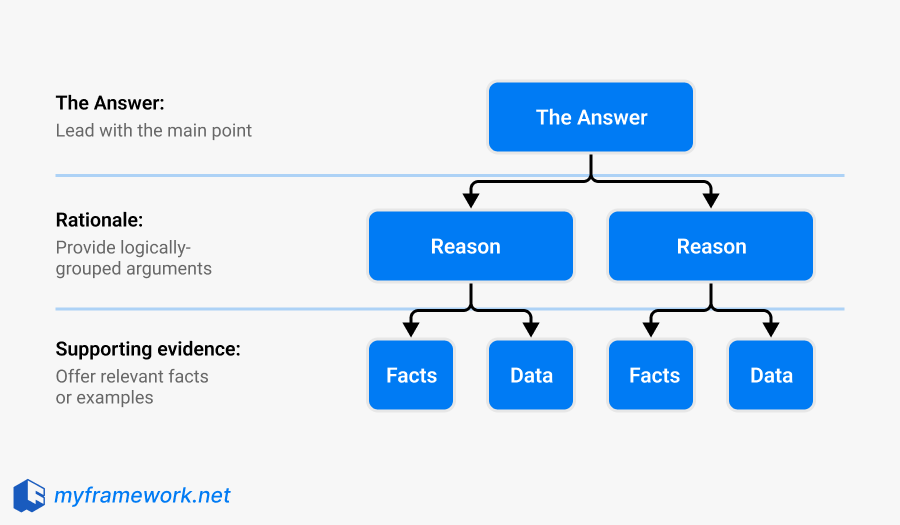
MECE (mutually exclusive, collectively exhaustive) is a test used when you form those groups. It is not a rival framework and not a personality trait.
The pyramid does not set up a consulting story, does not limit you to one reason and one example, and does not scan whether every fact category is present. It structures a conclusion you already have.
How it works
A useful pyramid is a defendable top sentence plus clean groups, not a triangle drawn on a whiteboard.
1. State the governing thought
Write the single conclusion or recommendation the audience should take away. It should be a sentence they can accept or reject. “We should pause the launch until the login defect is fixed” is a governing thought. “We will transform the industry” is a slogan.
2. Group the supporting arguments
Sort reasons into clusters that do not overlap. Typical groups might be customer evidence, operational risk, and cost. If two groups both say “users are confused,” they are one group. Aim for a small number of groups (often two to five).
3. Order the groups logically
Pick one rule and keep it: priority (largest risk first), cause and effect, or a build from what the audience already accepts. Mixing chronology and priority in the same layer makes the middle of the memo feel random.
4. Attach evidence under each group
Put facts, quotes, or calculations only under the group they support. Orphan detail that does not serve a group belongs in an appendix or out of the message.
If you cannot state the governing thought without the slides, you do not have a pyramid yet. You have a tour of the work.
How it compares
When another lens fits better, or when you need a complementary view, these frameworks do different jobs. They are not interchangeable labels for the same question.
| Framework | What it helps you see | How it differs from Pyramid |
|---|---|---|
| SCQA Framework | Situation, complication, question, then answer | How the story is set up before the answer. Pyramid is how the answer is held up. |
| PREP Framework | Point, reason, example, restated point | One reason and one example. Pyramid holds grouped reasons in a hierarchy. |
| 5W1H | Whether the fact set is complete | A completeness scan. Pyramid structures a recommendation you already have. |
| TOPS | Presentation section order | A talk recipe. Pyramid is argument hierarchy, not slide labels. |
| MECE (as a test) | Whether groups overlap or leave a hole | A grouping test used inside the pyramid, not a full message method |
The Pyramid Principle is the lens for answer-first grouped support. Other methods help when the question is story setup, a short opinion, or fact completeness.
When to Use This Framework
- A recommendation memo or executive briefing. The audience will not sit through the appendix first.
- A deck that buries the ask. The last slide is the only slide that states what you want.
- Several evidence streams under one claim. Interviews, numbers, and risks need buckets that do not repeat each other.
Example
A concrete example makes the structure easier to reuse when you are under uncertainty.
Example: A launch that should wait
A product manager has a Friday launch and a login defect that blocks checkout for a subset of users. The draft deck starts with timeline, then research, then the defect on slide 14.
Governing thought: delay the launch until the login defect is fixed and retested.
Possible groups (illustrative, not a universal template):
- Customer impact: checkout cannot complete for the affected cohort.
- Operational risk: support already has a workaround that does not scale through a launch spike.
- Cost of delay: one week of delay versus the cost of a broken first session.
Implication: The room can argue the groups. They cannot argue a slogan. The pyramid did not invent the defect. It stopped hiding the ask.
Example: A hiring freeze recommendation
A finance partner wants two more contractors. The operator’s real conclusion is: do not hire; reallocate two existing people for six weeks.
Groups: demand is a spike, not a new baseline; the work maps onto skills the current team already has; a contractor start date would miss the spike anyway.
Implication: Order might be cause (spike), then capacity (skills), then timing (start date). One order. Not a tour of every meeting that led here.
Takeaway
What the Pyramid Principle can help with
- Putting a defendable answer where a listener can find it
- Separating overlapping reasons into groups
- Choosing one order so the middle of the memo has a rule
- Catching a draft that is still a research diary
What the Pyramid Principle cannot replace
- Story setup. SCQA builds situation, complication, question, then answer. Pyramid assumes you already have the answer to structure.
- A short spoken opinion. PREP uses one reason and one example. A pyramid holds several groups.
- A completeness scan. 5W1H checks who, what, when, where, why, and how. It does not put a recommendation on top.
- A presentation-section recipe. TOPS orders talk sections. It is not an argument hierarchy.
- The analysis itself. A clean pyramid can still sit on a weak governing thought. Structure does not create evidence.
Honest scope: the method structures a conclusion and its support. It does not replace the methods above, and it should not be sold as system thinking.
Frequently asked questions
No. SCQA sets up a question. The pyramid organizes the answer and its support. Many decks use both. They are not the same job.
MECE tests whether groups overlap and whether they cover what the question needs. The pyramid is the whole hierarchy: governing thought, groups, order, evidence. MECE is used when you form the groups.
No. You still do the work. You do not make the audience redo the path in the same order you discovered it.
Enough to hold the governing thought, few enough that a listener can keep them. Two to five is a common teaching range, not a law.
You can use it after you know the point. If the job is to set up a narrative question, SCQA fits better. If the job is a plot of a change, a story spine fits better.