Radical Candor: Care Personally and Challenge Directly
Radical Candor helps you place a feedback stance on two axes, Care Personally and Challenge Directly, then move the next conversation toward specific challenge plus visible care. The other three quadrants (Ruinous Empathy, Obnoxious Aggression, Manipulative Insincerity) name how that stance fails.…
Framework Card
- Name:
- Radical Candor
- Goal:
- Place a feedback stance on Care Personally and Challenge Directly, then move the next conversation toward specific challenge plus visible care.
- Flow:
- Care Personally → Challenge Directly → Radical Candor → Ruinous Empathy → Obnoxious Aggression → Manipulative Insincerity
- Best For:
- Managers avoiding a needed performance conversation; Blunt critique that is landing as an attack; Teams where praise is political and critique happens off-record
Why it matters
Feedback gets stuck in patterns that feel like personality. A manager likes the person and skips the hard note. The work does not change. Another manager says the hard note in a hallway voice that strips the relationship. A third offers praise in public and critique only as gossip.
Calling the first pattern “kind” and the second “honest” hides the missing piece. One axis is care for the person. The other is a specific challenge about the work. Most failed conversations are missing one of those, or both.
Radical Candor is a habit of placing the current pattern on that map before you reach for a stock phrase. It does not write the sentence for you. It tells you which axis to restore.
What it is
Radical Candor is Kim Scott’s two-axis map, later described in the book of the same name.
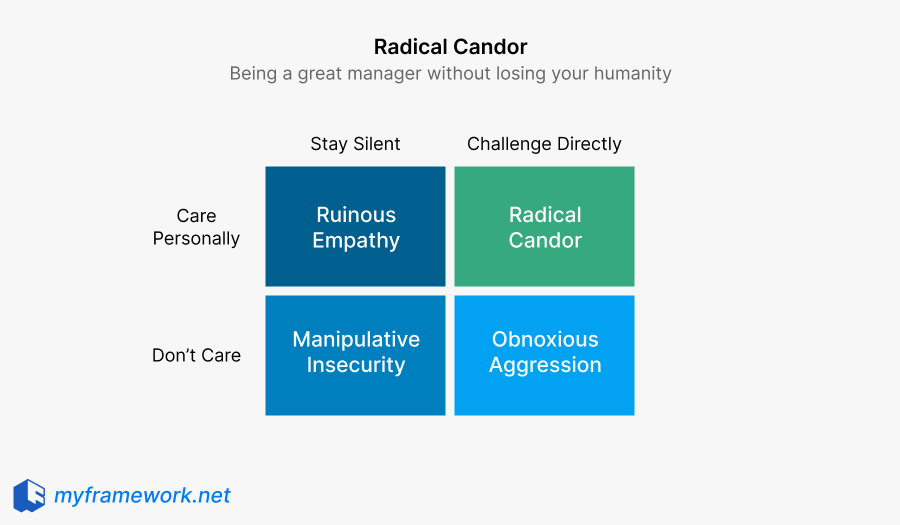
Care Personally is regard for the human being. Challenge Directly is specific, timely honesty about what to change or repeat.
The four quadrants are:
- Radical Candor: high care, high challenge.
- Ruinous Empathy: high care, low challenge. The kind silence that leaves someone stuck.
- Obnoxious Aggression: low care, high challenge. Blunt critique that lands as an attack.
- Manipulative Insincerity: low care, low challenge. Fake praise, quiet politics, or gossip instead of a direct conversation.
The map diagnoses how you show up. It is not SBI (a wording order), not FIRE (how to receive criticism), and not a culture program by itself.
How it works
A useful pass places the current pattern, then names the next move. It does not apply all four quadrants as parallel scripts.
1. Name the feedback situation
Who is involved, what work is at stake, and what has already been said or avoided. Stay with observable behavior. Do not invent the other person’s motives.
2. Place the pattern on the two axes
Was care visible (relationship, intent, regard for the person)? Was challenge specific and direct (the actual work issue, said to them)? High and low here are about this conversation, not a lifetime score.
3. Name the quadrant
If care is high and challenge is low, you are looking at Ruinous Empathy. If challenge is high and care is low, Obnoxious Aggression. If both are low, Manipulative Insincerity. If both are high, the stance is already Radical Candor and the remaining job may be wording or follow-through, not a new diagnosis.
4. Move toward care plus challenge
State what would count as more care, more challenge, or both in the next conversation, using facts from the case. Challenge should be specific and about work. Care should be visible, not a way to delete the fact. If you need a sentence order after the diagnosis, that is a complementary job (often SBI).
How it compares
When another lens fits better, or when you need a complementary view, these frameworks do different jobs. They are not interchangeable labels for the same question.
| Framework | What it helps you see | How it differs from Radical Candor |
|---|---|---|
| SBI Model | Situation, behavior, impact | A wording order for one piece of feedback. Radical Candor diagnoses stance. |
| FIRE Model | Facts, interpretations, reactions, ends | How to receive evaluation. Radical Candor is how you give it. |
| COIN Model | Context, observation, impact, next step | A talk recipe. Radical Candor is a 2x2 of care and challenge. |
| DESC | Describe, express, specify, consequences | Another wording recipe, not a stance map. |
Radical Candor is the lens for which axis a feedback stance is missing. Other methods help when the job is the sentence, the receive-side, or a step-by-step talk.
When to Use This Framework
- Avoided performance conversations. The manager can describe the problem privately and will not say it to the person.
- Blunt notes that are landing as attacks. The content may be right. Care is not visible.
- Political praise and hallway critique. Neither care nor challenge is happening in the actual conversation.
Example
A concrete example makes the structure easier to reuse when you are under uncertainty.
Example: A report that keeps shipping without the data
A manager likes an analyst and has mentioned “next time add the source table” twice in passing. The third report still lacks it. The manager drafts a praise-only note.
Placement: care is visible; challenge has been soft and private-to-the-void. Quadrant: Ruinous Empathy.
Implication: The next conversation needs a specific challenge (the missing table, the decision it blocked) said to the analyst, without dropping regard for them. A stock “have you considered…?” that still lets the table slide is the same quadrant.
Example: A hallway correction after a demo
An engineering lead tells a teammate, in front of two peers, that the demo “was a mess” and walks off. The defect list is real. The teammate stops volunteering for demos.
Placement: challenge is high and public; care is not visible. Quadrant: Obnoxious Aggression.
Implication: The next move is not more volume. It is the same specific defects, said privately, with enough care that the person can hear the work issue. Calling the hallway version “Radical Candor” is a misuse of the name.
Takeaway
What Radical Candor can help with
- Seeing whether a stuck pattern is missing care, missing challenge, or both
- Naming Ruinous Empathy, Obnoxious Aggression, and Manipulative Insincerity without treating them as personalities
- Deciding what the next conversation must restore
- Catching the habit of calling harshness “candor” or silence “kindness”
What Radical Candor cannot replace
- A wording order. SBI structures situation, behavior, and impact for one message.
- Receiving criticism. FIRE separates facts, interpretations, reactions, and ends for the person being evaluated.
- A four-step recipe. COIN walks context, observation, impact, and next step.
- A documented performance process. A 2x2 does not replace written expectations, evidence, or HR process.
- Motive reading. The map places observable feedback behavior. It does not diagnose character.
Honest scope: Radical Candor structures a stance diagnosis and a move toward care plus challenge. It does not replace the methods above, and it should not be sold as culture repair.
Frequently asked questions
No. Challenge without care is Obnoxious Aggression on this map. The namesake quadrant is both axes at once.
The map still applies. Harmony that withholds a needed challenge is Ruinous Empathy here. Care can include privacy and respect. It cannot include deleting the specific challenge.
No. Diagnose the current pattern, then move toward care plus challenge. The other quadrants are failure modes, not four speeches to deliver.
SBI tells you how to order one message (situation, behavior, impact). Radical Candor tells you whether the stance is missing care or challenge. Many managers need both, in that order: map first, wording second.
No. It can clarify how you show up in a conversation. Evidence, expectations, and formal process remain separate.