Research Funnel: Match Method to Exploratory, Strategic, or Tactical
The Research Funnel helps you match user-research methods to whether you still need context (exploratory), priorities (strategic), or refinement of a defined experience (tactical), so the next study answers the decision in front of you.
Framework Card
- Name:
- Research Funnel
- Goal:
- Match user-research methods to whether you are still exploring a problem, setting priorities, or refining a defined experience.
- Flow:
- Exploratory → Strategic → Tactical
- Best For:
- Kickoff when the problem space is open; Roadmap choices about which users and needs come first; Pre-launch checks on a defined flow
Why it matters
Teams often pick a method they already know. They run usability tests while the problem is still unnamed. Or they keep interviewing after the product already exists and the only question left is a registration step.
Mismatched research wastes the week and produces notes nobody can use. More sessions do not fix a wrong layer. A “zero budget” slogan does not fix it either. Time is still spent. The question is whether that time matches the decision.
The Research Funnel is a way to name the layer first, then pick methods that fit. It is not a growth funnel, and it is not a claim that good research is free.
What it is
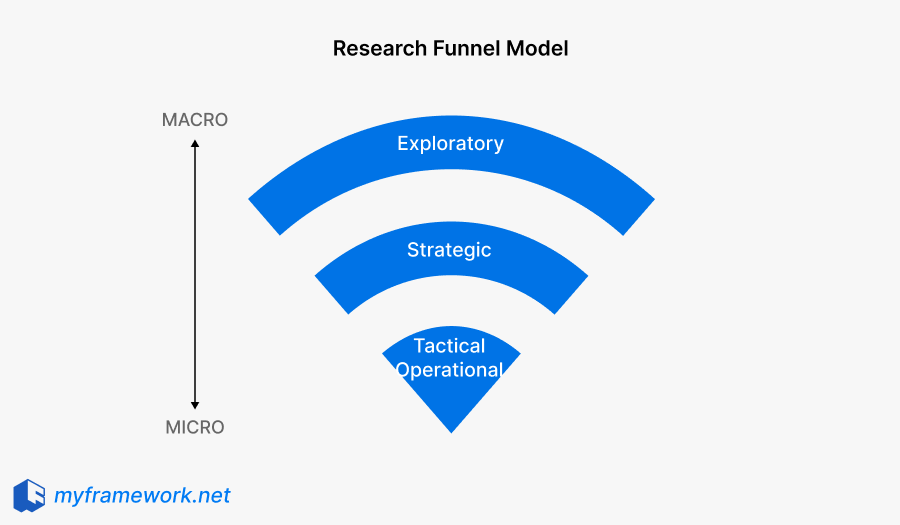
Jane Austin described a simple funnel that sorts user research into three categories, from broad discovery to detailed validation.
- Exploratory: You still need context. Methods often include open interviews and field observation. Output is a clearer problem space, not a feature list.
- Strategic: You have a direction and need priorities or audience focus. Methods often include clustering needs, ranking pains, and sharpening who is first. Output is what to build for whom now.
- Tactical: The product or flow exists enough to refine. Methods often include usability testing and experiments. Output is a specific fix, not a new vision.
You can return to exploratory when a “defined” product turns out to be the wrong problem. The funnel is a match, not a one-way staircase.
How it works
A useful funnel pass is a named layer plus a method that can actually answer it.
1. Name the decision
Write the decision in one line (what problem exists, who to serve first, which step fails). If you cannot name it, you are probably still exploratory.
2. Place the work in a layer
Exploratory if the space is open. Strategic if direction exists but focus does not. Tactical if the artifact is real enough to watch or test.
3. Pick methods that fit that layer
Do not run a usability test to “discover the market.” Do not run only open interviews to debug a checkout field. Lightweight methods can still be valid. They must still match the layer.
4. Stop when the decision can move
Collect enough to choose, not enough to feel exhaustive. If the problem reopens, say you are returning to a broader layer.
How it compares
When another lens fits better, or when you need a complementary view, these frameworks do different jobs. They are not interchangeable labels for the same question.
| Framework | What it helps you see | How it differs from the Research Funnel |
|---|---|---|
| POEMS | People, objects, environment, messages, services | Observation structure. Funnel chooses the research layer. |
| 5E Experience Model | Experience stages over time | Journey shape, not method match. |
| Hook Model | A product habit loop | Design of habits, not research staging. |
| DIKW Model | Data toward knowledge | Knowledge ladder, not which study to run. |
The Research Funnel is the lens for matching method to layer. Other methods help when the question is how to record a scene, map an experience, or design a habit.
When to Use This Framework
- Project kickoff. The problem space is open and a solution would be premature.
- Roadmap shaping. You know you will build, but not which users or needs come first.
- Pre-launch refinement. The flow exists and high-friction steps need evidence, not another vision workshop.
Example
A concrete example makes the structure easier to reuse when you are under uncertainty.
Example: A children’s coding tool and the wrong problem
A builder talks with parents before writing a question bank. Parents describe their own lack of guidance more than a lack of puzzles. The decision was still “what problem exists,” so exploratory conversations were the right layer. Jumping to usability on a quiz UI would have polished the wrong product.
Example: An MVP with two feature stories
A team knows they will ship a SaaS tool. Founder interviews show automation of reports matters more than chart styling. That is strategic: the direction exists, the first bet does not. Personas-as-posters would be weaker than a ranked pain. Usability on the chart color picker would be the wrong layer.
Both examples are teaching illustrations, not measured conversion studies.
Takeaway
What the Research Funnel can help with
- Naming whether you need context, focus, or refinement
- Matching methods to that layer
- Catching usability-too-early and interview-too-late
- Stopping research theater that does not move a decision
What the Research Funnel cannot replace
- In-context observation structure. POEMS records a scene across five lenses.
- Experience stages. The 5E Experience Model maps an experience over time.
- Habit design. The Hook Model designs a product loop.
- A growth funnel. AARRR is acquisition through referral, not research stages.
- Time and access. The method does not make research free. It makes the next study fit the question.
Honest scope: the funnel structures a method match. It does not guarantee insight quality.
Frequently asked questions
A named decision, a named layer (exploratory, strategic, or tactical), methods that can answer that layer, and a stop rule. If the output is only “do more interviews,” you do not have a match yet.
POEMS structures what you record in a setting. The Research Funnel decides which kind of study belongs at this point in the work. You can use POEMS inside an exploratory field visit.
No. If a live product has a specific broken step, tactical is honest. If that test reveals you do not know the user, return to exploratory and say so.
No. AARRR is about acquisition and retention mechanics. This funnel is about which research job you are in.
No. It means you can start with conversations and observation instead of waiting for a lab. Time and access still cost something.