SCR Framework: Situation, Complication, Resolution
The SCR Framework helps you land a short update as a shared situation, the complication that broke it, and the resolution that answers that complication. It is a shortened cousin of SCQA. It has no Question beat.
Framework Card
- Name:
- SCR Framework
- Goal:
- Land a short update as a shared situation, the complication that broke it, and the resolution that answers that complication.
- Flow:
- Situation → Complication → Resolution
- Best For:
- Status updates that must be absorbed quickly; Short crisis or incident notes; Emails that currently bury the problem and the fix
Why it matters
Many updates start in the middle. A standup lists tasks. An email opens with a file attachment. A crisis note jumps to “we added people” before anyone shares what was supposed to be true.
The audience then does unpaid work. They reconstruct the baseline, guess what broke, and only then hear the response. Follow-up questions are not a personality problem. They are a missing sequence.
SCR is a way to put baseline, break, and response in that order. It does not invent the fix. It stops the audience from hunting for the point.
What it is
SCR stands for Situation, Complication, Resolution. Situation is the current state the audience can accept quickly. Complication is the delay, defect, constraint, or change that makes that baseline insufficient. Resolution is what you did or propose to do about that complication.
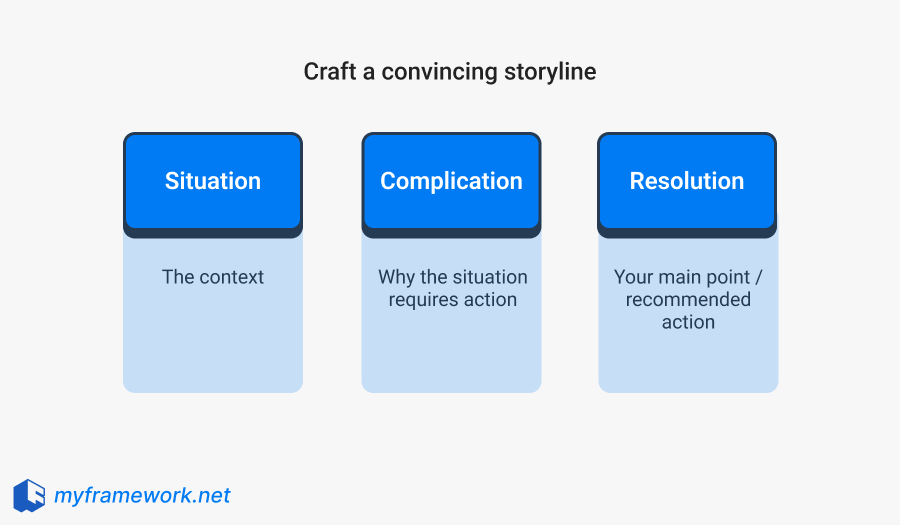
Barbara Minto’s SCQA uses Situation and Complication, then holds a Question before the Answer. SCR skips the Question. Use that skip on purpose: the audience already knows (or will accept) what must be resolved. If they still need to be led to the question, you are in SCQA territory.
SCR does not score options, does not group a pyramid of arguments, and does not assign a decision-maker slot. It structures one short update.
How it works
A useful SCR pass is three linked sentences, not three labels on a slide.
1. Situation
State the baseline the audience already lives in. “We are in week six of the checkout rewrite, due Friday” is a situation. A history of the company is not.
2. Complication
Name what broke that baseline. “SSO login failures added two days of rework” is a complication. “Things are challenging” is not.
3. Resolution
Answer that complication. “Two engineers moved from backlog to SSO, and we will re-estimate Friday” is a resolution. “We are focused on quality” is not.
Keep one complication. Two unrelated problems in one SCR become a tour. If you cannot state a resolution, you still have a status complaint, not SCR.
How it compares
When another lens fits better, or when you need a complementary view, these frameworks do different jobs. They are not interchangeable labels for the same question.
| Framework | What it helps you see | How it differs from SCR |
|---|---|---|
| SCQA Framework | Situation, Complication, Question, Answer | Holds a question before the answer. SCR omits that beat. |
| PREP Framework | Point, reason, example, point restated | Claim first. SCR is baseline then break then response. |
| Pyramid Principle | Governing thought with grouped support | Hierarchy of arguments. SCR is a three-beat update. |
| TOPS Framework | Targeted audience, objective, problem, solution | Deck slots for a decision meeting, not a short update. |
The SCR Framework is the lens for a short update with no Question beat. Other methods help when the question must be asked, the claim should come first, arguments must be grouped, or a room must decide.
When to Use This Framework
- Status updates. A standup or weekly note where “what I did” is noise until the complication is named.
- Short incident notes. A delay or defect that needs a response, not a workshop.
- Emails that bury the point. Subject and body both need S, C, and R so the reader does not hunt.
Example
A concrete example makes the structure easier to reuse when you are under uncertainty.
Example: Project standup that was a task list
A six-person team reports hours. Leadership still asks “are we late?”
- Situation: The team is on a two-week sprint for the billing export, due Thursday.
- Complication: A schema change from finance broke three fixtures, so export tests are red.
- Resolution: One engineer is pairing with finance today; we will confirm Thursday ship or a one-day slip by 3pm.
Implication: The room hears baseline, break, and response. The speaker did not run SCQA. Nobody needed to be asked “so what do we do?” The answer was already in hand.
Example: Customer replacement note
Support used to open with apology and a policy paragraph.
- Situation: You reported a crack on the unit shipped 12 March.
- Complication: The crack matches a known molding defect in that batch.
- Resolution: A replacement ships tomorrow, and we are holding the rest of that batch.
Implication: The customer still needs tone. SCR does not supply empathy as a fourth beat. It stops the note from hiding the defect and the action under a general apology.
Takeaway
What the SCR Framework can help with
- Sequencing a short update so baseline, break, and response are visible
- Cutting standups and emails that start in the middle
- Distinguishing a known response from a question the audience still must ask
What the SCR Framework cannot replace
- SCQA’s Question beat. SCQA is for when the audience must share the question before the answer. SCR assumes that step is unnecessary.
- Point-first opinion. PREP leads with the claim, then reason and example.
- Grouped arguments. The Pyramid Principle organizes a governing thought and supporting clusters. SCR is three beats, not a hierarchy.
- Decision-deck slots. TOPS names audience, objective, problem, and solution for a meeting that must decide.
- The analysis under the resolution. A tidy SCR cannot invent evidence or a choice that does not exist yet.
Honest scope: SCR structures a short update. It should not be sold as executive polish.
Frequently asked questions
Both start with Situation and Complication. SCQA then asks a Question and answers it. SCR goes from Complication to Resolution. Use SCR when the audience does not need to be led through the question.
A baseline the audience recognizes, a specific disruption tied to that baseline, and a response to that disruption. If the reader still has to guess what changed, you do not have SCR yet.
No. It packages a response you already have (or can state). Thin thinking stays thin inside three labels.
No. Standups, client notes, and internal emails use the same three beats. “Executive-ready” is a tone, not a requirement of the method.
You can hint at S, C, and R in a subject (“Billing export: tests red; pairing today”). The body still needs the three parts in order.