TAM-SAM-SOM Analysis: Nested Market Size, Then a Capture Target
TAM-SAM-SOM Analysis helps you nest total demand (TAM), the portion you can serve (SAM), and the near-term share you can credibly capture (SOM), each with explicit assumptions. It is a sizing lens, not a forecast and not a full segmentation system.
Framework Card
- Name:
- TAM-SAM-SOM Analysis
- Goal:
- Nest total demand, the portion you can serve, and the near-term share you can credibly capture, with explicit assumptions on each ring.
- Flow:
- TAM → SAM → SOM → Implications
- Best For:
- Inflated TAM slides that skip SAM and SOM; Choosing a first geography or segment to staff; Setting a near-term capture target that a TAM headline cannot justify
Why it matters
Pitch decks love a large TAM. The number is often a global category total that nobody on the team can serve. Resource fights then start from a fantasy ceiling. Or two teams argue “the market is huge” versus “the market is tiny” because they mixed TAM with SOM.
Nested sizing forces the translation: if the whole category is X, which slice can we actually serve, and which slice can we take in the next period given competition and capacity? Without that translation, TAM is decoration.
What it is
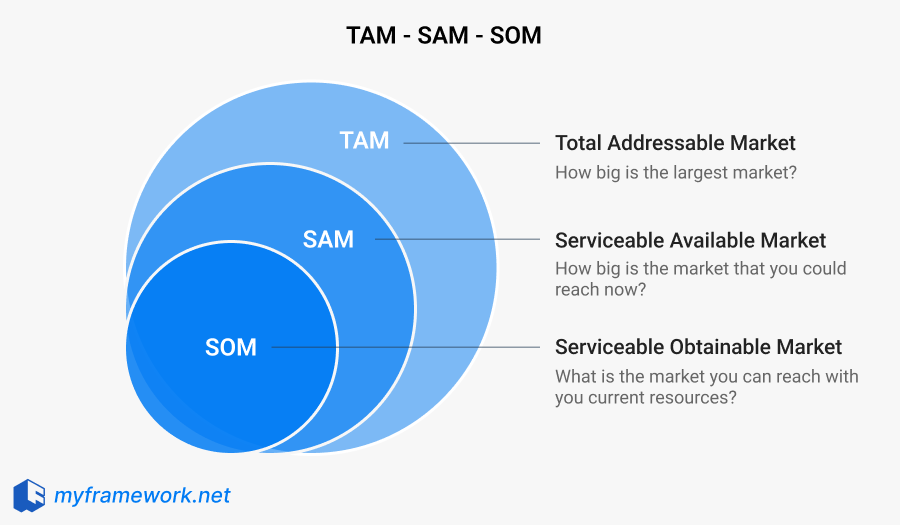
Three rings, usually drawn as nested circles:
| Ring | Question |
|---|---|
| TAM | What is total demand for this category under stated geographic and definitional assumptions? |
| SAM | Of that, what can we serve given our channels, licenses, product, and constraints? |
| SOM | Of SAM, what can we obtain in a named period given share, sales capacity, and rivals? |
Top-down (category reports, then filters) and bottom-up (accounts × price × adoption) are both valid if labeled. Mixing them without saying so is how numbers become incomparable.
This is not STP (segment, target, position) as a full marketing system. You may use segments to define SAM. The method still ends in nested size, not a brand position.
How it works
A useful pass writes definitions before numbers.
1. TAM
State the category, geography, and units (revenue, users, tons). Show the path: report, analog, or bottom-up. If you lack data, give a range and label it assumed. Do not paste a famous industry billion that does not match the product.
2. SAM
Apply constraints: region you can legally and operationally serve, customer types your product fits, channels you have. SAM must be smaller than TAM or your filters did no work.
3. SOM
Name a period (year 1, 18 months). Apply capacity, win rates you actually have or clearly analogize, and rivalry. A round “10 percent of SAM” with no engine is a wish.
4. Implications
State where to play and what the TAM headline must not justify (hiring, inventory, geography). Refresh when a constraint changes.
How it compares
| Framework | What it helps you see | How it differs from TAM-SAM-SOM |
|---|---|---|
| Business Model Canvas | How the business creates, delivers, and captures value | Model design. Nested size is not nine BMC blocks. |
| Porter’s Five Forces | Industry competitive structure | Arena quality. A big TAM can still be hostile. |
| Product GTM Canvas | Go-to-market motion | Broader GTM. TAM-SAM-SOM is the size stack inside it. |
| Jobs-to-be-Done | The job a customer hires a product to do | Demand reason. Not a market-dollar nest. |
TAM-SAM-SOM is the lens when the market number must be nested and assumed. Other methods help when the question is model, rivalry, GTM motion, or jobs.
When to Use This Framework
- New product or fundraising narrative. Stakeholders need a ceiling and a near-term target, not one inflated TAM.
- GTM focus. Choosing a first geography or customer group to staff.
- Resource fights. Two initiatives claim the same “huge market” without a SOM.
Example
A concrete example makes the structure easier to reuse when you are under uncertainty.
Example: Vertical SaaS with a global TAM slide
A team cites global “all accounting software” as TAM. They sell only to US dental clinics and have six sellers.
Implication: TAM might be global accounting software only if they truly plan to serve it. Honest SAM is US dental clinics they can reach. SOM is a first-year capture tied to six sellers and a sales cycle, not 10 percent of a global number. The nested cut changes hiring, not the adjective “huge.”
Example: Hardware accessory, two geographies
TAM: category demand in two countries they considered. SAM: country A only, because certification in country B takes 18 months. SOM: year-1 units from existing retail doors in country A.
Implication: Country B belongs in a later TAM/SAM discussion, not in this year’s SOM. Five Forces would still be needed to see retail power. BMC would still be needed to see whether the model even captures value. Sizing did one job.
Takeaway
What TAM-SAM-SOM can help with
- Separating a category ceiling from a reachable slice
- Forcing assumptions into the open
- Setting a near-term capture target that a TAM headline cannot justify
- Stopping two teams from arguing different rings as if they were one number
What TAM-SAM-SOM cannot replace
- A business model. Business Model Canvas is how value is created, delivered, and captured. Size is not a model.
- Industry structure. Porter’s Five Forces is rivalry and attractiveness. A large TAM can still be a bad arena.
- A full GTM design. Product GTM Canvas (when used) covers motion, not only nested size.
- Jobs-to-be-Done or customer research. Why someone buys is not a ring size.
- A forecast. Rings are scenarios under assumptions. They move.
Honest scope: TAM-SAM-SOM structures nested sizing. It should not be sold as precision or as segmentation theory.
Frequently asked questions
Only if your assumptions say so. A honest TAM is a defined category and geography. “Everyone with a phone” is usually a slogan.
You may use segments to build SAM. STP is a broader targeting and positioning system. This page is nested size.
Either, if labeled. Showing both and explaining the gap is stronger than pretending one method is truth.
When a constraint, product, or competitor set changes, or on a planned cadence. An annual ritual with stale assumptions is decoration.
No. If it does, a definition slipped. Fix the rings, do not celebrate the number.