Three Circles of Influence: Control, Influence, Concern
Three Circles of Influence helps you sort a real list of concerns into Control (what you can do), Influence (what you can shape), and Concern (what you can only watch), then move energy toward the inner rings. Stephen Covey’s original diagram used Concern and Influence. Control as an innermost ring…
Framework Card
- Name:
- Three Circles of Influence
- Goal:
- Sort current concerns into Control, Influence, and Concern, then move energy toward what you can do or shape instead of treating every factor as equally actionable.
- Flow:
- Circle of Control → Circle of Influence → Circle of Concern
- Best For:
- Stress that treats headlines and personal choices as one pile; Planning when a strategy is built on hope about things you cannot change; Separating a reaction you control from a person you cannot
Why it matters
A week can mix a delayed vendor, a market headline, a teammate’s mood, and a slide you have not written. They all feel like “the problem.” They do not all have the same agency.
If you spend the morning on the headline, the slide stays blank. If you treat a legal duty as “Concern, so ignore,” you create a different failure. The three circles are a way to see which items are actions, which are shaping moves, and which are watch-only, then to stop treating them as one pile.
What it is
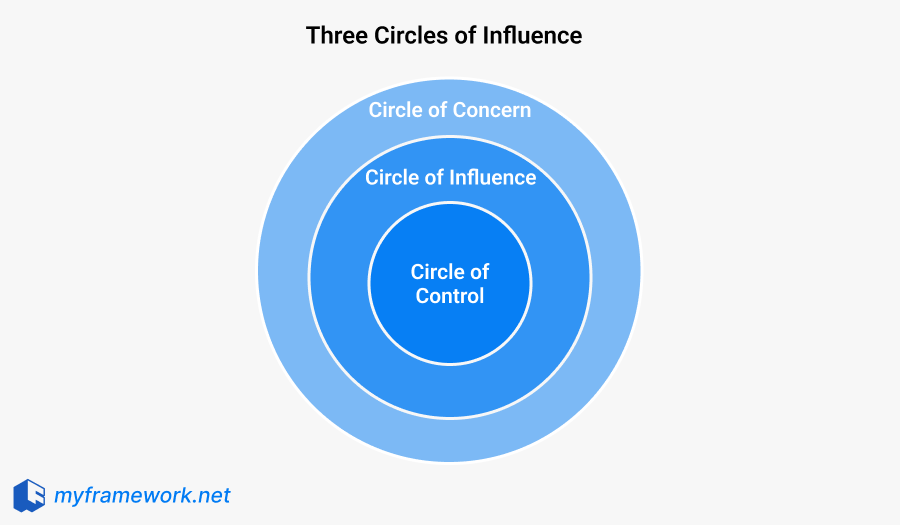
The model uses three nested rings:
- Circle of Control. Direct agency: a choice, a behavior, a response you can make.
- Circle of Influence. Indirect impact: a skill, a relationship, or a repeated action that can shape an outcome without owning it.
- Circle of Concern. Factors that affect you that you cannot currently change.
Covey’s *The 7 Habits of Highly Effective People* is the source most people mean. That book’s famous picture is two circles. This page’s three-ring version puts Control inside Influence inside Concern. The job is the same: stop leaking effort into items with no mechanism.
Teaching sometimes says that work in Control enlarges Influence over time. Treat that as a direction, not a measured law.
How it works
A useful pass is a sorted list plus an energy move.
1. Dump the current pile
Write the stressors, decisions, and hopes that are actually using attention. Do not import a textbook list (weather, the economy, “mindset”).
2. Sort each item
Control, Influence, or Concern. If an item is mixed (health, a project, a regulation), split it: the part you can do, the part you can shape, the part you can only watch.
3. Check the mechanism
Influence needs a plausible path (a meeting, a draft, a relationship). If there is no path, it is still Concern, even if you care a lot.
4. Move energy
Act on Control. Shape Influence. Release or monitor Concern. Monitoring is not the same as rumination. Some Concern items (safety, legal) stay on a watch list on purpose.
How it compares
When another lens fits better, or when you need a complementary view, these frameworks do different jobs. They are not interchangeable labels for the same question.
| Framework | What it helps you see | How it differs from Three Circles of Influence |
|---|---|---|
| 80/20 Rule | Which few inputs drive most of a named result | Contribution, not agency |
| VUCA Framework | Volatility, uncertainty, complexity, ambiguity | Environment character, not a personal agency sort |
| OODA Loop | Observe, orient, decide, act | An action cycle, not a three-ring sort |
| Urgency-importance matrix | Time pressure vs importance | Not control vs influence |
| Thomas-Kilmann Conflict Mode | Five conflict-handling modes | Mode choice in a dispute, not a sort of what you can control |
The three circles are the lens for agency on a real list, then a move of energy. Other methods help when the question is concentration, environment, action cycling, or conflict mode.
When to Use This Framework
- Scattered stress. Headlines and personal next actions sit in the same mental list.
- A conflict reaction. You cannot control the other person. You can control the next sentence and whether you escalate.
- A plan built on hope. Strategy assumes a market move you cannot cause. Product quality and outreach may still be yours.
Example
A concrete example makes the structure easier to reuse when you are under uncertainty.
Example: A product lead after a competitor launch
The pile: competitor pricing, a board Slack thread, the team’s demo quality, the lead’s own calendar. Competitor pricing is Concern. The Slack thread is mostly Concern (others’ opinions) with a Control slice (whether to reply today). Demo quality is Influence (coaching) plus Control (the lead’s own review comments). Calendar is Control.
Implication: The move is comments and calendar, not a morning spent rewriting the competitor’s price list. Crossing “board Slack” off as ignore may still leave a required update. That update is Control.
Example: Feedback that stung
Tone is Concern if you cannot change the other person’s delivery. The true sentence in the feedback, if any, is Control (a skill or a behavior you can change). Asking a clarifying question is Influence.
Implication: The circles did not process the emotion. They sorted where work remains.
Takeaway
What the three circles can help with
- Sorting a real list by agency
- Splitting mixed items into do / shape / watch
- Moving energy toward Control and Influence
- Catching plans that depend on hope about Concern
What the three circles cannot replace
- Contribution analysis. The 80/20 Rule finds which inputs drive a named result. Agency is a different cut.
- Environment scan. VUCA describes conditions. It does not sort your agency on a personal list.
- A decide-act loop. OODA is observe, orient, decide, act. This method asks what is even yours to act on.
- Urgency vs importance. An Eisenhower-style matrix is time pressure and importance, not control vs influence.
- Clinical care. The sort is not an anxiety protocol. It does not tell you to ignore duties you cannot fully control.
Honest scope: the framework structures an agency sort and an energy move. It does not replace the methods above, and it should not be sold as a way to reduce stress or expand influence by law.
Frequently asked questions
Not always. Some items stay on a watch list (legal, safety, a date you cannot move). The method asks you not to spend action-energy as if you could cause them.
A real list, each item in Control, Influence, or Concern (split if mixed), a mechanism for Influence, and an energy move. Three empty rings are not an analysis.
He taught Concern and Influence. Many later explanations add Control as the innermost ring. This page uses the three-ring teaching. The job is still the agency sort.
No. That is a teaching direction, not a measured law. Skill and relationships can enlarge Influence. They can also not.
80/20 ranks contribution to a result. The three circles sort whether you can act, shape, or only watch. You can need both. They are not the same cut.