Three Zones of Learning: Comfort, Learning, Panic
The Three Zones of Learning helps you sort current work into Comfort, Learning, and Panic, then adjust how much newness you take on so stretch stays recoverable. The familiar 85/15 mix is a teaching shorthand, not a law of skill.
Framework Card
- Name:
- Three Zones of Learning
- Goal:
- Sort current work into Comfort, Learning, and Panic, then adjust challenge so stretch stays recoverable instead of boring or overwhelming.
- Flow:
- Comfort Zone → Learning Zone → Panic Zone
- Best For:
- Practice that feels too easy and has stopped producing skill; Training that overwhelms and produces avoidance; Coaching when engagement dropped and the mix of familiar vs new is unclear
Why it matters
Practice can stall for opposite reasons that feel the same from the outside: “I am not improving.”
Sometimes the work is already easy. You can do it tired. Nothing new has to be solved, so skill plateaus while the calendar stays full. Sometimes the work is a cliff. Working memory fills, avoidance starts, and the person concludes they are bad at the subject.
A slogan to “leave your comfort zone” does not tell you which of those two you are in. Adding more difficulty to someone already in Panic makes the stall worse. Removing all stretch from someone in Comfort keeps the plateau.
The Three Zones of Learning is a way to name the mix, then change it. It does not promise faster mastery by itself.
What it is
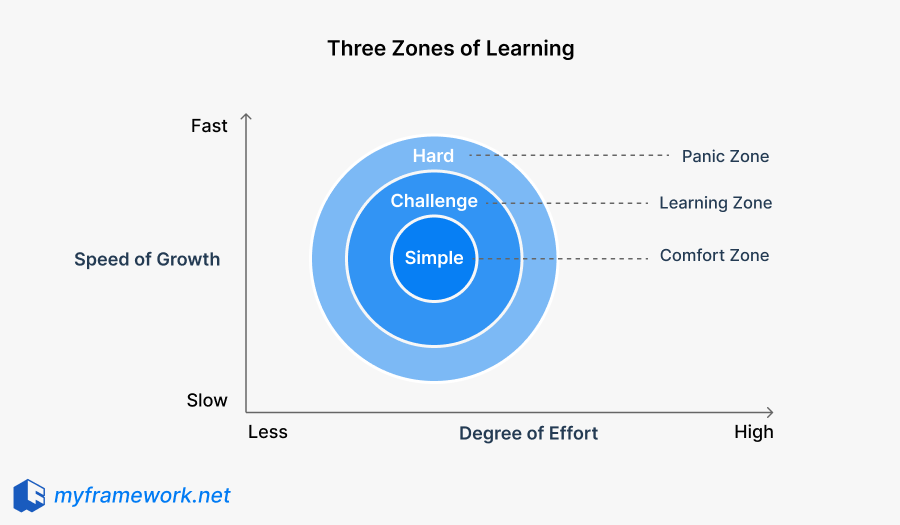
Noel Tichy’s teaching maps three spaces for how challenge lands on a person.
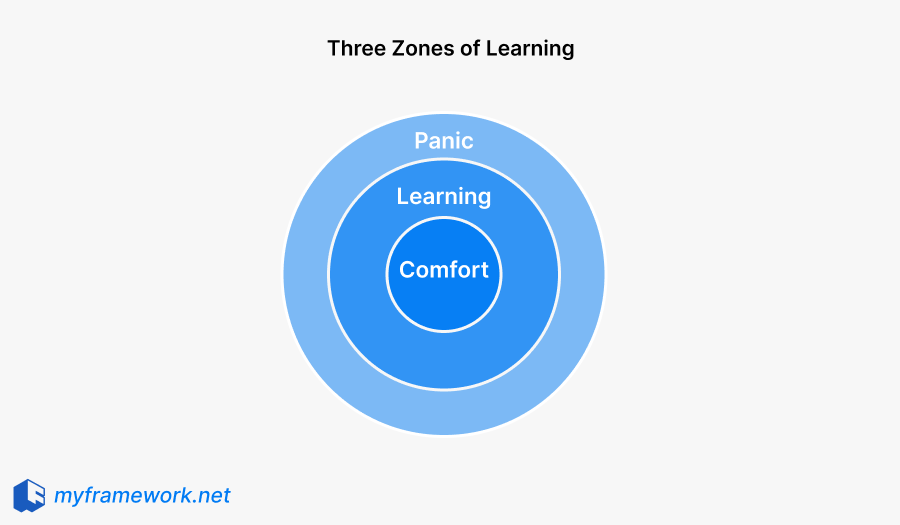
| Zone | What it feels like | What it tends to produce |
|---|---|---|
| Comfort | Familiar tasks, low stretch, safety | Fluency and recovery. Prolonged stay with a growth goal can plateau skill. |
| Learning | Enough newness to require attention, still recoverable | Skill can form. Discomfort is expected. Collapse is not. |
| Panic | Overwhelm, freeze, or avoidance | Learning usually stops. The job becomes surviving the hour. |
Production teaching often cites a mix of about 85 percent familiar material and 15 percent new. Treat that as a mnemonic, like a Pareto-style shorthand. Your mix might be 70/30 or something else. The method still holds: name the zone, then add stretch, add scaffolding, or allow recovery.
The map is about this person and this task. The same assignment can sit in Comfort for one teammate and Panic for another.
How it works
A useful pass is diagnosis and a mix change, not a poster that says “get uncomfortable.”
1. Name the task and the person
Pick one skill and one current assignment (a coding kata, a sales call type, a piece of repertoire). Mixing several goals in one zone label blurs the cut.
2. Place the work in a zone
Ask what actually happens in the hour: automatic fluency (Comfort), focused struggle that can still complete a recoverable chunk (Learning), or overwhelm and avoidance (Panic). Use the person’s report plus observable behavior. Do not rate difficulty from the job description alone.
3. Treat 85/15 as a check, not a quota
If almost nothing is new, you are likely in Comfort relative to the growth goal. If almost everything is new, you may be in Panic. Adjust toward a mix the person can recover from. Do not import a textbook 85/15 onto a case you have not watched.
4. Change the mix
- From Comfort: add a constrained stretch (one new move, one harder customer type) while keeping most of the work doable.
- From Panic: shrink the new slice, add scaffolding, or return to a fluent base until Panic drops.
- From Learning: keep the stretch, and allow Comfort for recovery so the Learning zone can widen over time.
Without a mix change, you only have a label.
How it compares
When another lens fits better, or when you need a complementary view, these frameworks do different jobs. They are not interchangeable labels for the same question.
| Framework | What it helps you see | How it differs from Three Zones |
|---|---|---|
| Deliberate Practice | Targeted reps, feedback, and progressive difficulty | A training system. Zones diagnose mix; deliberate practice designs the hour. |
| Simon Learning Method | Exclusive focus on one field until patterns emerge | Depth and time-boxing, not Comfort / Learning / Panic. |
| VITALS Method | Restart a stall through validation and micro-steps | Energy and initiation. Zones are about difficulty mix. |
| Pomodoro Technique | Timed intervals of focus | Attention boxing, not zone diagnosis. |
The Three Zones of Learning is the lens for whether stretch is recoverable. Other methods help when the question is session design, one-subject depth, restarting a freeze, or timing focus.
When to Use This Framework
- Practice that feels too easy. Hours are spent, skill is flat, and the work no longer requires attention.
- Training that overwhelms. People avoid the work, forget basics they already had, or freeze at the start.
- Coaching when engagement dropped. You need to tell boredom from threat before you add another stretch goal.
Example
A concrete example makes the structure easier to reuse when you are under uncertainty.
Example: Language practice that stopped improving
A product manager studies a language app every morning. Streak is intact. Speaking in meetings has not improved.
They name the task: unrehearsed two-minute updates in the other language. App drills are Comfort. Live updates feel like Panic (freeze, apology, switch to English).
Implication: Keep a Comfort block for vocabulary maintenance. Move a small slice into Learning: one rehearsed update with a colleague, not a full customer demo. A week of harder app levels would still be Comfort if it never touches unrehearsed speech. Panic-level immersion with no script would likely recreate freeze.
Example: New manager’s first budget cycle
A first-time manager is handed the full annual budget with little context. They delay opening the file.
On paper the assignment is “a stretch.” In the hour it is Panic: too many unknown systems at once.
Implication: Pull a fluent Comfort piece (last year’s line items they already understand) and add one new slice (one department’s variance). That is a Learning mix. Assigning a second stretch goal “to grow faster” would ignore the zone they are already in.
Takeaway
What the Three Zones of Learning can help with
- Naming whether the current mix is too easy, stretchable, or overwhelming
- Separating Learning-zone discomfort from Panic
- Deciding whether to add stretch, add scaffolding, or allow recovery
- Catching the habit of treating all discomfort as useful
What the Three Zones of Learning cannot replace
- Deliberate practice as a training system. Targets, immediate feedback, and designed progression are a different job. Zones tell you the mix. They do not run the session.
- Simon’s one-subject depth method. Exclusive focus and time-boxing for entering a field is not a three-zone map.
- VITALS. Restarting when emotion blocks initiation is not the same as calibrating difficulty.
- A Pomodoro timebox. Timed focus does not tell you whether the work is Comfort or Panic.
- A guarantee of growth. Placement is a judgment. The 85/15 figure is a mnemonic.
Honest scope: the model structures a challenge-mix judgment. It does not replace the methods above, and it should not be sold as a law of 15 percent newness.
Frequently asked questions
No. It is a teaching shorthand for “mostly familiar, some new.” Real mixes vary. You still need to watch whether this person can recover from the new slice.
Learning is effortful and still completable in recoverable chunks. Panic is overwhelm, freeze, or avoidance where skill cannot form. Brief nerves at the start of Learning are not the same as Panic.
No. Fluency and recovery live in Comfort. It becomes a problem when the goal is growth and the mix never leaves Comfort.
Not as a method. Prolonged Panic impairs learning. If someone is already there, shrink the new slice or add scaffolding rather than adding more difficulty.
Deliberate practice is how you structure practice (targets, feedback, progression). The Three Zones of Learning is how you judge whether the current difficulty mix is too easy, stretchable, or overwhelming.