TOWS Model: Options from Strengths, Weaknesses, Opportunities, Threats
The TOWS Model helps you turn already-identified strengths, weaknesses, opportunities, and threats into four classes of options by pairing internal factors with external ones: SO, WO, ST, and WT. It is formulation after diagnosis, not a second SWOT and not a finished plan.
Framework Card
- Name:
- TOWS Model
- Goal:
- Pair internal strengths and weaknesses with external opportunities and threats to generate SO, WO, ST, and WT strategic options after the factors are known.
- Flow:
- SO (Strengths and Opportunities) → WO (Weaknesses and Opportunities) → ST (Strengths and Threats) → WT (Weaknesses and Threats)
- Best For:
- Planning after a SWOT-style diagnosis still has no options; Naming defensive WT moves in a turnaround discussion; Forcing each candidate action to cite an internal factor and an external condition
Why it matters
Many teams can fill a SWOT. Fewer can say what to try next without another round of disconnected brainstorming.
The four lists sit on the wall. Strengths sound like branding. Opportunities sound like wishes. When someone asks “so what do we do,” the room either picks a favorite project or rewrites the lists.
That stall is expensive in a planning offsite and worse in a turnaround. You need candidate moves that still show their homework: which internal fact and which external fact they rest on.
TOWS is a pairing discipline for that moment. It will not score the options, fund them, or replace a strategy review. It will stop options that cite only a hope, or only a capability, as if that were enough.
What it is
Heinz Weihrich (1982) described TOWS as a systematic way to move from situation analysis to strategy alternatives. The letters are the SWOT set, rearranged to put the matching work first.
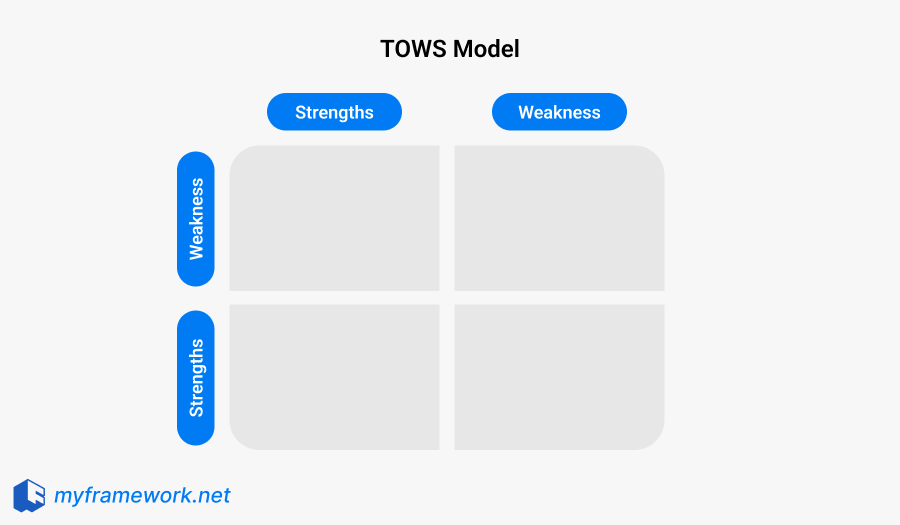
| Cell | Pairing | Typical question |
|---|---|---|
| SO | Strengths × Opportunities | Where can we use what we already have to pursue a real opening? |
| WO | Weaknesses × Opportunities | What gap must we close or work around before that opening is ours? |
| ST | Strengths × Threats | Which advantages can absorb or counter a real external risk? |
| WT | Weaknesses × Threats | Where do gaps and pressure stack, and what do we protect, pause, or exit? |
A TOWS option names both sides. “Expand globally” is not TOWS. “Use our existing distributor network (strength) to enter the two markets where incumbents are slow (opportunity)” is the shape.
SWOT Analysis still does a different job: it organizes position so internal and external factors are clean and evidenced. TOWS assumes that work is done enough to pair. If the room still argues whether a factor is a weakness or a threat, you are back in SWOT.
How it works
A useful TOWS pass is salient pairings, not a complete cross-product of every bullet.
1. Restate the factors with SWOT discipline
Keep strengths and weaknesses internal (controllable or influenceable). Keep opportunities and threats external. Drop slogans. If a factor is missing or fuzzy, label the assumption. Do not invent a strength to fill the SO cell.
2. Pair into four option types
Write a small set of options per cell that actually matter in this case. Uneven counts are expected. A stable grower may have more SO than WT. A distressed unit may be mostly WT.
3. Require a verb and both sides
Each option should read as “use / close / counter / reduce X given Y.” If you cannot name X and Y, it is still a wish.
4. Sequence or drop against constraints
TOWS produces candidates. Check whether an SO move worsens a WT stack. Check cash, talent, and time. Choosing, budgeting, and roadmapping remain other work.
How it compares
When another lens fits better, or when you need a complementary view, these frameworks do different jobs.
Related strategic lenses
| Framework | What it helps you see | How it differs from TOWS |
|---|---|---|
| SWOT Analysis | Internal-external position snapshot | Diagnosis first. TOWS formulates options from those factors. |
| Porter’s Five Forces | Industry structure and competitive pressure | Arena diagnosis, not firm-factor pairings. |
| Business Model Canvas | How value is created, delivered, and captured | Model design, not SO/WO/ST/WT options. |
| PEST Analysis | Macro environment | Wider external scan; does not pair with S/W the way TOWS does. |
Related resource and position tests
| Framework | What it helps you see | How it differs from TOWS |
|---|---|---|
| VRIO Framework | Whether a named resource is valuable, rare, hard to imitate, and organized | Resource-advantage test. TOWS does not score a moat. |
TOWS is the lens for pairing known factors into option types. SWOT clarifies the landscape first. Other methods help when the question is industry structure, the business model, a macro scan, or a resource test.
When to Use This Framework
- Planning after a SWOT-style diagnosis. The matrix is full; candidate moves are not.
- Turnaround or defensive work. You need WT options named, not only growth slogans.
- Resource debates. Two projects compete, and you need each to show an internal-external link.
Example
A concrete example makes the structure easier to reuse when you are under uncertainty.
Example: Regional services firm after a SWOT offsite
A 40-person services firm has a SWOT: strong senior relationships in healthcare; weak digital delivery; a regional buyer shift toward packaged analytics; a national competitor opening a local office.
SO: Use senior healthcare relationships to pilot a packaged analytics offer with two existing accounts (strength × opening).
WO: Hire or partner for digital delivery before selling the package more widely (gap × opening).
ST: Use those relationships for early renewal conversations before the national competitor lands (strength × threat).
WT: Pause a generic “rebrand” project that spends cash without closing the digital gap while the competitor arrives (stacked exposure).
Implication: The matrix did not pick the budget. It made the link between factors and candidates visible, including a WT “do less” option that brainstorming had skipped.
Example: Product team that already “has a SWOT”
The SWOT lists “great culture” as a strength and “AI wave” as an opportunity. TOWS SO becomes “use our culture to win at AI.”
That pairing fails the test: culture is not shown as a capability that changes the AI opening, and “AI wave” is not a checkable external condition for this product. A useful rewrite would need a real strength (for example a labeled dataset in one workflow) and a real opening (buyers in that workflow searching for lighter tools). Until then, the team is still in diagnosis, not in TOWS.
Takeaway
What TOWS can help with
- Turning SWOT-type factors into option classes (SO, WO, ST, WT)
- Forcing each candidate to cite an internal factor and an external condition
- Naming defensive WT moves instead of only growth SO
- Seeing when an option in one cell worsens stacked risk in another
What TOWS cannot replace
- SWOT as diagnosis. If internal and external are still mixed, pairing will copy the mess.
- A finished strategy, budget, or forecast. Options are candidates.
- Porter’s Five Forces. Industry structure is a different unit of analysis.
- VRIO. Whether a resource can sustain advantage is a sequential resource test, not a pairing matrix.
- PEST / PESTEL. A full macro scan is not TOWS, even though threats and opportunities may draw on it.
Honest scope: TOWS structures option generation from factors. It should not be sold as “the strategy.”
Frequently asked questions
They are different jobs. SWOT helps you see position (what you control vs what the environment is doing). TOWS helps you write options from those factors. Use SWOT to clarify the landscape. Use TOWS when you are ready to convert diagnosis into candidate moves.
You need checkable internal and external factors. A messy SWOT will produce messy options. If a factor is missing, label the assumption. That is still diagnosis quality, not a reason to skip pairing forever.
VRIO tests one internal resource for Value, Rarity, Imitability, and Organization. TOWS pairs several SWOT-type factors into option types. A rare capability might show up as a strength inside an SO option. It is not the same method.
No. Imbalance is expected. Survival work may be mostly WT. Growth work may be mostly SO. Forcing four equal lists is inventory again.
No. It produces candidates with visible links to factors. Choice, sequencing, and money remain other work.