VRIO Framework: Value, Rarity, Imitability, Organization
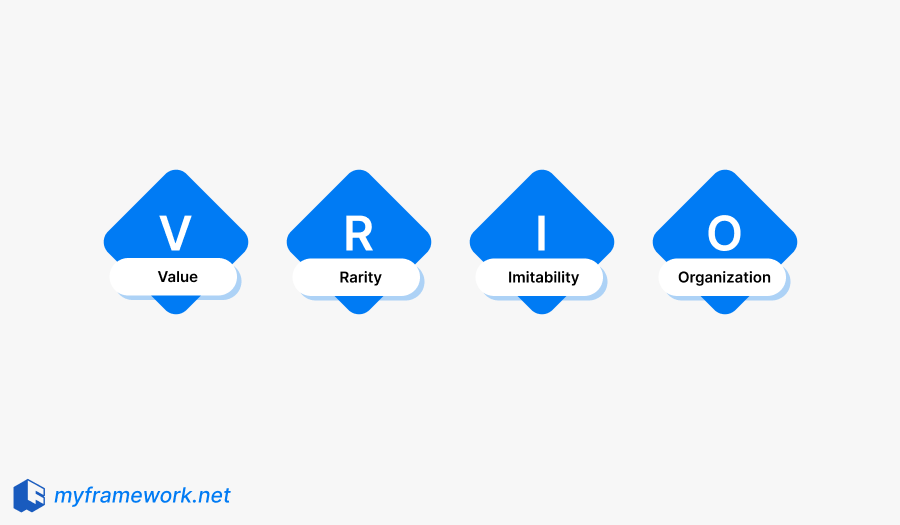
The VRIO Framework tests a named internal resource or capability for Value, Rarity, Imitability, and Organization. The result is a judgment about disadvantage, parity, temporary advantage, or potential sustained advantage. It is not SWOT.
Framework Card
- Name:
- VRIO Framework
- Goal:
- Test a named internal resource for Value, Rarity, Imitability, and Organization to judge disadvantage, parity, temporary advantage, or potential sustained advantage.
- Flow:
- Value → Rarity → Imitability → Organization
- Best For:
- Checking whether a claimed strength is a moat or only parity; Deciding which internal capability deserves further investment; Diligence on whether a target’s “unique” asset will stay unique
Why it matters
Companies often fund what they already brag about.
A process is called unique. A dataset is called a moat. A sales bench is called culture. Capital is scarce, so the cost of a wrong story is not theoretical: money goes to parity items while a quieter capability that is actually hard to copy goes hungry. In diligence, “they have tech” can survive a slide and fail a copy test six months later.
SWOT can list that process as a Strength next to an Opportunity in the market. That still does not tell you whether the process is rare, copyable, or even used. Those are different questions.
VRIO is a sequential test for that honesty. It will not invent a resource you do not have, and it will not replace an industry map.
What it is
Jay Barney’s resource-based work (VRIO formulation in the early 1990s) asks whether internal resources can be a basis for sustained competitive advantage. The four tests are usually run in order on one resource (or a tight cluster), not on “the company” as a whole.
| Test | Question | If the answer is no |
|---|---|---|
| Value | Does this help the firm compete (customers, cost, opportunity response)? | Not an advantage; may be a drag. Stop treating it as a strength. |
| Rarity | Do few rivals have it? | At best competitive parity: table stakes. |
| Imitability | Is it costly or slow to copy or substitute? | Any edge is likely temporary. |
| Organization | Are structure, processes, incentives, and skills set up to use it? | The resource is idle. Uniqueness is not realized. |
Only a resource that clears all four is a candidate for sustained advantage, and even then advantages erode. A teaching close converts the four answers into a move: protect and deepen, organize first, or stop overfunding a parity item.
Do not pour Opportunities and Threats into VRIO cells. External change can alter Value. It does not turn VRIO into a SWOT grid.
How it works
A useful pass is one resource, four gates, then a move.
1. Name the resource
Pick a specific asset or capability (a patented process, a labeled dataset, a distribution right, a practiced operating ritual). Mixing brand, culture, and a feature in one test blurs every gate.
2. Value
Does it help customers, cost, or the ability to respond to a real demand? If not, classify disadvantage or neutrality and do not continue as if it were a moat.
3. Rarity
How many rivals have it or can buy it quickly? Valuable-and-common is parity.
4. Imitability
What blocks copy or substitution (time, causal ambiguity, complements, legal rights, history)? Include substitutes, not only clones. Easy copy means temporary.
5. Organization
Can this firm actually exploit it (structure, incentives, skills, processes)? A rare resource in a company that cannot use it is not a realized advantage.
6. Convert to a move
State the classification and the implication: defend, organize first, or stop treating parity as strategy. That is still a judgment, not a valuation.
How it compares
When another lens fits better, or when you need a complementary view, these frameworks do different jobs.
Related strategic lenses
| Framework | What it helps you see | How it differs from VRIO |
|---|---|---|
| SWOT Analysis | Strengths, weaknesses, opportunities, threats as a position snapshot | Combined internal-external picture. VRIO tests one resource. |
| TOWS Model | SO, WO, ST, WT options from those factors | Formulation after diagnosis. VRIO does not generate the option set. |
| Porter’s Five Forces | Industry competitive pressure | Arena, not a resource gate. |
Related frameworks often taught beside VRIO
| Framework | What it helps you see | How it differs from VRIO |
|---|---|---|
| PEST Analysis | Political, economic, social, technological environment | Macro scan. Complements Value over time; does not replace V/R/I/O. |
VRIO is the lens for whether a named internal resource can sustain advantage. SWOT is the lens for position. Other methods help when the question is options, industry structure, or a macro scan.
When to Use This Framework
- Checking a claimed strength. Marketing says unique. You need rarity and imitability, not another adjective.
- Choosing where to invest among internal capabilities. Two “strengths” compete for budget.
- Diligence on a target’s advantage. Will this tech or know-how still be scarce after you buy it?
Example
A concrete example makes the structure easier to reuse when you are under uncertainty.
Example: Proprietary workflow in a vertical SaaS
A vendor claims its onboarding workflow is the advantage. Value: it cuts time-to-first-value for a specific buyer (supported by retention in that niche). Rarity: two rivals have a similar flow. Imitability: the flow is visible in the product and not tied to exclusive data. Organization: a team owns it.
Implication: Valuable, not truly rare, easy to imitate: at best a temporary edge. Budget that assumes a moat is a story. Investment might still be justified as table stakes, labeled as such.
Example: Brand listed as a Strength in SWOT
A SWOT workshop lists “beloved brand” as a Strength and “new region” as an Opportunity. Someone proposes VRIO on “brand.”
VRIO still needs a named resource (which brand asset, in which category). Value may hold in the home market and fail in the new region (different buyers). Rarity and imitability need competitive facts, not affection. Organization asks whether the firm can deploy the brand with the new channel. SWOT already did position. VRIO does not replace the O/T side. It tests whether that brand-as-resource can carry an edge.
Takeaway
What VRIO can help with
- Testing a named internal resource through four sequential gates
- Separating disadvantage, parity, temporary advantage, and potential sustained advantage
- Catching “unique” claims that fail rarity, imitability, or organization
- Pointing a move: defend, organize first, or stop overfunding
What VRIO cannot replace
- SWOT Analysis. Internal and external position in one snapshot is SWOT’s job. VRIO does not list Opportunities and Threats.
- TOWS. Option generation from factor pairings is not a resource test.
- Porter’s Five Forces. Industry structure is a different unit of analysis.
- PEST / PESTEL. A macro scan can change Value over time. It is not the four gates.
- A valuation or a build-the-missing-resource playbook. VRIO judges what you have. It does not create what you lack.
Honest scope: VRIO structures a resource-advantage judgment. It should not be sold as a proof of a permanent moat.
Frequently asked questions
SWOT organizes internal strengths and weaknesses against external opportunities and threats so you can see position. VRIO runs four sequential tests on one resource. A Strength on a SWOT board can still fail rarity, imitability, or organization.
Fail Value: do not treat it as an advantage. Fail Rarity: parity at best. Fail Imitability: temporary. Fail Organization: unused; fix the organization before claiming the edge.
Not usefully. The gates need a named resource. A pile of mixed assets produces mixed answers.
No. Most advantages erode. VRIO is a structured judgment at a point in time.
No. Five Forces diagnoses the industry arena. VRIO tests a firm resource. You can need both. They do not answer the same question.