VSNC Framework: Vision, Steps, News, Contributions
The VSNC Framework helps you structure a persuasive message as Vision, Steps, News, and Contributions so a future the audience cares about is tied to a plan, recent progress on that plan, and a stated impact. It is a way to show you can deliver, not only promise.
Framework Card
- Name:
- VSNC Framework
- Goal:
- Link a future the audience cares about to a plan, recent progress on that plan, and a stated impact so a persuasive message has proof.
- Flow:
- Vision → Steps → News → Contributions
- Best For:
- Pitches or meetings that need a credible plan, not only a vision; Reports that must move from future to evidence to impact; Stakeholder updates where progress has to prove the next ask
Why it matters
Rooms dismiss a vision that has no plan. They also glaze over a plan that has no recent proof, and they distrust a recap of activity that never says why the work matters to them.
Those failures often come from the same draft: the speaker has a future they care about and a pile of tasks, but the message never locks the two together. The vision sounds naive. The update sounds like a status dump. The ask sounds unearned.
VSNC is a habit of putting four chapters on the same work: what future we are aiming at, what plan makes that future look possible, what recently moved on that plan, and what impact that movement created. Missing any chapter changes the feel of the message. It is not a promise that four labels will persuade a skeptical room.
What it is
VSNC is a four-part persuasion sequence taught by Patrick Henry Winston in *Make It Clear: Speak and Write to Persuade and Inform*. The letters stand for Vision, Steps, News, and Contributions.
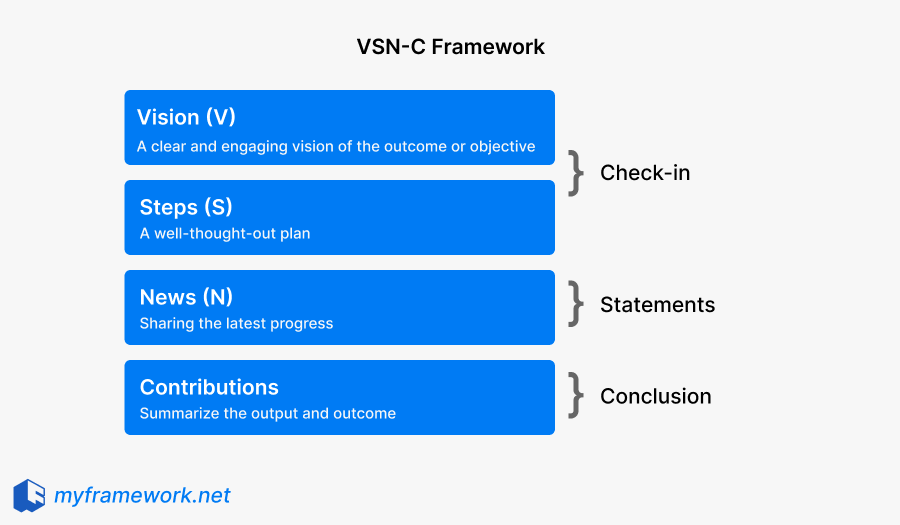
Vision is the outcome, challenge, opportunity, or hypothesis the audience should care about. It does not have to be framed as a "goal." Steps are a structured plan, or actions already taken, that show the speaker can solve the problem. News is recent progress on those steps, preferably with results someone could check. Contributions summarize output and outcome as impact for this audience.
Winston also taught a five-point model called Winston's Star in the same book. That model helps an idea stick in memory. VSNC is a different job: it helps a plan look believable.
How it works
A useful VSNC pass is four chapters about one body of work, not four posters with unrelated content.
1. Vision
Name a future the audience already cares about. Different groups may need different visions. A challenge, an opportunity, or a bold hypothesis can work as well as a goal statement. If the vision is only about you, it is not ready.
2. Steps
Show a plan, or the actions already taken, that makes that future look achievable. You do not need every task. You do need enough structure that the room can see you have thought through the problem. CMS sometimes points at an Outcome-based Roadmap for this outline. That can feed the chapter. It is not a substitute for the rest of VSNC.
3. News
Report recent progress on the Steps you just named. Prefer results someone could inspect. Do not rehash old work and call it News. If nothing recent exists, say so. Invented progress is a method error.
4. Contributions
State the output and the outcome as impact for this audience. This is not a second activity list. It answers why the work matters to them.
If a chapter is missing, the message usually feels dreamy (no Steps or News), messy (no Vision), or self-focused (no Contributions). Review the four parts together before you treat the draft as done.
How it compares
When another lens fits better, or when you need a complementary view, these frameworks do different jobs. They are not interchangeable labels for the same question.
| Framework | What it helps you see | How it differs from VSNC |
|---|---|---|
| Winston's Star | Slogan, symbol, salient idea, surprise, and story so an idea is remembered | Same author and book. Star is a memorability kit. VSNC is vision plus receipts. |
| PREP Framework | A short point-first spoken loop | PREP starts with the claim. VSNC opens with a future and then proves a plan. |
| SCQA Framework | Situation, complication, question, then answer | SCQA withholds the answer until the room shares the problem. VSNC leads with a future. |
| Pyramid Principle | A governing thought with grouped supporting arguments | Pyramid is argument architecture. VSNC is a four-chapter credibility sequence. |
| Outcome-based Roadmap | A plan of outcomes and bets for delivery | A planning artifact. VSNC uses a plan as communication proof, not as the operating system. |
The VSNC Framework is the lens for persuasion that needs a plan and recent progress. Other methods help when the question is recall, a short claim, a narrative setup, argument grouping, or delivery planning.
When to Use This Framework
- Pitches and meetings. You need a narrative a room can believe, not a stack of disconnected slides.
- Reports and posts. Readers should be able to follow from a future to evidence to impact without hunting for the ask.
- Teaching that must be repeatable. A complex idea needs a plan and a progress story, not only a definition.
- Stakeholder influence. Future value has to be tied to concrete progress before the next resource request.
Example
A concrete example makes the structure easier to reuse when you are under uncertainty.
Example: Internal pitch for a billing rewrite
A product lead wants engineering time for a billing rewrite. The first draft opens with architecture diagrams. Leadership hears a task list and stalls.
A VSNC pass might look like this (illustrative, not a measured case):
- Vision: Cut failed renewals that customers already complain about, not "modernize the stack."
- Steps: Isolate invoice generation, add a replay queue, then migrate one plan type.
- News: A two-week replay pilot on one plan type recovered 40 failed renewals last month.
- Contributions: Support hours drop on that plan type, and finance stops reconciling those invoices by hand.
Implication: The ask is no longer "trust our rewrite." It is "continue a plan that already moved a customer-visible number." If the 40 recovered renewals were not real, the News chapter should not have been written.
Example: Nonprofit update to a grant officer
A program manager sends a two-page activity recap. The officer cannot see whether the grant's future is closer.
- Vision: Keep 80 families in stable housing through the winter, the outcome the grant named.
- Steps: Case-manager pairing, landlord mediation, and a 30-day emergency rent fund.
- News: 22 families used mediation this quarter; 14 stayed housed.
- Contributions: Those 14 households did not enter shelter intake, which is the cost the city asked the program to reduce.
Implication: The update is now a progress story on the grant's own future. Listing every workshop would have been Steps without News, or activity without Contributions.
Takeaway
What VSNC can help with
- Putting a future, a plan, recent progress, and impact into one followable message
- Catching a vision that has no proof, or a status dump that has no future
- Making a next ask easier to evaluate because the receipts sit next to the promise
- Teaching a complex piece of work so others can repeat the logic
What VSNC cannot replace
- Memorability design. Winston's Star uses slogan, symbol, surprise, and story so an idea is recalled. VSNC does not do that job.
- A short point-first answer. PREP is a claim, one reason, one example, and the same claim again.
- Context before the answer. SCQA shares a situation and a complication before the question and the answer.
- A multi-argument memo architecture. The Pyramid Principle groups supporting arguments under a governing thought.
- A delivery operating system. An Outcome-based Roadmap plans the work. VSNC only uses a plan as proof in a message.
- Missing evidence or missing judgment. Four labels cannot invent progress or settle a decision the work has not earned.
Honest scope: VSNC structures a persuasion sequence. It does not replace the methods above, and it should not be sold as an MIT speaking formula.
Frequently asked questions
A named Vision the audience cares about, Steps that make that future look achievable, recent News on those Steps, and Contributions that state impact for this audience. If the four chapters describe four different projects, you do not have a VSNC yet.
Winston's Star helps people remember an idea through slogan, symbol, salient idea, surprise, and story. VSNC helps people believe a plan through vision, steps, recent progress, and impact. They can sit in the same talk. They are not the same method.
Prefer results someone could check. If you only have a qualitative update, say so and keep it tied to the Steps. Do not invent a number to fill the slot.
Yes. Winston's teaching allows a challenge, an opportunity, or a bold hypothesis. The test is whether this audience cares, not whether the sentence contains the word "goal."
Yes. Reports and posts use the same four chapters. The method is the lock between future, plan, progress, and impact, not the slide format.