Winston's Star: Slogan, Symbol, Salient Idea, Surprise, Story
Winston's Star helps you design one idea so people can remember it and repeat it. The five points are Slogan, Symbol, Salient Idea, Surprise, and Story. The method is a memorability kit, not a persuasion-with-receipts sequence.
Framework Card
- Name:
- Winston's Star
- Goal:
- Make one idea memorable and repeatable by giving it a slogan, a symbol, a standout point, a meaningful surprise, and a short story.
- Flow:
- Slogan → Symbol → Salient Idea → Surprise → Story
- Best For:
- Talks that will be forgotten if they stay as a list of points; Reports or pitches that need one recallable idea; Teaching a complex idea so others can repeat it
Why it matters
A talk can be accurate and still evaporate. A report can be complete and still be skimmed into nothing. The usual cause is not a missing fact. It is a missing design for recall.
People keep a few ideas, not ten. If you do not name the one point that should survive, the room will invent its own, or keep none. If you have no phrase they can say, no image they can see, and no story they can retell, the idea stays in your slides.
Winston's Star is a habit of giving one idea five handles: a short phrase, a visual, a stated standout point, a meaningful break in expectation, and a human episode. It is not a promise that five labels will make any talk unforgettable.
What it is
Winston's Star is a five-point communication model taught by Patrick Henry Winston.
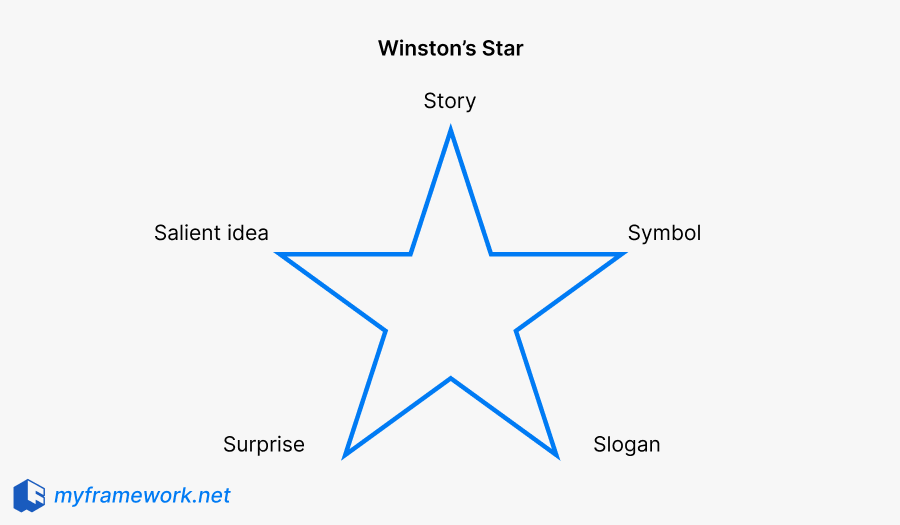
The points are Slogan, Symbol, Salient Idea, Surprise, and Story.
- A slogan is a short, sayable phrase that captures the core.
- A symbol is a visual, object, or mental image that stands for the idea.
- The salient idea is the one point that should remain if almost everything else is forgotten.
- Surprise is an unexpected fact, twist, or contrast that still belongs to the idea.
- Story is a short human episode that carries feeling and fact together.
The same book contains VSNC (Vision, Steps, News, Contributions). That sequence helps a plan look believable. Winston's Star helps an idea stay in memory. They are siblings, not synonyms.
How it works
A useful Star pass designs one idea, then gives that idea five handles. The points are components, not a rigid speaking order, but they should still be visible in the draft.
1. Slogan
Write a short phrase that is easy to say and easy to repeat. In a report it can live in the title, abstract, or close. In a talk it can be said more than once. Winston used project names such as Genesis and Watson as slogans for bodies of work. Those are illustrations, not a rule that every idea needs a product name.
2. Symbol
Choose one visual or object that stands for the idea. A famous teaching example is Charles Minard's chart of Napoleon's invasion of Russia: a complex campaign becomes one image of loss. Keep the symbol simple. Many decorations are not a symbol.
3. Salient Idea
Name the one point you want people to keep. You can signal it with a line such as "If you remember only one thing." If you cannot say that sentence, you do not have a salient idea yet. The slogan should attach to this point, not to a second thesis.
4. Surprise
Add a fact, twist, or contrast that breaks expectation and still supports the idea. A surprise that does not connect is a stunt. Curiosity helps memory only when it lands on the salient idea.
5. Story
Add a short, preferably true, episode: who had the problem, what they tried, what turned. Feelings travel with facts here. A long plot is a different method (StoryBrand, Hero's Journey). This is one human handle, not a three-act screenplay.
Review the five points against the same idea. If the slogan, the surprise, and the story point in three directions, you still have a list, not a Star.
How it compares
When another lens fits better, or when you need a complementary view, these frameworks do different jobs. They are not interchangeable labels for the same question.
| Framework | What it helps you see | How it differs from Winston's Star |
|---|---|---|
| VSNC Framework | Vision, steps, news, and contributions on the same work | Same author and book. VSNC proves a plan. The Star makes an idea stick. |
| PREP Framework | A short point-first spoken loop | PREP delivers a claim. The Star designs recall handles around one idea. |
| SCQA Framework | Situation, complication, question, then answer | SCQA sets up the answer. The Star does not withhold a conclusion on purpose. |
| Pyramid Principle | A governing thought with grouped supporting arguments | Pyramid is written architecture. The Star is five memory points. |
| StoryBrand | A customer-as-hero narrative for a brand | A full story system. The Star uses one short story as a handle, not a plot engine. |
Winston's Star is the lens for making one idea recallable. Other methods help when the question is proof, a short claim, a narrative setup, argument grouping, or brand story architecture.
When to Use This Framework
- Talks and keynotes. The audience will remember a few things. You need those few to be the ones you chose.
- Reports and posts. Readers will skim. A slogan, a visual, and one standout line give them something to keep.
- Product pitches. A complex offer needs one repeatable idea, not ten feature names.
- Teaching. Abstraction has to become a phrase, an image, and a story someone else can retell.
Example
A concrete example makes the structure easier to reuse when you are under uncertainty.
Example: Internal talk on on-call load
An engineering manager has twelve slides on pager volume. After the meeting, people remember "we are busy" and nothing else.
A Star pass might look like this (illustrative, not a measured case):
- Slogan: "One wake-up, one owner."
- Symbol: A single bedside clock, not a dashboard collage.
- Salient idea: Night pages should have one accountable team, not three groups guessing.
- Surprise: Last month, half the night pages were duplicates across two rotations.
- Story: A new hire was paged twice at 3 a.m. for the same disk alert and did not know whom to call.
Implication: The room can repeat the phrase and the picture. The ask (one owner per wake-up) is the salient idea. If the duplicate-page figure was not real, the surprise should not have been used.
Example: Grant one-pager for a literacy program
A nonprofit sends a dense page of program history. Reviewers cannot retell the idea.
- Slogan: "Twenty minutes with a real book."
- Symbol: A child's library card, stamped once a week.
- Salient idea: The program buys regular reading time, not more workbooks.
- Surprise: The families who stayed with weekly visits gained more than the families who received extra packets.
- Story: One parent started sitting on the apartment stairs for twenty minutes because the apartment was too noisy, and the child asked to go back the next week.
Implication: A reviewer can repeat the slogan and the story. A history of the organization would have been completeness, not memorability.
Takeaway
What Winston's Star can help with
- Designing one idea so it can be recalled and repeated
- Cutting a crowded talk down to a slogan, a visual, and a standout point
- Adding a surprise and a story that still belong to that point
- Catching a draft that is accurate and still forgettable
What Winston's Star cannot replace
- Persuasion with receipts. VSNC ties a future to a plan, recent progress, and impact. A memorable slogan is not proof.
- A short point-first answer. PREP is a claim, one reason, one example, and the same claim again.
- Context before the answer. SCQA shares a situation and a complication before the question and the answer.
- Argument architecture. The Pyramid Principle groups supporting reasons under a governing thought.
- A full narrative system. StoryBrand and the Hero's Journey design a longer plot. The Star story is one handle.
- A missing idea. Five points cannot invent a point of view or the evidence underneath it.
Honest scope: Winston's Star structures memorability. It does not replace the methods above, and it should not be sold as an MIT persuasion formula.
Frequently asked questions
One idea with a sayable slogan, a simple symbol, a named salient point, a surprise that supports that point, and a short story. If the five pieces describe five different ideas, you do not have a Star yet.
VSNC helps people believe a plan through vision, steps, recent progress, and impact. Winston's Star helps people remember an idea through slogan, symbol, salient idea, surprise, and story. They can share a talk. They are not the same method.
No. It has to break an expectation and still belong to the idea. A quiet contrast can work. A loud stunt that does not support the salient idea will not.
Yes. The slogan can be a title. The symbol can be one figure. The salient idea can be a single sentence the reader could quote. The method is the five handles, not the stage.
The model is five points for a reason: they cover phrase, image, standout claim, attention, and human connection. If one is missing, say so. Do not fake a story or a surprise to fill a slot.