4Ps Problem-Solving Framework: Purpose, Perspective, Position, Period
The 4Ps Problem-Solving Framework helps you reframe a stuck problem through Purpose, Perspective, Position, and Period before you choose a fix. It is problem finding, not the 4P marketing mix, and not a 5 Whys chain by itself.
Framework Card
- Name:
- 4Ps Problem-Solving Framework
- Goal:
- Reframe a stuck problem through Purpose, Perspective, Position, and Period before choosing a fix.
- Flow:
- Purpose → Perspective → Position → Period
- Best For:
- Activity that stays high while the result stays the same; Groups that disagree on what the problem even is; Short-term pressure that is distorting a longer effect
Why it matters
Teams can stay busy and still miss. The ticket says “speed up onboarding.” The real fight is a purpose that drifted, a system nobody mapped, three groups who want different success, and a week-long panic that hides a year-long cost.
If you skip the frame, you ship a patch that recreates the same ticket. The 4Ps are a way to slow the frame, not a promise that insight will appear.
What it is
Yoshinori Saito’s method uses four dimensions. Purpose asks why the activity exists, and whether the original intent was replaced by a habit. Perspective asks what larger system the issue sits in. Position asks how different stakeholders see “the problem.” Period asks how the issue looks across short and long time.
Helpers are allowed. 5 Whys can support Purpose. Zoom-In and Zoom-Out can support Perspective. Those helpers are not this framework.
This 4Ps is not Product, Price, Place, Promotion. If you landed here from a marketing search, you are in the wrong loop.
How it works
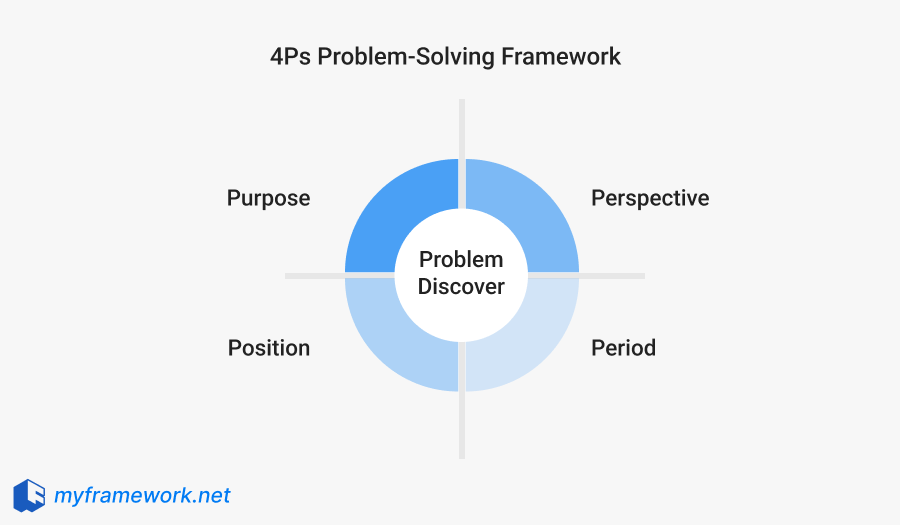
A useful pass writes all four dimensions, then states a reframed problem.
1. Purpose
Ask why this work exists. Watch for a habit that replaced the intent.
2. Perspective
Widen and narrow the system: policies, markets, people, timing. Do not stop at the ticket’s local symptom.
3. Position
Write the issue from more than one stakeholder. Conflict is often different scoreboards, not a villain.
4. Period
Stretch effects across a short, medium, and long horizon using the case. Do not invent a forecast model.
5. Reframe
State the problem in one sentence that could not have been written before the four views. Without that sentence you have four notes, not a 4Ps.
How it compares
When another lens fits better, or when you need a complementary view, these frameworks do different jobs. They are not interchangeable labels for the same question.
| Framework | What it helps you see | How it differs from these 4Ps |
|---|---|---|
| 5 Whys | A backward cause chain | Helper for Purpose, not four dimensions |
| 5 So's Technique | Forward consequence chain | Foresight, not framing |
| Zoom-In and Zoom-Out | Scale of view | Perspective cousin |
| Fishbone Diagram | Cause categories | Different structure |
| 5W1H | Who, what, when, where, why, how | A question set, not Saito’s four |
| 4P Marketing Mix | Product, Price, Place, Promotion | Name collision only |
The 4Ps Problem-Solving Framework is the lens for a four-dimension reframe. Other methods help when the question is causes, consequences, or mix.
When to Use This Framework
- Busy but unchanged. Activity is high; the result does not move.
- Disagreement on what matters. Groups do not share success or trade-offs.
- Time distortion. A short-term pressure is making a long-term cost invisible.
Example
A concrete example makes the structure easier to reuse when you are under uncertainty.
Example: “Onboarding is too slow”
A product team keeps adding checklist items because new users drop in week one. Support wants more emails. Engineering wants fewer screens.
Purpose: the original intent was first value, not completeness of a tour. Perspective: drop-off also tracks a billing hold and a missing data import. Position: support scores tickets closed; product scores activation; sales scores logos. Period: a two-day delay looks fatal this week; a rushed import creates a quarter of bad data.
Implication: The reframed problem is not “add more onboarding.” It is “first value is blocked by import and billing, while three teams score different success.” A tutorial patch would have been a Purpose miss.
Takeaway
What the 4Ps can help with
- Catching purpose drift
- Seeing system and stakeholder splits
- Testing a fix against more than one time horizon
- Writing a better problem statement
What the 4Ps cannot replace
- Root-cause chains. 5 Whys traces backward. It may help Purpose. It is not four dimensions.
- Forward consequences. 5 So's asks “so what?” down a path.
- Cause categories. Fishbone groups causes.
- Scale of view only. Zoom-In and Zoom-Out is a Perspective cousin, not Position or Period.
- Marketing mix. 4P Marketing Mix is a different 4P.
Honest scope: 4Ps structures a reframe. It does not replace cause analysis or a mix.
Frequently asked questions
No. Marketing 4P is Product, Price, Place, Promotion. This method is Purpose, Perspective, Position, Period.
No. It can support Purpose. The method is still four dimensions.
Four views plus a problem statement that changed. Four headings with no reframe is incomplete.
No. It is a time stretch so a short panic does not hide a long cost.
You can write imagined counterparties (customer, ops, future you). Skipping Position hides scoreboard conflict.