Communication
The Relationship Map: Audit Your Social Net Worth
A simple way to evaluate your relationships.
Applications
Framework Card
The Relationship Map
- Goal
- Allocate your limited social energy to the people who fuel your growth.
- Best For
- Annual Life Audits; Burnout Prevention
Relationship Around Us
Some relationships make us feel alive, while others weigh us down.
Most of us don't pause to reflect on which relationships are helping ur grow and which ones are pulling us back. Now the Relationship Map can help us with it.
This tool was introduced by Sahil Bloom in his book The 5 Types of Wealth. It provides a clear and simple way to evaluate your relationships, whether they bring value or just hold you back.
What this framework is
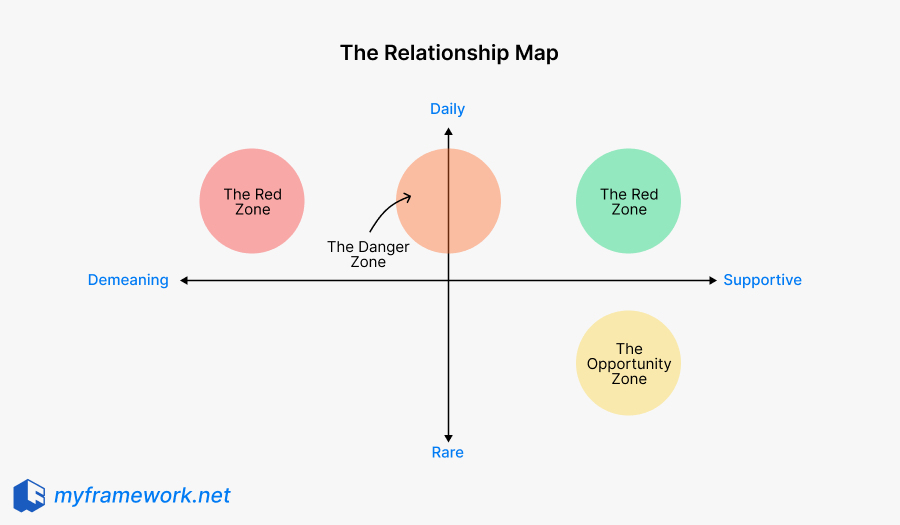
The Relationship Map is a visual tool that organizes your relationships based on:
- Supportiveness – How positive or negative the relationship feels.
- Frequency – How often you interact with the person.
These two factors are placed on a 2×2 grid, forming four zones:
Advertisement
How the framework works
Green Zone (Supportive & Frequent)
These are your strongest and most valuable relationships. They are both highly supportive and regularly engaged. Prioritize and invest in maintaining their strength and presence in your life.
Who goes here:
- Your spouse or partner who encourages and supports your goals
- A close friend you talk to every week and who makes you feel heard
- A manager or teammate who trusts you and helps you grow
- A sibling who checks in regularly and genuinely cares
Action:
- Keep the relationship strong.
- Show appreciation and stay connected.
- Spend regular quality time together.
Opportunity Zone (Supportive & Infrequent)
These relationships offer high support but occur infrequently.
Seek to increase the frequency of interactions to deepen these meaningful connections.
Who goes here:
- A high school best friend you haven’t seen in years, but who always supported you
- A former mentor or coach who gave you great advice but you lost touch with
- A cousin you love spending time with during holidays but rarely speak to otherwise
- A respected colleague who has always been kind but you rarely collaborate with
Action:
- Reach out and reconnect.
- Schedule meetups or calls.
- Try to make interactions more regular.
Danger Zone (Ambivalent & Frequent)
These relationships may not offer consistent support and occur often.
They should be carefully managed—either by reducing interaction or by working to improve their quality.
Who goes here:
- A coworker you must work with daily, but who can be dismissive or competitive
- A family member who criticizes you often but is always around
- A friend group where some dynamics feel off, but you’re still included
- A neighbor you see often but feel drained after talking to
Action:
- Set clear limits.
- Decide if the relationship can improve.
- Talk openly if you want to fix the issues, but it's totally fine if you just want to leave it as is.
Red Zone (Demeaning & Frequent)
These are potentially toxic relationships that are both harmful and recurring.
To protect your emotional well-being, consider distancing yourself or removing these entirely from your life.
Who goes here:
- A boss who belittles or micromanages you regularly
- A friend who constantly talks down to you or dismisses your achievements (hey, maybe we shouldn't call him/her "friend")
- A partner who is emotionally abusive or manipulative
- A toxic teammate who gossips, competes unfairly, or disrespects boundaries
Action:
- Step back or end the connection.
- Protect your mental and emotional health.
- Focus on people who support you.