Leadership & Management
Bridges Transition Model: Manage Change with Confidence
Focus on the emotional and psychological transitions individuals experience during change.
Applications
Framework Card
Bridges Transition Model
- Goal
- Diagnose where people are emotionally during change and apply the right leadership response.
- Flow
- Ending → Neutral Zone → New Beginning
- Best For
- Mergers & Acquisitions; Restructuring
Change vs. Transition
Do you often feel overwhelmed when big changes happen at work or in life? Maybe you find it hard to accept new routines, feel uncertain, or even resist changes strongly.
These challenges are very common, and overcoming them is not easy.
What this framework is
William Bridges, an American author and expert in change management, observed these struggles. He realized that the hardest part isn't the change itself, but rather the internal emotions and adjustments people experience during transitions.
To address this, Bridges developed a helpful framework called the "Transition Model" to guide people through these tough times, making change smoother and less stressful.
Advertisement
The 3 Stages of Transition
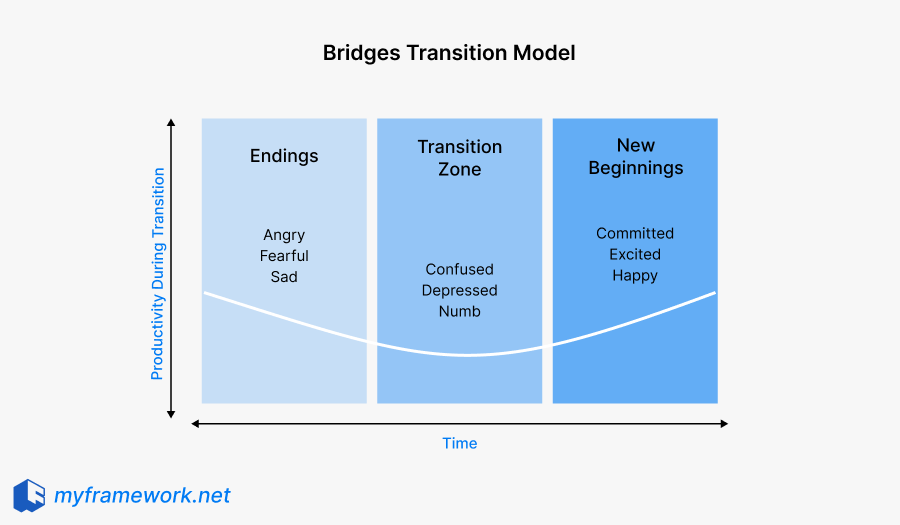
Bridge's Transition Model divides the process of adjusting to change into three clear stages.
Ending, Losing, and Letting Go
Every transition starts with an ending.
In this stage, people feel they are losing something valuable—such as familiar routines, comfortable environments, or established relationships. This loss can make them feel sad, anxious, or frustrated.
The biggest mistake leaders make at this stage is rushing people forward
before acknowledging what they are losing.
To navigate this stage successfully, people must:
- Accept that something is ending.
- Clearly recognize and understand their own emotions.
- Give themselves time to experience feelings like grief or disappointment.
Neutral Zone
After accepting the end, people enter a confusing middle ground called the "Neutral Zone." Here, the old ways have stopped, but the new ways aren’t fully clear yet.
The Neutral Zone is where productivity dips, but innovation quietly begins.
This can be uncomfortable and uncertain. People might feel confused, impatient, or stuck, but it’s also a place of potential creativity and new ideas.
To make the best of this stage, people should:
- Stay patient, understanding confusion is normal.
- Try new ways and think openly.
- Communicate and ask questions to understand what's coming next.
New Beginning
The last stage is when people finally embrace and adapt to the new situation.
At this point, people feel hopeful, energized, and committed. They clearly understand their role in the new scenario and become comfortable with their new routines or environments.
To fully enter this stage, people must:
- Clearly understand their new roles and responsibilities.
- Build confidence by celebrating small achievements.
- Commit positively to the new reality.