Personal Development
151515 Career Planning Model: Plan Your 45-Year Career Marathon
Guiding you through three 15-year stages for your 45-year career.
Applications
Framework Card
151515 Career Planning Model
- Goal
- Prevent burnout and short-termism by aligning actions with career life-stages.
- Flow
- Fuel (Skills) → Focus (Differentiation) → Legacy (Advising)
- Best For
- Early-Career Professionals; Mid-Career Transitioners
The Marathon vs. The Sprint
Career planning is a lifetime topic, but many professionals view their career like a sprint. They focus on short-term achievements, urgent deadlines, and immediate promotions, but they fail to plan for the decades ahead.
This short-sighted approach often leads to burnout, stagnation, or loss of direction after just a few years. People may realize too late that they have not built the skills, reputation, and adaptability needed for a 40+ year career journey.
The reality is that a career is more like a long-distance marathon, requiring strategy, pacing, and a clear roadmap. Without it, talented people risk running out of energy before reaching their full potential.
Why This Framework Helps
Brian Fetherstonhaugh introduced a model called 151515 Career Planning Model in his book The Long View.
This model reframes a career as a 45-year marathon divided into three distinct 15-year stages.
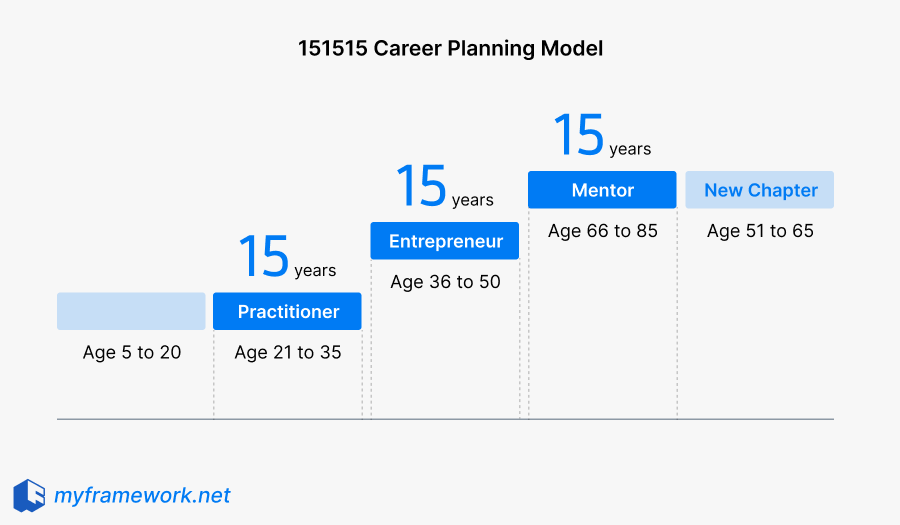
This structure helps professionals avoid short-term thinking by planning milestones and skills for each phase.
Advertisement
Detailed Explanation and Core Structure
The author thought a sustainable and successful career spans roughly 45 years, with three consecutive 15-year stages. Based on this idea,
151515 Career Planning Model defines different priorities in different stages:
- Early career is about learning and skill-building
- The middle years are about mastery and leadership
- The later stage is about influence, mentorship, and legacy
Each stage has its own purpose (WHY), focus (WHAT), method (HOW), and success identity (WHO).
Stage 1 – Learn and Build the Foundation
Ages ~5–20 for study, 21–35 for work
- Purpose (WHY): Fill skill gaps and build a strong base.
- What to Do (WHAT): Deepen your marketable skills, gain diverse work experience, and form lasting relationships.
- How (HOW): Keep learning through practical work, develop strong habits, and seek varied experiences.
- Who You Become (WHO): A dedicated learner.
Tip: Focus on skills that are marketable, relevant, and enduring.
Stage 2 – Mastery and Distinction
Ages 36–50
- Purpose (WHY): Strengthen your strengths and stand out in your field.
- What to Do (WHAT): Identify your “sweet spot” where your interests, strengths, and opportunities intersect.
- How (HOW): Focus on roles that maximize your strengths, refine your expertise, and build a personal brand.
- Who You Become (WHO): A recognized personal brand.
Tip: Apply the five career planning rules – keep learning, clarify your goals, develop a roadmap, use your network, and update your plan often.
Stage 3 – Influence and Legacy
Ages 51–65, and new life chapter from 66+
- Purpose (WHY): Optimize your influence and sustain momentum.
- What to Do (WHAT): Pass on your experience, protect your network, and find ways to renew your professional energy.
- How (HOW): Mentor others, start new projects, and keep learning transferable skills.
- Who You Become (WHO): A trusted advisor and mentor.
Tip: Combine continued learning with exploration of new passions.