Personal Development
ABC Model: How to Take Charge of Your Emotions
A simple and practical way to break free from negative emotions.
Applications
No application mappings are available for this framework yet.
Framework Card
ABC Model
- Goal
- Regain emotional control by identifying and changing irrational beliefs.
- Flow
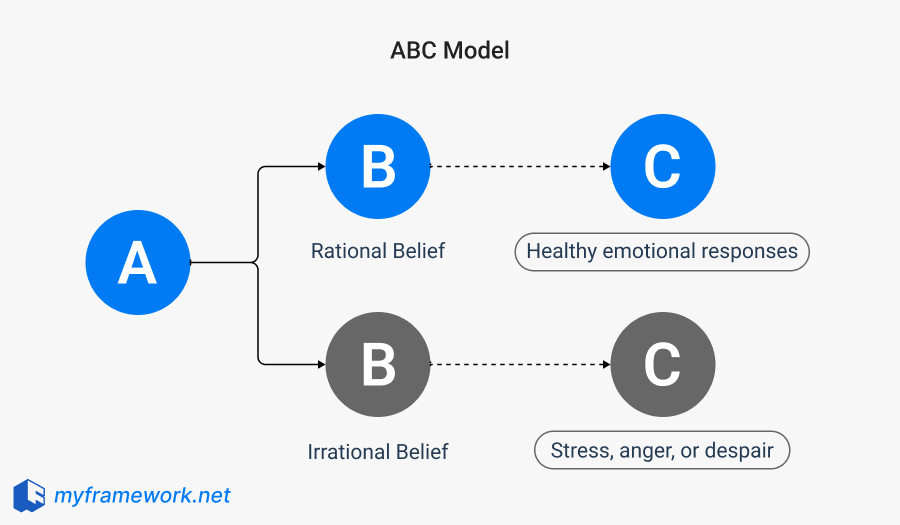
- Event (A) + Belief (B) = Emotion (C)
- Best For
- Irrational Thinking Loops; Belief-Driven Emotional Reactions
Why We Often Feel Stuck In Negative Emotions
Many people struggle with sudden frustration, anxiety, or even sadness that seems to appear out of nowhere.
We blame the event itself, like a harsh comment from a boss or a friend not replying to a message. But in reality, the root of our emotions is not the event. It is how we interpret it. If we can manage these interpretations, we can better manage our emotions and actions.
What this framework is
The ABC Model is part of Rational Emotive Behavior Therapy (REBT), created by psychologist Albert Ellis in the 1950s.
Ellis believed that people are not disturbed by events themselves, but by their beliefs about those events. He called this process the ABC Theory of Emotion.
This model is now widely used in psychology, coaching, and personal improvement because it gives a practical tool to identify and change unhelpful thinking.
Advertisement
How the framework works
A - Activating Event
The situation that happens. It's only the trigger and it can be neutral or even random. Whatever the result is, one thing is obvious: it can not be changed.
B- Belief
The thoughts or assumptions we hold about the event.
It's the critical factor, because this is the only thing we can control.
A rational belief leads to healthy emotional responses, while an irrational belief creates stress, anger, or despair.
| Type | Definition | Example |
| Absolutism | Demanding that things must go our way | "I must win" or "Everyone must like me" |
| Overgeneralization | Judging yourself or others based on one event | "I failed once, so I am useless" |
| Catastrophizing | Assuming the worst possible outcome | "If I get criticized, I cannot survive it" |
C - Consequence
The consequenceis how we feel and act. Change the belief, and the consequence changes too.
By recognizing these patterns, we see that our emotions are not fixed. They are shaped by how we think.
So far, you can see that the ABC Model is a simple and practical way to break free from negative emotions. Still, I know it’s hard to follow any method when you feel really low.
If there’s only one thing to remember from this post, let it be this:
The real task is not managing emotions, but managing the irrational beliefs that drive them.