Personal Development
Cornell Note-Taking System: How to Take Better Notes
Encourage active engagement with the material and reinforces memory with review.
Applications
Framework Card
Cornell Note-Taking System
- Goal
- Improve comprehension and recall through structured layouts.
- Best For
- University Students; Exam Preparation
Check-in
You are not short of notes. You are short of structure.
If your notes are hard to review or never revisited, the problem is not effort, but design. A simple system can turn passive recording into active learning.
What this framework is
The Cornell Note-Taking System is a highly effective method for organizing and reviewing notes, developed by Dr. Walter Pauk at Cornell University in the 1950s. It’s designed to enhance learning by focusing on summarization, active recall, and review.
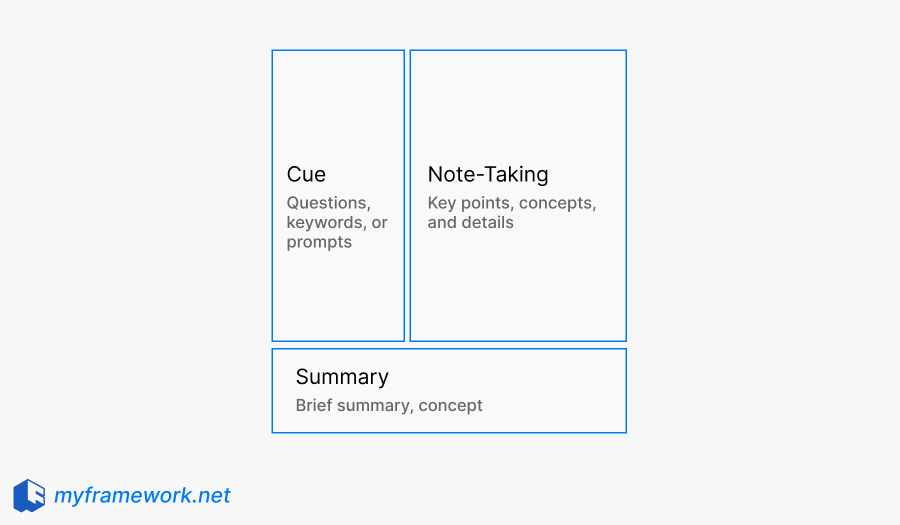
This system is widely used in education and can also be adapted for various professional contexts, such as meetings or lectures, to improve knowledge retention and clarity.
Advertisement
How it Works
Note-Taking Area
The larger area on the right. This is where you take detailed notes during class or a lecture.
During the lecture or reading, write down key points, concepts, and details there. Focus on understanding rather than transcribing everything.
Cue Column
A narrow column on the left. This is where you write key terms, questions, or main ideas after your note-taking.
Immediately after the session, fill out the Cue Column with questions, keywords, or prompts that correspond to the material you’ve written in the Note-Taking Area. These should be cues that will help trigger your memory or facilitate self-testing.
Summary Section
At the bottom of the page, leave a space for writing a brief summary of the content after the lecture or study session.
Summarize the main points and concepts in your own words. This helps reinforce the material and aids in review later.
In Review
Periodically review your notes by covering the Note-Taking Area and testing yourself with the questions or keywords in the Cue Column.
Use the Summary Section to refresh your memory and deepen understanding by recalling the main ideas.