Problem Solving
3R Review Framework: A Simple Way to Learn From Every Experience
A fast reflection loop that helps you learn from everyday work and improve continuously.
Applications
Framework Card
3R Review Framework
- Goal
- Reduce repeated mistakes by building awareness and refining how work is done.
- Flow
- Record (Facts) → Reflect (Motives) → Refine (Methods)
- Best For
- Daily Work Reviews; Study Sessions
The Trap of Repetition Without Growth
Some people work hard, but their growth curve remains flat.
Yes, people want to improve, yet many move from task to task without pausing to learn from what they just did.
Improvement comes from awareness, not repetition. The 3R Review Framework just gives us a practical way to build this awareness.
What this framework is
The 3R framework is a compact assessment tool designed for rapid iteration.
Unlike complex quarterly reviews, 3R is lightweight enough to be used daily or weekly. It works effectively for student study sessions, agile project sprints, or personal habit building.
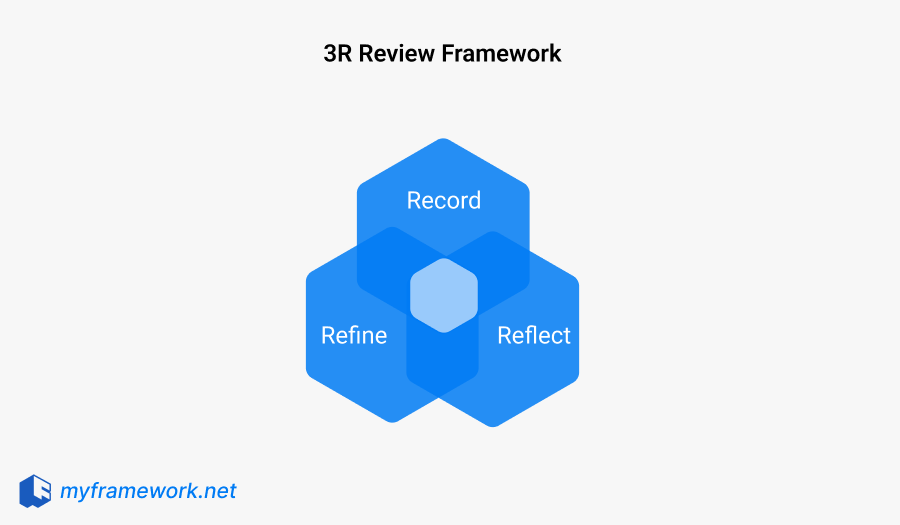
This framework includes three simple steps:
- Record - Capture what happened
- Reflect - Think about why it happened
- Refine - Shape a better method for next time
It is a compact yet powerful assessment tool that works in studies, work, team projects, and personal development.
Advertisement
3R Framework Deep Dive
Record: Capture the Process With Detail
Improvement begins with observation.
You record the full sequence of actions, decisions, and reactions. This is not a quick note. It is a deliberate record that shows what you did, how you did it, and what the result was.
A clear record helps you evaluate every step later. It also prevents memory bias, which often colors events with emotion rather than accuracy.
Reflect: Understand the Motive Behind the Action
Reflection is the heart of learning.
Ask yourself why you behaved a certain way and what you really needed at that moment. This step uncovers your deeper motives.
You understand what drove your decisions and why certain patterns repeat, and when you understand your motives, you can adjust with intention instead of reacting on autopilot.
You could also see the motives of others more clearly, which improves communication and teamwork.
Refine: Extract Principles and Build a Better Plan
The final step is turning reflection into action: identify what can be improved.
A framework, a method, or a checklist that will guide your next attempt.
Create a simple improvement plan that can be tested and adjusted again. Over time, this cycle strengthens your decision-making and builds a personal playbook that supports long-term growth.