3R Review Framework: Record, Reflect, Refine
3R helps you learn from a recent piece of work by recording what happened, reflecting on why, and refining the method you will use next time, in a loop short enough for the same day or week.
Framework Card
- Name:
- 3R Review Framework
- Goal:
- Learn from a recent piece of work by recording what happened, reflecting on why, and refining the method you will use next time.
- Flow:
- Record → Reflect → Refine
- Best For:
- Daily or weekly personal reviews; After a study session or exam; Short reflection after a meeting or task
Why it matters
Plenty of people work hard and still feel the curve is flat. The usual pattern is simple: finish a task, start the next one, trust memory.
Memory is a poor log. By evening the meeting has become a mood. By next week the exam has become "I should have studied more." Without a record, reflection is guesswork. Without a refine, reflection is a diary entry.
That matters after a class, an exam, a difficult meeting, or a day of tickets. You do not always need a quarterly Goal-Result write-up or a process experiment. You need a loop you will actually finish.
3R is that loop. It is personal and lightweight. It is not a team after-action ritual.
What it is
3R is a three-stage review for a recent piece of work. 3R stands for Record, Reflect, Refine.
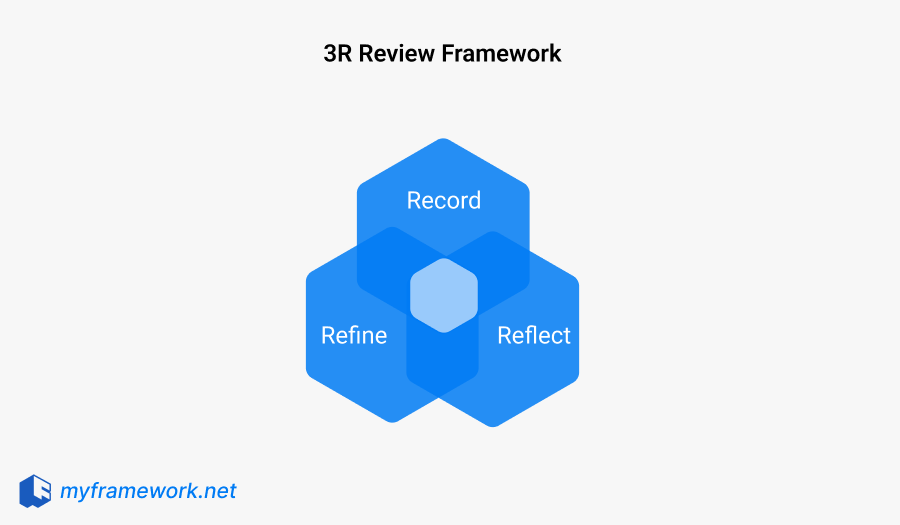
| Stage | Focus | Question |
|---|---|---|
| Record | Facts | What did I do, how did I do it, and what resulted? |
| Reflect | Motives and patterns | Why did I act that way, and what keeps repeating? |
| Refine | Methods | What will I change in the method next time? |
Unlike a quarterly GRAI write-up, 3R does not require a formal Goal baseline before you start. Unlike After-Action Review, it is not built as a facilitated team debrief. It is compact enough for daily or weekly use: a study session, a work block, a short project pause.
How it works
A useful 3R is short and specific, not a three-heading essay.
1. Record (facts)
Write the sequence: what you did, how you did it, what resulted. Include decisions and reactions you can still name. This is not a one-line mood. A clear record is what later reflection has to stand on, and it is what fights the bias of remembering only the feeling.
2. Reflect (motives and patterns)
Ask why you behaved that way and what you needed in the moment. Production teaching treats this as the center of the loop: motives, repeating patterns, and (when relevant) a clearer read of someone else's motive so you communicate differently next time. Stay on the work. 3R is not a therapy session and not a team blame round.
3. Refine (methods)
Turn the reflection into a method you can try: a checklist item, a time rule, a study card, a meeting template. Make it small enough to test on the next attempt. "Be more focused" is not a refine. "Close Slack for the first 25 minutes of the next study block" is.
Then stop. The loop is meant to repeat. It does not need a fourth stage called "deliver a structured response."
How it compares
When another loop fits better, these methods do different jobs. They are not interchangeable labels for "reflect."
Related review and improvement loops
| Framework | What it helps you see | How it differs from 3R |
|---|---|---|
| PDCA Model | Plan, Do, Check, Act as a repeating process test | Includes doing a planned change. 3R reviews work already done. |
| After-Action Review (AAR) | Intent, reality, cause, and next time, often as a team debrief | Organizational event review. 3R is personal and lightweight. |
| KISS Review Framework | Keep, Improve, Start, Stop | Action piles. 3R records facts and reflects on motives before refining the method. |
| GRAI Review Framework | Goal, Result, Analysis, Insight against a baseline | Requires a stated Goal. 3R can start from a single task with no formal target. |
3R is the lens when the question is: what just happened, why did I do it that way, and what method do I try next? Other methods help when the job is a process experiment, a team event debrief, action sorting, or a Goal-Result period review.
When to Use This Framework
- After a study session or exam: Record what you studied versus what appeared, reflect on the mismatch, refine the next study plan.
- After a meeting or a work block: Record friction (agenda, interruptions, unclear next steps), reflect on why you handled it that way, refine the next agenda or checklist.
- Daily or weekly personal notes: A short loop at the end of the day, not a status report for a manager.
- A small project pause (secondary): A personal or two-person note at a midpoint. This is not a substitute for an organizational After-Action Review.
Example
A concrete example makes the structure easier to reuse when you are under uncertainty.
Example: After a midterm
A student finished a statistics midterm sure they had "studied a lot." The score was lower than the homework average.
Record: Three nights of rereading slides. Two practice sets, both from week 1 to 3. The exam spent half its points on hypothesis tests from week 5, which the student had only highlighted, not worked. Time on the exam: 20 minutes stuck on one proof, then a rush.
Reflect: Rereading felt like work, so it was easy to choose over new problem sets. The motive was comfort, not coverage. The repeating pattern is staying on familiar weeks when a test is close.
Refine: Next unit test: one timed mixed set that includes the latest week, before any reread. Cap any single exam item at eight minutes, then move. That is a method change, not a promise to "study harder."
Example: After a weekly planning meeting
An operator left the Monday planning meeting with three "priorities" and no sequence. By Thursday two of them had slipped.
Record: The meeting ran 50 minutes. The operator added every request to the shared doc in the room so nobody would feel refused. No owner or date was written on two items. After the meeting, Slack added a fourth request that the operator accepted in the thread.
Reflect: The motive in the room was to keep the meeting pleasant. The pattern is saying yes in public, then discovering the week cannot hold it.
Refine: Next Monday: a one-line template (owner, date, "not this week") pasted at the top of the doc before the meeting starts. Slack requests after 11:00 go to Friday triage, not to the same-day list. This is a personal method. It is not an After-Action Review for the whole company.
Takeaway
What 3R can help with
- Capturing a recent piece of work before memory turns it into a mood
- Seeing why a pattern repeats, including the motive that made the easy choice
- Leaving with a small method change you can try next time
- Running a loop short enough for daily or weekly use
What 3R cannot replace
- An organizational After-Action Review: AAR uses four questions and is often a team debrief after an event, with a rule to focus on the work rather than the person. 3R is personal and lightweight.
- A PDCA experiment: Plan, Do, Check, Act includes doing a planned process test. 3R reviews work already done.
- A GRAI write-up: Goal, Result, Analysis, Insight starts from a stated baseline. 3R does not require that Goal.
- A KISS action grid: Keep, Improve, Start, Stop sorts practices. 3R records and reflects before refining one method.
- A personal-development program: 3R is a loop after a piece of work. It is not coaching, therapy, or a curriculum.
Honest scope: 3R structures a short personal review. It does not run a team debrief, and it should not be sold as growth from every experience.
Frequently asked questions
Record, Reflect, and Refine. Record captures facts. Reflect asks why (motives and patterns). Refine changes the method for next time.
No. After-Action Review is usually four questions after a specific event, often with a group. 3R is a personal three-stage loop you can finish the same day. If you need a team debrief, use AAR. If you need a short personal note, use 3R.
PDCA plans a change, does it, and checks it. 3R starts after the work already happened. Use PDCA when you are designing a process test. Use 3R when you need a rapid look at what you just did.
You can share a personal 3R as a note. That is not the same as running an After-Action Review. A team event with intent versus reality and a blame-free rule is AAR's job.
A factual Record, a Reflect that names a motive or repeating pattern (not only a mood), and a Refine specific enough to try on the next attempt. If the output is three adjectives, you still have a diary entry.