Problem Solving
Magic Loop Framework: Close Feedback Gaps
Capture feedback, act on it, make changes stick, and report back with clarity.
Applications
No application mappings are available for this framework yet.
Framework Card
Magic Loop Framework
- Goal
- Close broken feedback loops to build trust and ensure continuous improvement.
- Best For
- Product Development; Customer Support
Why Feedback Loops Break
Many teams struggle with broken feedback loops, where insights get stuck, action is delayed, and users or stakeholders feel unheard. These gaps weaken trust, lower engagement, and stall progress.
What this framework is
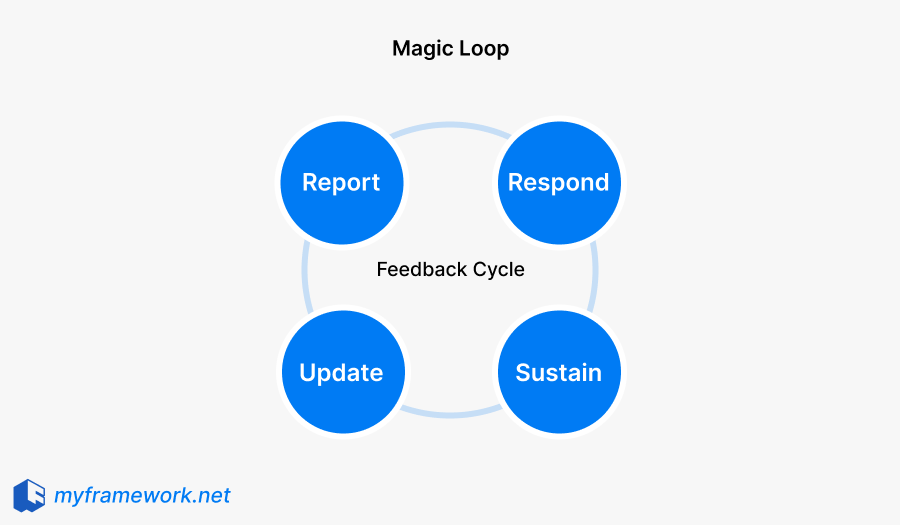
Magic Loop, a practical, cyclical communication framework designed to close the feedback loop efficiently and transparently. While its exact origin isn’t tied to a single creator, the model has been increasingly adopted in tech, service design, and product teams to enhance continuous learning and customer responsiveness.
Advertisement
Core Concept of Magic Loop
Report
Capture and share what has been observed — be it a bug, user feedback, performance insight, or operational issue. The goal is to ensure the problem or input is clearly logged and acknowledged.
- Use accessible channels (support tickets, surveys, retrospectives).
- Structure the report: What happened? Who’s affected? What’s the evidence?
Respond
Take timely action.
This doesn’t always mean solving the issue immediately but showing that the input has been heard and addressed. A fast acknowledgment often matters more than an instant fix. Silence feels like rejection, even when the team is working on it.
- Acknowledge receipt and give an expected timeline.
- Prioritize and route to the right owner.
- Respond with empathy and clarity.
Sustain
Sustain is about ensuring that the solution or change is working and can be maintained over time.
- Introduce monitoring or documentation to lock in the change.
- Train teams or update procedures to prevent backsliding.
- Reinforce the impact of improvements.
A quick tip here: Don’t announce the fix until you’re sure it sticks. Let me give you an example:
- A bug is fixed — great.
- But to Sustain, you make sure it’s tested, won’t regress, and is supported by systems or policies.
Once the fix is stable and verified, you can move to the final stage: Update.
Update
Close the loop with the original reporter or broader community. Let them know what was done, what changed, or why it couldn’t be implemented (and what’s next).
- Share outcomes (even partial wins).
- Communicate clearly, even if the result isn’t perfect.
- Build trust by being transparent and consistent.
It’s called a “loop” for a reason — the process is ongoing and should repeat as new feedback or issues emerge.