Magic Loop Framework: Report, Respond, Sustain, Update
The Magic Loop Framework helps you close one feedback item as Report, Respond, Sustain, and Update: capture it, acknowledge and act, keep the fix in place, and tell the person who reported it what happened. It is a communication cycle. It is not a promise that trust will rise, and it is not PDCA.
Framework Card
- Name:
- Magic Loop Framework
- Goal:
- Close a feedback item as Report, Respond, Sustain, and Update so the reporter is acknowledged, the fix is kept, and the outcome is communicated back.
- Flow:
- Report → Respond → Sustain → Update
- Best For:
- Feedback that disappears after it is logged; Fixes that ship with no word to the reporter; Retro actions that die after the meeting
Why it matters
Teams can be busy and still look absent. A user files a bug. The ticket exists. Engineering even ships a fix. The user never hears a word, so they file again, or they stop filing. Internally the loop looks closed. Externally it never started.
Retros have the same hole. Someone names a recurring pain. The board gets a sticky note. Two sprints later the pain is back because no one owned Sustain, and no one Updated the room.
The Magic Loop is a way to make those four beats visible on a single item. It does not make the team faster. It asks whether the source of the feedback was actually closed with.
What it is
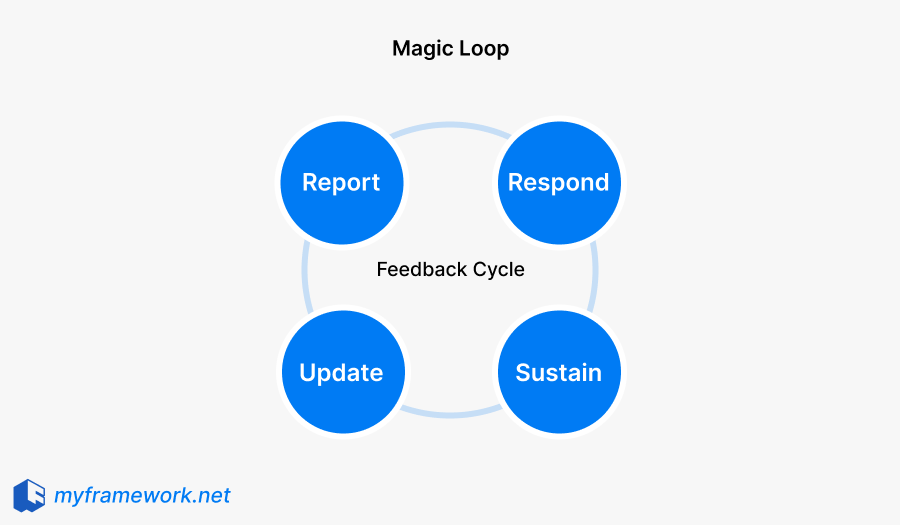
Four stages, in order:
| Stage | Job |
|---|---|
| Report | Capture the issue in a place the team will see |
| Respond | Acknowledge in time, even if the full fix comes later |
| Sustain | Keep the change from silently regressing |
| Update | Tell the reporter (or the group) what was done, what changed, or why not |
Production pages sometimes list a fifth "deliver a structured response" step. That is generic wrap, not part of the loop.
This is not Plan-Do-Check-Act (a tested process change). It is not Observe-Orient-Decide-Act (a speed loop under uncertainty). It is not Situation-Behavior-Impact (how to phrase one piece of feedback).
A tracker status of Done is not Update. Update is a human message.
How it works
A useful pass follows one item. Do not mix five tickets into one loop.
1. Report
Write what was observed, who reported it, and where it lives. If it is only in someone's head, you do not have Report yet.
2. Respond
Acknowledge to the source. A same-day "we have it, next update on Thursday" is Respond. Silence until a perfect fix is the usual failure.
3. Sustain
After the change, say how it will be kept: a test, a doc, a training, an owner. Announcing a fix that is not stable is not Sustain.
4. Update
Send the outcome to the reporter or the community. "No, and here is why" is still an Update. No message is not.
If a stage has no facts, label it. Do not invent that someone was told.
How it compares
When another lens fits better, or when you need a complementary view, these frameworks do different jobs. They are not interchangeable labels for the same question.
| Framework | What it helps you see | How it differs from Magic Loop |
|---|---|---|
| PDCA | Plan a change, try it, check evidence, act | Process experiment. Magic Loop is communication close on one item. |
| OODA Loop | Observe, orient, decide, act under time pressure | Decision speed. Magic Loop is feedback close. |
| SBI | Situation, Behavior, Impact | How to word a feedback message. Magic Loop is the cycle after input arrives. |
The Magic Loop is the lens for Report, Respond, Sustain, and Update on a specific item. Other methods help when the question is an experiment, a speed decision, or feedback phrasing.
When to Use This Framework
- Bugs or requests that vanish after they are logged. The system of record is not the loop.
- Support fixes that never get a note back. The customer still thinks the issue is open.
- Retro actions that die after the meeting. The room needs Sustain and Update, not another sticky note.
Example
A concrete example makes the structure easier to reuse when you are under uncertainty.
Example: A customer bug that engineering already fixed
A SaaS user reports that CSV export drops the last column. Support files a ticket. Engineering ships a patch two days later. No one emails the user. The user files a duplicate.
A Magic Loop pass:
- Report: Ticket #4182, CSV last-column drop, user: finance lead at Acme.
- Respond: Support replies the same day: logged, targeting this week's patch window.
- Sustain: A regression test on the CSV fixture; owner is the reports squad.
- Update: After the patch is in production, Support writes what changed and how to re-export.
Implication: The missing beat was Update. The tracker was green. The human loop was not.
Example: A retro action that comes back every quarter
The team keeps saying "design review is late." Each retro adds the same note. Nothing sticks.
- Report: The recurring note is named as one item, not a vibe: reviews miss Thursday, last three sprints.
- Respond: Eng manager acknowledges in Slack the day of the retro: we will try a Tuesday review block.
- Sustain: Calendar block plus a backup reviewer; the block is treated as a meeting, not optional.
- Update: Two sprints later, the manager reports back in retro: how many reviews still missed Thursday, and whether the block stays.
Implication: Sustain is the calendar mechanism. Update is the return to the room. PDCA would be the method if they were testing a process change with a planned Check. Here the job was closing the retro loop.
Takeaway
What the Magic Loop can help with
- Making capture, acknowledgment, keep-the-fix, and tell-the-source visible
- Catching a ticket that is Done with no human close
- Catching a retro action that never returns to the room
- Allowing an honest no as a valid Update
What the Magic Loop cannot replace
- PDCA. Plan, Do, Check, Act tests a change against expected evidence. This loop is communication around one item.
- OODA. Observe, Orient, Decide, Act is a speed loop. This is not a combat or market-timing method.
- SBI. Situation, Behavior, Impact is how to word feedback to a person. This loop starts after input exists.
- A culture program. Four beats on one item do not create continuous improvement by themselves.
- A guarantee of trust. Closing loops is a practice. Trust is not an output you can claim on a page.
Honest scope: Magic Loop structures the close. It should not be sold as efficiency or trust.
Frequently asked questions
No. Done in a tracker is not Update. Update is a message to the reporter or the group.
Yes. Acknowledgment can precede the full solution. Silence until perfection is the usual failure.
Say no in Update, with a reason. That still closes the loop. Pretending the request is still in progress is not Sustain.
PDCA tests a process change against expected results. Magic Loop makes sure one piece of feedback is captured, acknowledged, kept, and reported back.
That last "structured response" step is generic wrap, not part of the four-beat loop. Use Report, Respond, Sustain, Update.