Maslow's Hierarchy of Needs: Find the Unmet Level Before You Motivate
Maslow's Hierarchy of Needs helps you find which unmet need is blocking motivation (physiological, safety, belonging, esteem, or self-actualization), then match the next move to that level. The five-level sequence is a diagnostic heuristic, not a law that every person climbs in a fixed order.
Framework Card
- Name:
- Maslow's Hierarchy of Needs
- Goal:
- Diagnose which unmet need level is blocking motivation, then match the next move to that level rather than skipping to growth or purpose talk.
- Flow:
- Physiological → Safety → Belonging → Esteem → Self-actualization
- Best For:
- Diagnosing stalled team motivation; Matching a product message to a customer need level; Checking whether a growth program is asking too soon
Why it matters
When people stall, the default response is often a higher-level fix. A team offsite. A purpose talk. A stretch assignment. A luxury brand message. Those moves can still fail if the person or customer is occupied by something more basic: rest, job security, inclusion, or respect.
A pay bump will not substitute for belonging if the person is isolated. A recognition program will not land if people expect another round of layoffs. A creativity workshop will not hold if the room is hungry, unsafe, or excluded.
Maslow's Hierarchy of Needs is a way to name the unmet level first, then choose a move that actually addresses it. It is not a promise that meeting one level automatically produces the next.
What it is
Maslow's Hierarchy of Needs, published by Abraham Maslow in 1943, organizes motivation into five levels. Teaching versions often show a pyramid.
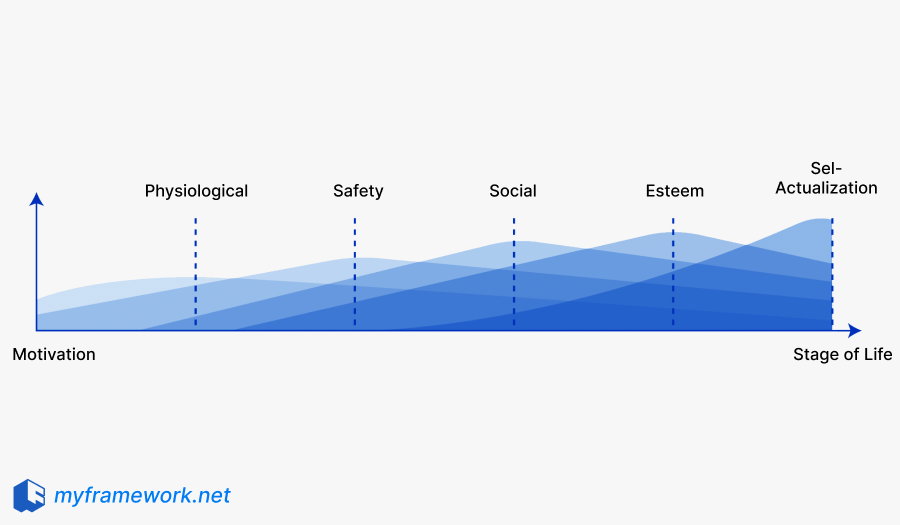
From the base:
- Physiological. Food, rest, pay that covers basics, conditions the body can tolerate.
- Safety. Security, predictability, protection from arbitrary loss or harm.
- Belonging. Inclusion, relationships, being part of a group.
- Esteem. Recognition, competence, respect from self and others.
- Self-actualization. Using capacity in a way that fits the person.
The method is sequential as a diagnostic order of attention: lower levels tend to dominate until they are reasonably satisfied. "Reasonably" is enough. The model does not require perfect fulfillment, and people sometimes pursue higher needs while lower ones are strained. Treat those cases as exceptions you name, not as proof the hierarchy is fake.
Maslow is not a personality test and not a pay-band policy. It diagnoses which need is currently blocking, in this case.
How it works
A useful Maslow pass is evidence and a matched move, not a poster of a pyramid.
1. Frame the person or group and the stall
Name whose motivation you are examining (a team, a segment, a learner) and what "stuck" looks like in observable terms. Mixing several unrelated groups into one pyramid blurs the diagnosis.
2. Gather signals by level
Look for case evidence: pay and rest (physiological), job or physical security (safety), isolation or cliques (belonging), missing recognition or competence (esteem), unused capacity (self-actualization). Use behavior and constraints, not job titles.
3. Name the lowest unmet level
Pick the lowest level that is clearly not reasonably satisfied. Higher-level wishes can still be present. The diagnostic cut is which gap is occupying attention now.
4. Match the next move to that level
State what would reasonably address that level in this context (clearer tenure, inclusion practices, recognition design, scope of work). Without that match, you still have a label, not a Maslow decision.
Review the diagnosis when conditions change (a reorg, a pay freeze, a new cohort). Need dominance is a snapshot.
How it compares
When another lens fits better, or when you need a complementary view, these frameworks do different jobs. They are not interchangeable labels for the same question.
| Framework | What it helps you see | How it differs from Maslow |
|---|---|---|
| Herzberg Two-Factor | Which job factors prevent dissatisfaction versus drive motivation | Split of workplace factors, not a five-level climb |
| Self-Determination Theory | Autonomy, competence, relatedness | Coequal needs, not a hierarchy |
| SCARF Model | Social threat and reward at work | Five domains of social experience, not physiological-to-growth needs |
| SMART Goal Framework | Whether a goal is specific and checkable | Goal quality, not which need is unmet |
| Johari Window | Known versus unknown self in a relationship | Disclosure and feedback, not need levels |
Maslow is the lens for diagnosing which unmet need is blocking, then matching the next move. Other methods help when the question is job hygiene, psychological needs as coequals, social threat, or goal wording.
When to Use This Framework
- Diagnosing stalled team motivation. Effort, perks, or speeches continue while a more basic gap (security, belonging, respect) is unaddressed.
- Matching a product or campaign message to a customer need. Safety language for a security product is a different job from esteem language for a status product.
- Checking whether a growth or learning program is asking too soon. Stretch work or self-actualization talk lands poorly if the environment still feels unsafe or excluding.
Example
A concrete example makes the structure easier to reuse when you are under uncertainty.
Example: Team performance after a reorg
A manager sees missed dates and wants a "motivation reset" workshop.
Signals: people ask whether roles will survive the next quarter. Informal help has dropped. Stretch projects are declined.
Implication: Safety is the unmet level. Stabilize role expectations and decision rights before running a purpose workshop. The workshop may still be useful later. Running it first treats esteem or self-actualization as the current block, which the signals do not support.
Example: Home security campaign versus luxury campaign
A marketer has one template: exclusive lifestyle imagery.
For a home security offer, customers are often occupied by safety (protection, reliability, what happens at night). For a premium watch, esteem and belonging cues may be the relevant level.
Implication: Match the message to the need the offer actually serves. Using esteem language on a safety product, or safety fear on a status product, is a level mismatch. The hierarchy does not prove conversion. It forces you to say which need you are speaking to.
Takeaway
What Maslow's Hierarchy of Needs can help with
- Naming which of five need levels is occupying attention in a case
- Catching a higher-level intervention aimed at a lower-level gap
- Matching a message, management move, or learning design to that level
- Making "reasonably satisfied" explicit instead of assuming the base is done
What Maslow's Hierarchy of Needs cannot replace
- Herzberg's Two-Factor Theory. Hygiene versus motivators at work is a different split. Maslow sequences need levels. Herzberg asks which job factors prevent dissatisfaction versus drive motivation.
- Self-Determination Theory. Autonomy, competence, and relatedness are treated as coequal psychological needs, not a climb.
- SCARF. Status, certainty, autonomy, relatedness, and fairness are social threat and reward domains at work. Useful for change reactions. Not a five-level need pyramid.
- SMART goals. Goal quality and checkability. Not a need diagnosis.
- A clinical or cultural law. The model is a teaching heuristic. Individuals and cultures vary. It should not be sold as a universal climb rate or as therapy.
Honest scope: Maslow structures a need-level judgment and a matched move. It does not replace the methods above, and it should not be sold as a proven sequence of personality.
Frequently asked questions
No. It is a diagnostic heuristic. Lower needs often dominate attention until they are reasonably satisfied, but people can pursue higher needs while lower ones are strained. Use evidence from the case, not a textbook climb.
A named person or group, signals by level, a stated lowest unmet level, and a matched next move. If the output only says "they need self-actualization," you do not have an analysis yet.
Herzberg splits hygiene and motivators at work. SCARF maps social threat and reward. Maslow asks which of five need levels is currently occupying attention. Use them for different jobs.
You can note a higher-level wish. You still need to check whether safety or belonging is occupying attention. A growth program on top of unresolved insecurity often fails for that reason, not because people lack ambition.
No. Satisfying safety does not manufacture esteem. The method only says: do not aim the next move at a higher level while a lower gap still dominates.