Stakeholder Saliency Model: Power, Legitimacy, Urgency
The Stakeholder Saliency Model helps you classify parties by power, legitimacy, and urgency so limited attention is not spent only on whoever is loudest. Mitchell, Agle, and Wood described the three attributes and the classes that follow from them. The model is a diagnosis of salience, not a RACI c…
Framework Card
- Name:
- Stakeholder Saliency Model
- Goal:
- Classify stakeholders by power, legitimacy, and urgency so limited attention goes to parties whose combination of attributes warrants it in this situation.
- Flow:
- Power → Legitimacy → Urgency
- Best For:
- Project governance when the claimant list is long; Crisis triage when several groups demand action at once; Explaining why some voices get partnership and others get a slower queue
Why it matters
Project lists fill up with names. A regulator, a loud customer, a silent budget owner, and a partner with no deadline all look like “stakeholders.” Without a cut, the week goes to whoever emails most.
That habit misses two failures. A quiet party with veto power can still stop the work. A party with a real injury and no power can still have a legitimate claim you are not free to ignore. Volume is a poor proxy for either.
Saliency is a way to make power, rightful claim, and time pressure visible, then change who gets partnership, monitoring, or a slower queue. It does not tell you to please a definitive stakeholder at any cost.
What it is
Ronald K. Mitchell, Bradley R. Agle, and Donna J. Wood described stakeholder identification and salience through three attributes.
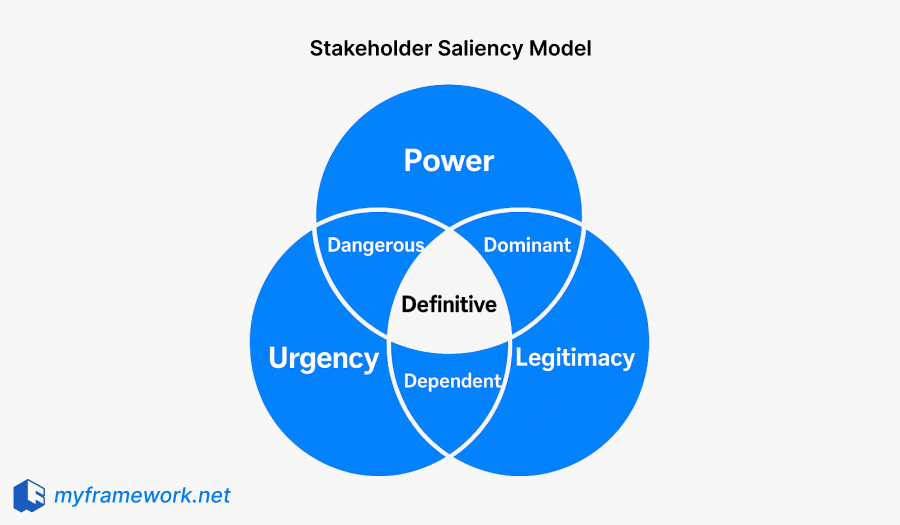
- Power is the capacity to affect the outcome.
- Legitimacy is whether the claim is appropriate (role, law, or a moral standing others accept).
- Urgency is whether delay is costly.
Classes follow from which attributes are present:
- Latent: Dormant (power only), Discretionary (legitimacy only), Demanding (urgency only)
- Expectant: Dominant (power and legitimacy), Dangerous (power and urgency, legitimacy weak or contested), Dependent (legitimacy and urgency, little power)
- Definitive: all three
Site pages use “Saliency.” Academic writing often uses “salience.” The method is the same.
The model does not assign who does the work. That is RACI. It does not plot interest against power as two axes. That is a power-interest grid.
How it works
A useful pass is evidence, class, then an attention move.
1. Name the decision and the set
Pick one initiative or crisis and the parties who can affect it or who are affected by it. Mixing several unrelated programs blurs the scores.
2. Evidence power, legitimacy, and urgency
Use authority, budget, coalitions, contracts, legal duty, harm, and deadlines from the case. Job titles are a hint, not a score. If evidence is thin, label the assumption.
3. Classify
Mark which attributes each party has. Name the type (dormant, discretionary, demanding, dominant, dangerous, dependent, definitive). Do not treat the seven labels as a personality test.
4. Allocate attention
State who gets partnership or rapid response, who is monitored because they could gain a missing attribute, and who is in a slower queue on purpose. Revisit when a dependent party finds an ally, or when urgency expires.
How it compares
When another lens fits better, or when you need a complementary view, these frameworks do different jobs. They are not interchangeable labels for the same question.
| Framework | What it helps you see | How it differs from Saliency |
|---|---|---|
| RACI Model | Who is Responsible, Accountable, Consulted, Informed | Work roles. Saliency classifies attention, not task ownership. |
| Power-interest grid (Mendelow) | Power vs interest as two axes | No legitimacy or urgency as named attributes. A related mapping cousin. |
| Influence or relationship maps | Ties, closeness, coalitions | Network picture. Saliency scores three attributes per party. |
The Stakeholder Saliency Model is the lens for three-attribute classification, then an attention move. Other methods help when the question is role assignment or a two-axis map.
When to Use This Framework
- Project governance. Many parties, and you need a defensible reason some get partnership and others get updates.
- Crisis triage. Several groups demand action at once, and “definitive first” is a starting cut, not a moral ranking of people.
- Explaining attention. Leadership asks why one group is in the room and another is on a slower cadence.
Example
A concrete example makes the structure easier to reuse when you are under uncertainty.
Example: Product launch with a compliance date
A launch team treats every Slack ping as equal. The list includes a regulator, a vocal user on social media, finance, and a partner with no deadline.
A possible picture (illustrative, not a measurement):
- Regulator: power and legitimacy, plus a filing date (definitive).
- Finance: budget control and a formal role, no immediate deadline (dominant).
- Vocal user: urgency, little formal power or standing (demanding).
- Partner: legitimacy via contract, no power or deadline in this launch (discretionary).
Implication: Protect time for the filing. Keep finance in the decision loop. Acknowledge the user without treating volume as veto. The team did not “make the right people happy.” They evidenced attributes and moved attention.
Example: Outage war room
Legal, a major account, an internal tool team, and a journalist all want a call.
- Major account with contract penalties tonight: power, legitimacy, urgency (definitive).
- Legal: power and legitimacy on disclosure (dominant or definitive if the clock is legal).
- Internal tool team: urgency for their own users, weaker external standing (demanding or dependent).
- Journalist: urgency of the news cycle, contested legitimacy inside the firm (often demanding or dangerous if they can force a narrative).
Implication: Sequence calls by class, and write down why. A journalist is not “nobody.” Dangerous or demanding still needs a plan. Saliency does not mean ignore. It means do not pretend every claim is equal.
Takeaway
What the Stakeholder Saliency Model can help with
- Making power, legitimacy, and urgency visible for a named decision
- Separating definitive parties from latent or expectant ones
- Explaining an attention split without relying only on volume
- Noticing when a class can change (a dependent party gaining an ally)
What the Stakeholder Saliency Model cannot replace
- Role assignment. RACI says who does the work and who is informed. Saliency says who warrants attention. CMS takeaway that you “filter with Saliency and assign with RACI” is a sequence of two methods, not one method.
- A power-interest grid. Mendelow-style maps plot power against interest. They do not name legitimacy or urgency as attributes.
- A license to ignore legitimate but low-power parties. Dependent stakeholders can still have a rightful claim.
- Legal or ethics review when legitimacy is contested.
- A permanent ranking of people. Attributes move.
Honest scope: the model structures a salience judgment and an attention move. It should not be sold as political mastery.
Frequently asked questions
A named decision, parties scored on power, legitimacy, and urgency with evidence or labeled assumptions, a stated type for each, and an attention move. A VIP list with no attributes is not the model.
RACI assigns work roles. Saliency classifies who warrants attention in this situation. You can run Saliency first, then RACI. They are not the same grid.
Yes. Urgency expires or spikes. A dependent party can gain power through an ally. Re-score when the situation changes.
No. It means they warrant primary attention. The decision can still be no, with a clear reason.
No. Loudness is a reason to check urgency, not a score by itself.