Straight Line Selling: Target, Certainty, Next Commitment
Straight Line Selling helps you keep a sales conversation on a defined decision: locate the buyer’s certainty, raise it in the product, in you, and in the company, handle resistance without dropping the target, and ask for the next commitment. Jordan Belfort popularized the teaching. This page is t…
Framework Card
- Name:
- Straight Line Selling
- Goal:
- Keep a sales conversation on a defined decision path by locating buyer certainty, raising it, handling resistance, and asking for the next commitment.
- Flow:
- Define the conversation target → Locate the buyer position → Build certainty → Handle resistance → Ask the next commitment
- Best For:
- Calls that lose the thread after an objection; High-consideration conversations that need a clear next ask; Teams that confuse discovery (SPIN) with close-path control
Why it matters
Calls wander. An objection appears. The seller answers it, then another topic appears, then the hour is gone and nobody named a next step. Or the seller pushes an ask the buyer’s certainty cannot support, and trust drops.
Straight Line names a target at the start (what decision this conversation is for) and treats objections as loops back to certainty, not as a new meeting. That can be used well (keep a professional path) or badly (ignore a real no). This page teaches the structure. It does not endorse pressure or deception.
What it is
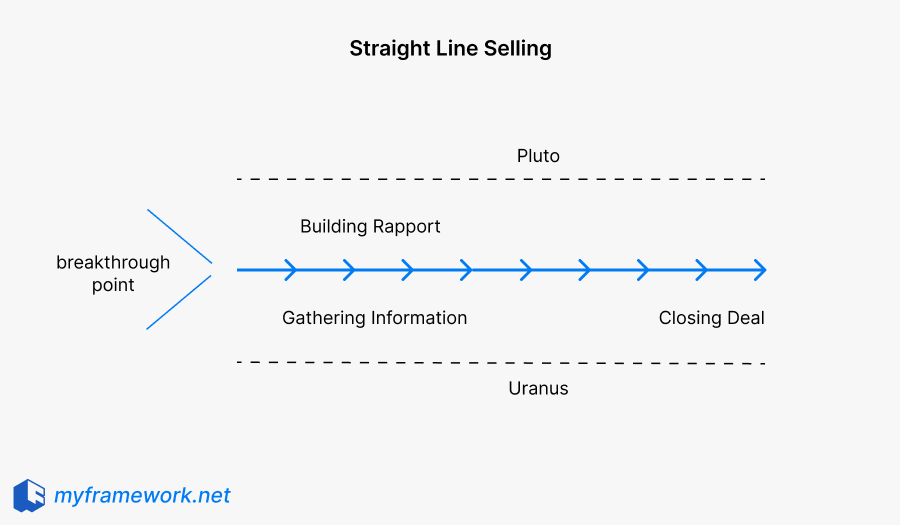
A straight line is the shortest path from the open to a named decision. Teaching usually includes:
| Move | Job |
|---|---|
| Target | The decision you are trying to reach today (a meeting, a trial, a signature) |
| Buyer position | Where they sit on interest, trust, and certainty |
| Certainty | Often taught as Three Tens: product, salesperson, company |
| Resistance | Objections that would pull the talk off the line |
| Next commitment | An ask that matches current certainty |
Three Tens are a teaching scale, not a laboratory measurement. If any of the three is low, the next ask is usually smaller, or the loop goes back to that pillar.
SPIN is how a buyer forms a need with questions. FABE is how you prove a feature. Straight Line is how you steer once you are in a decision conversation. They can follow each other. They are not the same spine.
How it works
A useful Straight Line pass is a path, not a hostage script.
1. Define the conversation target
Write the decision this call is for. If you cannot name it, you cannot stay on a line.
2. Locate the buyer’s position
Are they curious, skeptical, comparing, or ready? Guessing “they love it” is not locating.
3. Build certainty
Address product fit, your credibility, and the company’s. A hole in one pillar is the loop to run, not a reason to shout the ask.
4. Handle resistance
Acknowledge, answer, return to the target. Arguing the person off their concern is not looping. If the answer is a true no, the honest output is stop.
5. Ask the next commitment
Match the ask to certainty. A signature ask on low trust is a method failure, not toughness.
Ethics sit outside the acronym. Misleading claims are not Straight Line. They are misconduct.
How it compares
| Framework | What it helps you see | How it differs from Straight Line |
|---|---|---|
| SPIN Model | Need formation through questions | Discovery. Straight Line is path-to-decision control. |
| FABE Model | Feature, Advantage, Benefit, Evidence | Proof language. Straight Line is where that proof sits on a certainty path. |
| FORM Technique | Rapport topics to open a talk | Opener. Not the Five-move line. |
Straight Line is the lens when a decision conversation needs a target, certainty, and a next ask. Other methods help when the job is discovery, proof, or small talk.
When to Use This Framework
- Objection-heavy closes. The call dies in the middle every time a concern appears.
- High-consideration asks. Trust in person and company matters as much as the spec.
- Inconsistent next steps. Some reps always collect a date. Others never ask.
Example
A concrete example makes the structure easier to reuse when you are under uncertainty.
Example: Demo that never books a trial
A rep finishes a product tour. The buyer says “send information.” The rep sends a deck. No date.
A Straight Line reading: the target was a trial start date. Certainty in the product may be medium. Certainty in the company is untested. The next ask should have been a dated trial with a success check, or a smaller commitment if company trust is low.
Implication: SPIN might still be needed if the problem was never named. Straight Line does not replace that. It stops the “send information” fog from counting as a close path.
Example: Objection as a new meeting
A buyer says implementation looks heavy. The seller starts a twenty-minute architecture lecture and never returns to the original target (a security review next week).
Implication: Looping would answer the implementation concern in a bounded way, then restate the review date. Abandoning the target is the failure. Inventing a fake “everyone implements in two days” is also a failure.
Takeaway
What Straight Line can help with
- Naming a conversation target
- Seeing which certainty pillar is low
- Returning from an objection without losing the ask
- Matching the next commitment to actual trust
What Straight Line cannot replace
- Need discovery. SPIN is Situation, Problem, Implication, Need-payoff. Straight Line assumes you are already steering a decision talk.
- Feature proof. FABE is how a claim is evidenced. Certainty without proof is a slogan.
- Rapport small talk. FORM is Family, Occupation, Recreation, Message as an opener. It is not the straight-line spine.
- Ethics, product fit, or a guaranteed close. Control of a conversation is not the same as a right to the buyer’s yes.
Honest scope: Straight Line structures a decision path. It should not be sold as Belfort folklore or as a close machine.
Frequently asked questions
A teaching scale: high certainty in the product, in the salesperson, and in the company. If one is low, loop there before a large ask. It is not a scientific instrument.
FORM is a rapport opener often taught in the same culture. On this site it has its own page. Straight Line’s spine is target, position, certainty, resistance, next commitment.
No. A straight path can include a clean no. Pressure and deception are not the quality bar for this page.
SPIN builds the need with questions. Straight Line keeps a decision conversation from drifting. Use SPIN when the problem is not named. Use Straight Line when the problem is known and the path keeps breaking.
This page does not claim a rate. It claims a clearer target and a matching ask.