2-Minute Rule: Change Format Before the Room Drifts
The 2-Minute Rule helps you plan a live talk as short units, each in a different format (one-liner, analogy, chart, story, light visual, anecdote), so the room gets another way in before one mode goes stale. Two minutes is a teaching interval, not a law of attention. It is not the GTD rule that say…
Framework Card
- Name:
- 2-Minute Rule
- Goal:
- Change the format of a live talk on a short interval so the audience gets a new entry point instead of one static mode.
- Flow:
- Name the talk and setting → Cut into short units → Assign a format to each unit → Cue the transitions
- Best For:
- Data-heavy live briefings that stay in one slide style; Pitches and training sessions where the room drifts; Recurring meetings that feel like the same update every week
Why it matters
A briefing can be accurate and still lose the room. The speaker stays in one mode: slide, then slide, then a longer explanation of the same kind of slide. People look at laptops. The point was on slide six. Nobody can replay it.
The usual fixes are speed and volume: talk faster, add more charts. Those keep the same stimulus. If the problem is static delivery, the useful move is a planned change of format, not a denser deck.
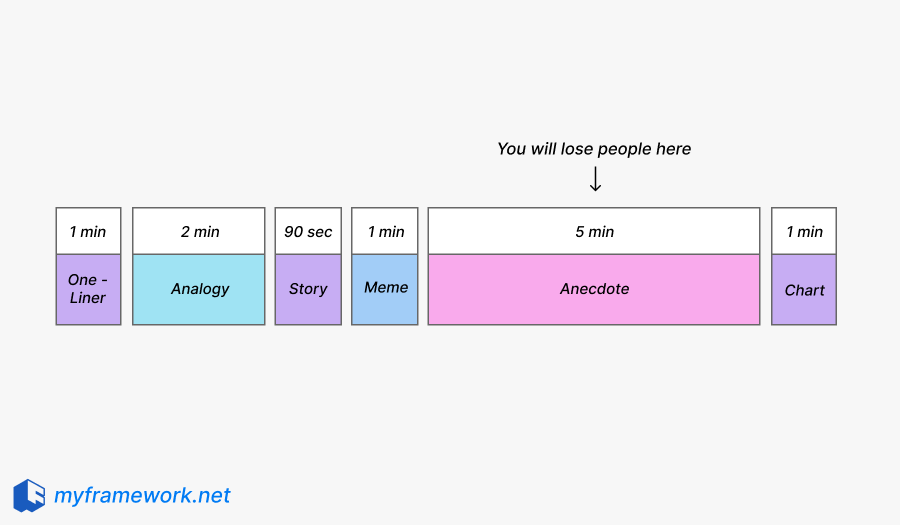
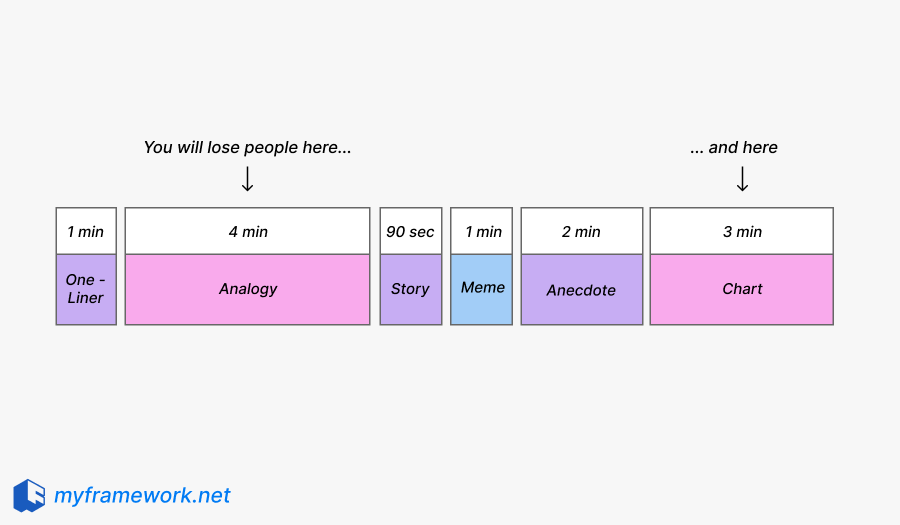
The 2-Minute Rule is a habit of asking: what will this unit look and sound like, and what will the next unit be that is not the same thing? It does not claim that human attention always dies at 120 seconds.
What it is
The 2-Minute Rule, in this sense, is a live-delivery heuristic: cut the talk into short units and change the kind of stimulus between units. Production teaching names common switches: a one-liner, an analogy, a chart, a story, a meme or light visual, an anecdote. The pattern is variety, not a required six-step ritual.
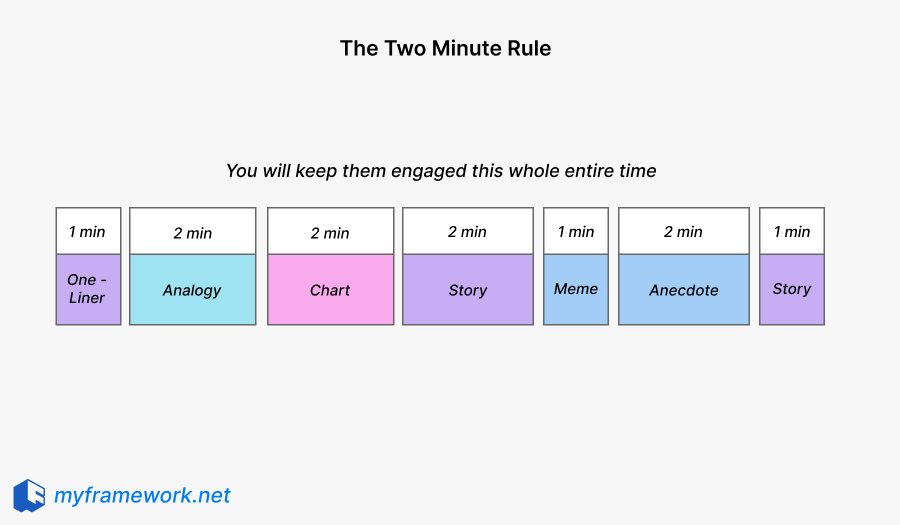
The figure "two minutes" is a planning aid. A unit might run a little longer if the chart needs it. A unit that is still "another bullet slide" is not a switch, even if the clock reset.
This is not Getting Things Done's 2-minute rule (if a task takes under two minutes, do it now). Same nickname. Different job: personal task triage versus audience-facing format.
How it works
A useful 2-Minute Rule pass is a sequence of formats, not a reminder to "be more engaging."
1. Name the talk and the live setting
Who is in the room, how long you have, and what must land. Mixing several unrelated talks into one ranking of "energy" blurs the plan.
2. Cut the talk into short units
Aim for units that can finish in about two minutes. The cut is by idea, not by slide count. If one idea needs a chart and a sentence of implication, that can still be one unit.
3. Assign a distinct format to each unit
Rotate kinds of stimulus. A workable teaching set: one-liner, analogy, chart, story, light visual, anecdote. You do not need all six. You do need adjacent units to differ. Two charts in a row with the same layout is still one mode.
4. Cue the transition
Write a short bridge ("this is like replacing an engine," "back to the numbers," "here is what that looked like on Tuesday"). The cue tells the room a new unit started. Without it, the switch feels like a jump.
Review the plan after a rehearsal. If every unit is still a slide of bullets, you have a deck, not a format map.
How it compares
When another lens fits better, or when you need a complementary view, these frameworks do different jobs. They are not interchangeable labels for the same question.
| Framework | What it helps you see | How it differs from the 2-Minute Rule |
|---|---|---|
| GTD 2-minute rule | Whether a short task should be done now | Personal task triage. Same nickname, different job. |
| Pomodoro Technique | Focused work intervals for the person doing the work | Speaker's clock, not the audience's format map |
| Peak-End Rule | How people remember peaks and endings | Recall design, not a cadence of format switches |
| The Rule of Suspense | Tension across a narrative | An arc. This method is variety of stimulus. |
| PREP Framework | One argument as Point, Reason, Example, Point | Structure of a single claim, not a talk-length format plan |
The 2-Minute Rule is the lens for changing live format before the room sits in one mode. Other methods help when the question is personal time, memory of the experience, story tension, or one tight argument.
When to Use This Framework
- Data-heavy status updates. Numbers matter, and a wall of similar charts is how the insight disappears.
- Pitches and fundraising. The room is deciding, and a single mode (demo only, or story only) leaves half the audience without an entry.
- Training and conference talks. Sessions run long. Participants go passive unless the stimulus changes.
- Recurring team meetings. The update is familiar. Format variety is one way to stop the slot from feeling identical every week.
Example
A concrete example makes the structure easier to reuse when you are under uncertainty.
Example: Quarterly product update that feels like last quarter
A product lead has 20 minutes with leadership. Last time, twelve similar metric slides. People scrolled email after minute five.
They name the job: three decisions (keep investing in onboarding, pause a regional bet, staff a reliability patch). They cut 20 minutes into nine short units, not twelve twin charts.
A possible sequence (illustrative, not a required ritual):
- One-liner: "We did not have a growth problem. We had a first-week drop-off problem."
- Chart: first-week activation, two quarters, one annotation.
- Analogy: onboarding as a badly labeled airport, not a funnel lecture.
- Story: one customer who completed setup only after a support workaround.
- Chart: reliability incidents tied to the regional bet.
- Anecdote: the on-call week that made the pause recommendation concrete.
Implication: The room got more than one way into the same three decisions. The speaker did not prove a cosmic two-minute law. They stopped using twelve copies of the same stimulus. Adding a meme with no link to a decision would have been decoration, not a switch that serves the talk.
Takeaway
What the 2-Minute Rule can help with
- Planning a live talk as short units with different formats
- Reducing the "same slide, again" mode in data-heavy updates
- Giving the room multiple entry points into the same point
- Making transitions visible instead of hoping energy appears
What the 2-Minute Rule cannot replace
- GTD's 2-minute rule. That rule is personal task triage. This page is live delivery.
- Pomodoro. Pomodoro timeboxes the speaker's own work. It does not sequence audience-facing formats.
- Peak-End Rule. Peak-End is about how people remember peaks and endings, not in-the-moment format cadence.
- A storytelling arc. The Rule of Suspense shapes narrative tension. A story can be one unit. An arc is not a switch clock.
- PREP. PREP structures one argument (point, reason, example, point). This method sequences formats across a talk.
- Content quality. Format change does not fix a missing point, a wrong audience, or a talk that should have been a memo.
Honest scope: the 2-Minute Rule structures delivery rhythm in a live setting. It should not be sold as a measured law of attention.
Frequently asked questions
No. GTD says: if a task takes under two minutes, do it now. This page is about changing format in a live talk.
No. Two minutes is a teaching interval. The method is frequent format change, not a stopwatch you must obey.
A different kind of stimulus: a line, an analogy, a chart, a story, a light visual, an anecdote. A new slide with the same bullet layout is usually not a change.
You may still switch once. Forcing many switches in a very short slot can feel rushed. The method is more useful when the talk is long enough for one mode to go stale.
Not as the primary method. The 2-Minute Rule is for live, synchronous delivery where the audience can see and hear the switch.