7C Pyramid: Seven Checks Before You Send
The 7C Pyramid is a pre-send audit of one message against seven checks: Clarity, Conciseness, Concreteness, Correctness, Consideration, Completeness, and Courtesy. It helps you see which gap would force a clarifying reply. The seven letters are a mnemonic, not a promise that the reader will agree.
Framework Card
- Name:
- 7C Pyramid
- Goal:
- Audit one message against seven checks (clarity, conciseness, concreteness, correctness, consideration, completeness, courtesy) before sending.
- Flow:
- Clarity → Conciseness → Concreteness → Correctness → Consideration → Completeness → Courtesy
- Best For:
- High-stakes emails and announcements; Reports or client notes that keep drawing clarifying replies; Public wording where an error or a rough tone is costly
Why it matters
A draft often fails in a boring way. The purpose is buried. The ask is polite but unspecific. A number is missing. The tone assumes the reader already lives in your calendar.
Those misses are expensive when the reader is a client, a leadership group, or a team that will not ping you for the fifth time. "Write more clearly" does not tell you what to fix. The 7C list names the failure: unclear purpose, extra fat, vague claim, error, audience-blindness, missing action data, or needless roughness.
The method is a checklist for this send. It is not a personality upgrade and not a way to win an argument the organization has not settled.
What it is
The 7 Cs of communication are a classic public-relations teaching list (often traced to Cutlip and Center): qualities a message should meet.
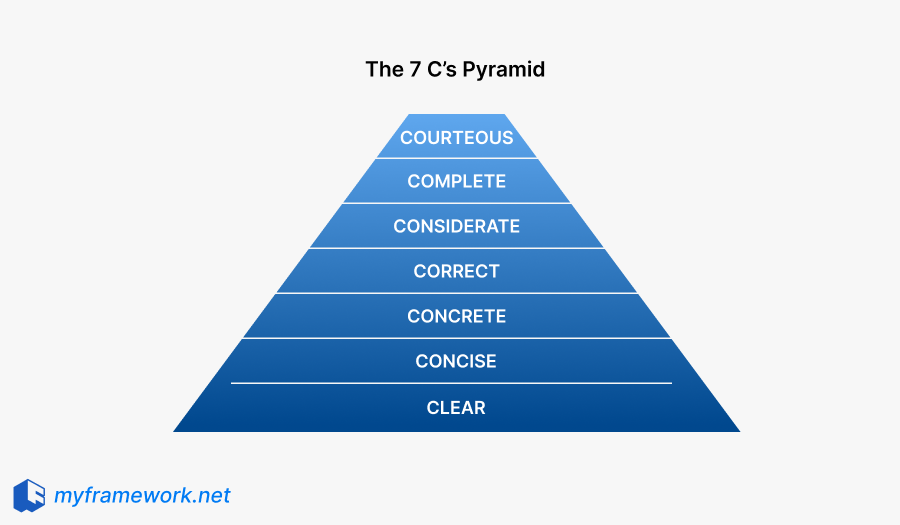
The seven checks:
| Check | Job |
|---|---|
| Clarity | The reader can name the purpose and the words do not fork |
| Conciseness | Repeated points and filler are gone |
| Concreteness | Claims sit on specifics (a date, a number, an example) |
| Correctness | Facts, names, grammar, and formality fit this reader |
| Consideration | The draft is written from the reader's job and knowledge (you-attitude) |
| Completeness | The reader can act without a clarifying round |
| Courtesy | Respect without hiding the ask |
Some other 7C lists use Coherence (logical flow) as a C. This page keeps Consideration as audience-centered you-attitude. Sequence and transitions belong with Clarity and Completeness, not as a stand-in for Consideration.
How it works
A useful 7C pass is diagnosis of this text, not a poster of seven virtues.
1. Clarity
State the purpose in language this reader already has. Cut jargon that is not shared. If the opening could mean two requests, it is not clear yet.
2. Conciseness
Remove sentences that repeat a point already made. Bullet a list if the reader must scan. Conciseness is not a license to drop the ask.
3. Concreteness
Replace "soon," "some issues," and "strong results" with what the case actually has: a date, a count, a named blocker. If you lack a number, say so rather than inventing one.
4. Correctness
Check names, figures, and the formality the relationship requires. Correctness includes tone level, not only spelling.
5. Consideration
Ask what this reader already knows, what they must do, and what would land as noise or blame. You-attitude is not flattery.
6. Completeness
Give the information needed to act. Who, what, when, where, why, and how are useful probes here. Using those questions does not turn 7C into the 5W1H method.
7. Courtesy
Keep respect while stating the point. Courtesy is not a buried request.
The checks trade off. Extreme conciseness can starve completeness. Courtesy can hide the ask if you let it. Name the tradeoff instead of pretending all seven max out at once.
How it compares
When another lens fits better, or when you need a complementary view, these frameworks do different jobs. They are not interchangeable labels for the same question.
| Framework | What it helps you see | How it differs from 7C |
|---|---|---|
| Pyramid Principle | Governing thought, then grouped support | Argument architecture. 7C is quality checks on a draft. |
| PREP | Point, Reason, Example, Point | Opinion sequence. 7C can audit a PREP draft; it is not PREP. |
| SCQA | Situation, Complication, Question, Answer | Story spine for a problem. |
| 5W1H | Who, what, when, where, why, how | Completeness probe. 7C has six other checks. |
| KISS | Whether something is simple enough | Simplicity only. |
The 7C Pyramid is the lens for seven qualities of one send. Other methods help when the question is argument shape, opinion order, narrative problem, or fact completeness alone.
When to Use This Framework
- Email and announcements. Reply chains keep asking for the missing date, owner, or ask.
- Reports and client notes. Claims sound confident but are not checkable.
- Public or crisis wording. An error or a rough tone will be quoted.
Example
A concrete example makes the structure easier to reuse when you are under uncertainty.
Example: Status email that produces a meeting about the email
A product lead sends: "We should talk about the launch. There are some issues. Please find time soon."
A 7C read:
- Clarity: "talk" is not an ask.
- Concreteness: "some issues" is empty.
- Completeness: no time, place, or prep.
- Consideration: it ignores that the team already knows the date slipped.
A revised send (illustrative): "Launch is two weeks later than the plan because legal review is still open. I need 30 minutes Thursday at 10:00 in Room B to reassign owners. Bring current task status. Goal of the meeting: a new date we can publish."
Implication: The checklist named missing completeness and concreteness. It did not prove that the new date is right. That is a decision, not a C.
Example: Customer note that sounds confident and still unclear
A success manager writes: "We remain committed to an excellent experience and will follow up shortly with next steps."
A 7C read:
- Courtesy is present.
- Concreteness and completeness are not: no owner, no date, no action the customer can take.
- Consideration is weak if the customer already waited a week.
Implication: Politeness failed Completeness. Adding warmth would not have fixed the missing date.
Takeaway
What the 7C Pyramid can help with
- Naming which quality of this draft is weak
- Reducing the clarifying round on emails, reports, and announcements
- Catching audience-blind tone and missing action data
- Making tradeoffs among the seven checks explicit
What the 7C Pyramid cannot replace
- Answer-first argument structure. The Pyramid Principle groups support under a governing thought. 7C does not build that pyramid.
- An opinion sequence. PREP is Point, Reason, Example, Point.
- A narrative problem spine. SCQA is Situation, Complication, Question, Answer.
- A fact-only completeness sheet. 5W1H can live inside Completeness. It is a different method when the job is research completeness alone.
- A simplicity rule as the whole method. KISS overlaps Conciseness. It does not cover correctness or consideration.
- Alignment the organization does not have. A checklist cannot invent a decision no one has made.
- Culture, hierarchy, or language difference as a full theory. Courtesy and Consideration help at the wording layer. They do not replace that work.
Honest scope: 7C structures a quality judgment on one message. It should not be sold as a guarantee of understanding.
Frequently asked questions
No. Casual chat does not need a seven-pass audit. Use the full set when a miss is costly. Even then, one C is often the constraint. Name it.
No. The Pyramid Principle is how you group an argument: answer first, then supporting clusters. 7C is a quality checklist. A message can be pyramid-shaped and still fail Completeness or Courtesy.
Consideration is you-attitude: this reader's knowledge, job, and constraints. Logical flow belongs with Clarity and Completeness. Some other 7C lists call that Coherence.
Yes, as an internal audit before you talk. Completeness and Clarity still matter. Do not perform the seven letters as a ritual in the room.
No. It can reduce misunderstanding of the ask. Agreement is a different problem.