Active Listening Spiral: Hear Through Respond
The Active Listening Spiral is an eight-stage process: Hear, Attention, Understand, Remember, Analyze, Evaluate, Empathize, Respond. It helps you stay with someone else's message long enough that the reply is not a guess from a first gist. The stages are mostly internal. They are not a script you r…
Framework Card
- Name:
- Active Listening Spiral
- Goal:
- Move through eight listening stages (Hear through Respond) so a reply is based on meaning, judgment, and empathy, not on a first gist.
- Flow:
- Hear → Attention → Understand → Remember → Analyze → Evaluate → Empathize → Respond
- Best For:
- High-stakes talks where a fast reply would miss intent; Coaching or conflict conversations that skip empathy; Customer or stakeholder concerns with subtext
Why it matters
Many talks fail after the first accurate paraphrase. The listener got the words, then answered the problem they would have had. The speaker's actual constraint (fear of the date, not dislike of the scope) never got in.
That is not always a lack of kindness. It is stopping too early: hearing, getting a gist, drafting a fix. Analysis without empathy can sound like a cross-examination. Empathy without evaluate can sound like agreement you do not mean.
The spiral is a way to notice where you stopped. It will not make a hostile room safe, and it is not a speaker template for your own point.
What it is
This package's listening model has eight stages in order. In a long conversation you may loop back when new information arrives. This is the "spiral." It is not a license to skip Evaluate or Empathize on the first pass.
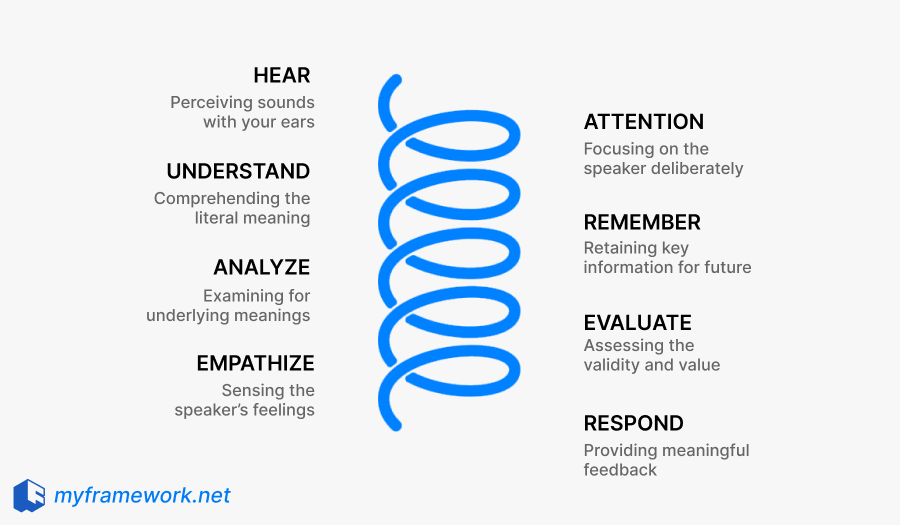
| Stage | Job |
|---|---|
| Hear | Take in the words (and relevant tone) without drafting a reply |
| Attention | Drop competing inputs and inner rehearsal |
| Understand | Decode content and likely intent |
| Remember | Hold the points you will need later in this talk or in follow-up |
| Analyze | Notice pattern, gap, and subtext. Label guesses as guesses |
| Evaluate | Judge relevance and credibility for your role, without dismissing the person |
| Empathize | Register the speaker's experience as theirs. Agreement is not required |
| Respond | Reply in a way that shows the prior work (check, question, or next move) |
"Active listening" in popular use often means nod and paraphrase. This spiral is more specific: it includes analysis, evaluation, and empathy as separate stages before the reply.
It is not ORID (how a group moves from facts to a decision). It is not PREP (how you structure an opinion). It is not SBI (how you give feedback).
How it works
Walk the stages as inner work. The other person should hear a better reply, not a lecture on listening.
Hear and Attention
Stop composing. Phones down. You cannot recover words you treated as background.
Understand and Remember
Get the explicit request and the likely intent. Keep the few details you will need (a date, a name, a constraint). If you cannot repeat the constraint, you do not have Understand yet.
Analyze and Evaluate
Look for what is not said, and whether it matters for your role. Analysis is inference. Say so internally. Evaluate is your judgment: is this feasible, credible, in scope? You can evaluate without arguing in the same breath.
Empathize
Contact the speaker's experience: load, risk, embarrassment. You can empathize with the pressure of a date and still believe the date should hold.
Respond
Show the work: a check ("the timeline is the strain, not the scope"), a question, or a next move that matches what you actually heard. A generic "I hear you" with a pre-loaded solution is a skip from gist to Respond.
If the speaker adds a layer, loop to Hear. Do not pretend the first gist still governs.
How it compares
When another lens fits better, or when you need a complementary view, these frameworks do different jobs. They are not interchangeable labels for the same question.
| Framework | What it helps you see | How it differs from the spiral |
|---|---|---|
| ORID | Facts, reactions, meaning, decision | Facilitation levels for a group. Not eight inner listening stages. |
| PREP | Point, Reason, Example, Point | Speaking structure. |
| SCQA | Situation, Complication, Question, Answer | Narrative spine for a speaker. |
| SBI | Situation, Behavior, Impact | Feedback output, not listening process. |
| HURIER | Hear, Understand, Remember, Interpret, Evaluate, Respond | Educational cousin. Six stages, different split. |
| Reflective listening | Paraphrase and feeling reflection | Mirroring emphasis. Less analysis/evaluate as named stages. |
The Active Listening Spiral is the lens for eight inner stages before a reply. Other methods help when the question is group facilitation, your own argument, or feedback wording.
When to Use This Framework
- A report names a worry inside a "I'm fine." Scope is accepted, timeline is not.
- A customer says "not a fit" and the real issue is onboarding, not the feature list.
- Conflict. Positions are loud. Interests are not.
Example
A concrete example makes the structure easier to reuse when you are under uncertainty.
Example: "I'm fine with scope, worried about timeline"
A teammate says that in a planning meeting. A manager who stops at Understand hears "timeline complaint" and answers with a pep talk about commitment.
A spiral pass:
- Remember the exact split: scope accepted, date not.
- Analyze: "worried" may mean already over capacity, not dislike of the plan.
- Evaluate: the date may still be right. That judgment waits.
- Empathize: the strain is real even if the date holds.
- Respond: "You are with the scope. The date is the strain. Is this already too many hours, or a dependency you do not control?"
Implication: The reply tests a constraint instead of arguing motivation. The spiral did not decide the date. It stopped a pep talk.
Example: "I'm not sure this software is a fit"
A buyer says that on a call. A seller who stops at gist pitches more features.
A spiral pass might hear onboarding risk, not feature doubt. Evaluate still asks whether the product can actually support the switch. Empathize with the risk of a failed rollout. Respond with a question about learning curve versus support during cutover, not a longer feature list.
Implication: Features were the wrong reply. The spiral does not close the deal. It changes which problem you address.
Takeaway
What the Active Listening Spiral can help with
- Noticing that you answered from a gist
- Separating understand, judge, and empathize
- Holding detail for a later check
- Shaping a reply that matches the speaker's actual constraint
What the Active Listening Spiral cannot replace
- A group thinking sequence. ORID holds facts, reactions, meaning, and a decision in a room.
- A speaker template. PREP and SCQA structure what you will say.
- Feedback wording. SBI is for one behavior-based message.
- HURIER or Rogers-style reflective listening as identical methods. They overlap. Their stage lists differ. This page is the eight-stage spiral.
- Safety or power. Listening well does not fix a room where speaking is punished.
- A speaker who will not talk. The spiral needs a message to work on.
Honest scope: the spiral structures listening. It should not be sold as trust transformation or as clinical training.
Frequently asked questions
Popular "active listening" often stops at paraphrase. This spiral adds Analyze, Evaluate, and Empathize as named stages, then Respond. If you already paraphrase, the extra work is the middle.
Usually no. Performing them as a ritual can feel mechanical. The other person should get a better check or question.
Evaluate is where your judgment lives. Empathize does not require agreement. You can name their constraint and still hold a different call.
You can skip consciousness of the labels. Skipping Understand or Empathize in a high-stakes talk is how gist-replies happen. Train the full pass when you can slow down.