Freytag's Pyramid: Seven Beats for a Rise, Peak, and Close
Freytag's Pyramid helps you arrange a narrative so tension rises, peaks at a turning point, and resolves. This page uses seven teaching beats (Exposition through Denouement). Those beats expand Gustav Freytag's five-part dramatic pyramid. They are not a promise that any labeled talk will hold a roo…
Framework Card
- Name:
- Freytag's Pyramid
- Goal:
- Arrange a narrative so tension rises, peaks at a turning point, and resolves, using seven teaching beats from exposition to denouement.
- Flow:
- Exposition → Inciting Incident → Rising Action → Climax → Falling Action → Resolution → Denouement
- Best For:
- Presentations that list events but never peak; Leadership speeches that need a turning point; Change stories that must show before, crisis, and after
Why it matters
A project update can be factually complete and still land as a grocery list. Slide one is background. Slide two is more background. The "decision" appears as another bullet. Listeners cannot tell what was at stake, when the situation actually turned, or why the ending matters.
That is a structure problem, not a charisma problem. If every event is presented at the same intensity, the audience has no peak to wait for and no close to remember. They start filling in their own story, or they stop tracking yours.
Freytag's Pyramid is a way to place events on a rise, a turn, and a fall. It does not make the content more dramatic than the facts allow. It asks you to choose which moment is the climax and to earn it.
What it is
Freytag's Pyramid is a dramatic-structure lens.
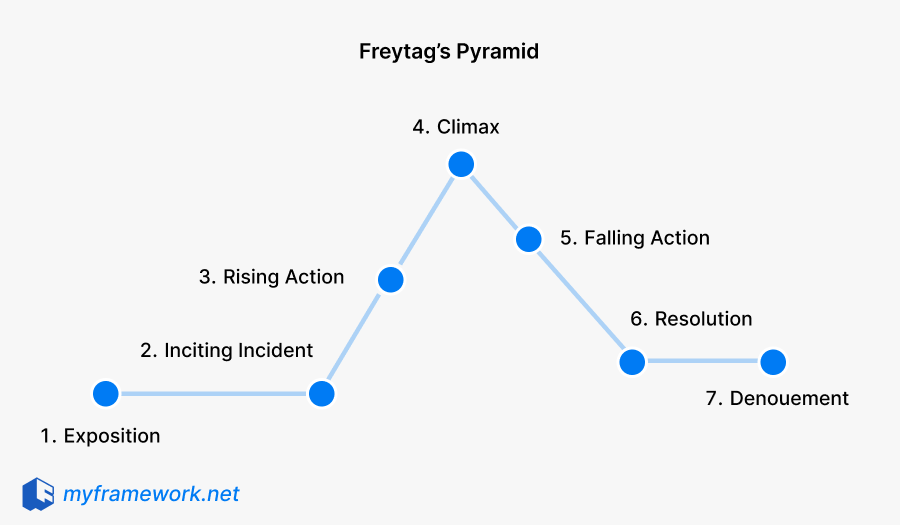
Gustav Freytag mapped five parts of a play: exposition, rise, climax, fall, and catastrophe (the close). Later teaching, including this page, splits the opening and the ending into seven named beats:
| Beat | Job |
|---|---|
| Exposition | Starting world, who is involved, what is already true |
| Inciting Incident | The disruption that makes the starting world unstable |
| Rising Action | Complications and rising cost of staying put |
| Climax | The irreversible turn or decision |
| Falling Action | What immediately follows that turn |
| Resolution | How the central conflict is settled |
| Denouement | The after-image: what is now true, and what it means |
The letters and labels are teaching shorthand. The method is the shape: the audience should feel a rise, a peak, and a release. Freytag does not put the recommendation first (that is the Pyramid Principle). It does not compress the story into Set-up, Conflict, Resolution as a hero transformation. It does not assign the customer the hero role and the brand the guide role.
You do not have to give every beat equal time. A short talk may spend seconds on Exposition and Denouement. If you skip the climax, you still have a timeline.
How it works
A useful Freytag pass is placement of real events, not a poster of seven boxes.
1. Name the story job and the facts you may use
Decide what the audience must understand by the end (why we changed course, why the outage happened, why this decision). List only events you can stand behind. Do not invent a villain or a crisis to create tension.
2. Place Exposition and the Inciting Incident
Give enough starting world that the disruption is intelligible. Then name the incident that made the old state unsustainable. If the incident is vague ("things got harder"), you do not have a pyramid yet.
3. Build Rising Action toward one Climax
Show increasing cost, failed patches, or narrowing options. The climax is the turn: the decision, the failure that could not be ignored, the vote. It should be recognizable as a peak, not as a louder restatement of the setup.
4. Fall, resolve, and close
Falling Action is consequence, not a new subplot. Resolution settles the conflict you actually named. Denouement is brief: what is now true, and what the audience should carry out of the room.
If a beat has no facts, say so and shorten it. Empty boxes are not structure.
How it compares
When another lens fits better, or when you need a complementary view, these frameworks do different jobs. They are not interchangeable labels for the same question.
| Framework | What it helps you see | How it differs from Freytag |
|---|---|---|
| Pyramid Principle | The governing conclusion, then grouped support | Argument order, not rise-peak-fall tension |
| Hero's Journey | Set-up, Conflict, Resolution as a transformation | Three-beat change story. Freytag is a finer dramatic pyramid. |
| Pixar Storytelling Formula | A causal chain of "because of that" | Sentence-level cause and effect, not a named climax beat |
| StoryBrand | Customer as hero, brand as guide | Marketing roles. Freytag is the rhythm of one narrative. |
| Self-Us-Now | Speaker identity, shared identity, present ask | A speech opener pattern, not a full dramatic pyramid |
Freytag's Pyramid is the lens for placing events on a rise, a peak, and a close. Other methods help when the question is logic, a three-beat hero story, a causal chain, or marketing roles.
When to Use This Framework
- A retrospective that currently reads as a log. The team lived a messy month. They need the room to see what triggered the mess, where the decision happened, and what is now settled.
- A leadership speech that needs a turning point. The facts are known. The talk still feels like a tour of the org chart.
- Change communication that must show before, disruption, and after. People need to know what broke the old state and what the new state is, not only a list of workstreams.
Example
A concrete example makes the structure easier to reuse when you are under uncertainty.
Example: A CTO briefing the board after a week of outages
The facts (illustrative, not a universal incident): a payments API degraded over a weekend. Customers could not complete checkout. The team rolled a change, then rolled it back, then isolated a cache bug.
A flat version lists every war-room hour. A Freytag version might look like this:
- Exposition: Checkout had been stable. Black Friday traffic was two days away.
- Inciting Incident: Error rates jumped after a cache configuration change.
- Rising Action: Rollback did not fully recover. A second theory (database locks) burned half a day. Merchant tickets piled up.
- Climax: Engineering froze unrelated deploys and shipped a targeted cache fix with a kill switch.
- Falling Action: Error rates dropped. A residual queue of failed orders had to be replayed.
- Resolution: Checkout recovered before the peak shopping window.
- Denouement: The board hears the new rule: no cache changes in the freeze window without a paired rollback test.
Implication: The climax is the freeze-and-fix, not the loudest Slack message. The denouement is a rule, not a second hero moment. Inventing a "near bankruptcy" beat would be a method error.
Example: Announcing an office-policy change
A COO needs to explain why hybrid attendance is becoming two anchored days. The current draft is a policy PDF with dates.
- Exposition: The team already knows hybrid is the default.
- Inciting Incident: Two large customers asked for overlapping on-site workshops the team could not staff.
- Rising Action: Calendar collisions, delayed decisions, and a missed workshop.
- Climax: Leadership chooses two anchored days rather than a full return-to-office.
- Falling Action: Exceptions process, desk booking, and a 90-day review.
- Resolution: The policy is the settlement, not a debate still open in the room.
- Denouement: What "good" looks like in the first month (staffed workshops, fewer last-minute scrambles).
Implication: Freytag organizes the why-we-turned story. It does not replace the policy document, and it does not make the change popular.
Takeaway
What Freytag's Pyramid can help with
- Ordering a real sequence so the audience can see rise, peak, and close
- Stopping a talk that treats every event as equally intense
- Giving change or crisis communication a recognizable turning point
- Separating settlement (Resolution) from after-meaning (Denouement)
What Freytag's Pyramid cannot replace
- Conclusion-first logic. The Pyramid Principle groups arguments under a governing idea. Freytag sequences tension over time.
- A three-beat transformation story. This site's Hero's Journey uses Set-up, Conflict, and Resolution. That is a different compression.
- Cause-and-effect sentence chains. The Pixar formula ("Once upon a time... Because of that...") is a causal scaffold, not a seven-beat peak.
- A marketing role map. StoryBrand assigns customer, problem, guide, and plan. Freytag does not put the brand in a guide role.
- A substitute for missing facts. If there was no turning point, labeling a slide "Climax" does not create one.
Honest scope: Freytag structures dramatic rhythm. It does not replace the methods above, and it should not be sold as a guaranteed engagement device.
Frequently asked questions
No. He described a five-part dramatic pyramid for plays. This page's seven beats are a teaching expansion (splitting the opening and the close). You can still use the method if you collapse beats on a short talk.
A named story job, real events placed on the beats, a climax that is an actual turn, and a close that settles the conflict. If the output only lists seven headings, you do not have a structure yet.
The Pyramid Principle leads with the answer and groups reasons. Freytag delays the peak so tension can rise. Use them for different jobs: argument versus dramatic rhythm.
Yes. Keep Exposition short, name one Inciting Incident, earn one Climax, and close. Empty Rising Action or a second climax usually means the story is still a list.
No. Tension has to come from the case. Invented crises are a method failure, not a creative upgrade.