Business & Growth
Ohmae’s 3C’s Model: The Strategic Triangle
Emphasizes the balanced integration of Company, Customer, and Competitor for strategic decisions, avoiding a singular focus.
Applications
Framework Card
Ohmae’s 3C’s Model
- Goal
- Avoid tunnel vision by integrating three critical perspectives into one cohesive strategy.
- Best For
- Market Entry; Rebranding
Introduction
Ohmae's 3C’s model is a well-known business framework. It focuses on three key elements that drive a business’s success: Customer, Competitor, and Company.
Japanese management consultant Kenichi Ohmae developed this model, and he introduced it as a way to assess and align these elements for competitive advantage.
What this framework is
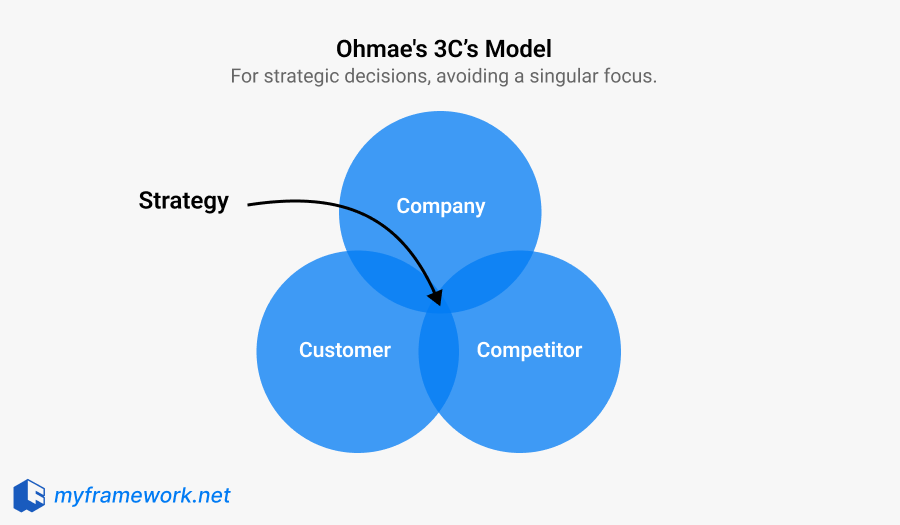
The model is a "Strategic Triangle" consisting of:
- The Customer (The market)
- The Competitor (The rival)
- The Company (The self)
Ohmae posits that the job of a strategist is to find the "Sweet Spot" where company strengths match customer needs better than the competition does.
Advertisement
Core Concept of Ohmae's 3C’s Model
At its core, the 3 C’s strategy emphasizes that businesses must consider three essential factors when making strategic decisions:
Customer
Understanding customer needs is the starting point.
Companies must know what their customers value and how they can meet or exceed those expectations. It's about identifying what the market truly wants, and not just what the business thinks they want.
Competitor
Knowing your competition is critical.
This part of the model stresses the need to analyze competitors’ strengths and weaknesses. By doing this, a business can find ways to differentiate itself, spot gaps in the market, or offer something unique that competitors do not.
Company
Finally, a business must assess its own capabilities.
It should ask, “What can we do best?” This involves analyzing internal strengths and weaknesses, resources, and skills to ensure the company can successfully deliver on its strategy and stand out in the market.
These three elements work together in harmony to create a strategy that is responsive to both the market and the internal capabilities of the company.