Business & Growth
TAM-SAM-SOM Analysis: A Guide to Effective Market Segmentation
Enhance your market segmentation and marketing strategy
Framework Card
TAM-SAM-SOM Analysis
- Goal
- Enable better market evaluation and strategic planning.
- Best For
- Market sizing; Go-to-market planning
Introduction
Have you ever wondered how businesses identify the potential of a market and segment it effectively? The TAM-SAM-SOM model helps companies do just that.
Developed by marketing and business strategists, this framework allows organizations to better understand and measure the opportunity within a market.
What this framework is
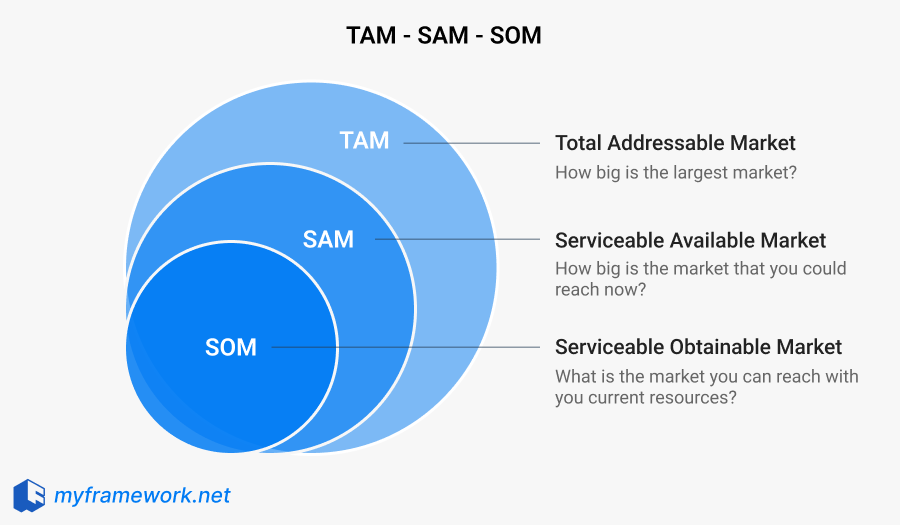
The model divides the market into three categories:
- Total Addressable Market (TAM)
- Serviceable Available Market (SAM)
- Serviceable Obtainable Market (SOM)
Each with a different level of market potential.
Advertisement
How the framework works
TAM (Total Addressable Market)
This is the broadest category and represents the total demand for a product or service within a market. It is the ideal scenario where a company has 100% market share and is serving every possible customer.
Key Questions for Defining TAM
What is the total size of the market globally or regionally?
What is the overall demand for this product or service?
How many potential customers exist, regardless of product availability?
What are the long-term trends driving the market’s growth?
SAM (Serviceable Available Market)
SAM is a more realistic view of the market. It narrows down the TAM to only those customers who are reachable based on geography, regulations, capabilities or resources.
Key Questions for Defining SAM:
Which geographic areas can I serve with my product or service?
What specific customer groups can I realistically target based on current capabilities?
What are the legal, regulatory, or cultural barriers preventing access to certain customers?
How does my offering meet the needs of this specific market?
SOM (Serviceable Obtainable Market)
SOM is the most specific category. It represents the portion of the SAM that your business can realistically capture, given your resources, competition, and market position.
Key Questions for Defining SOM:
What is the current competition in this segment, and what is their market share?
What portion of the market can I realistically reach in the next 6 to 12 months?
What resources (financial, human, or technological) do I have to capture this market?
How can I differentiate my offering to stand out in this specific segment?