Communication
7-38-55 Rule: How Tone and Body Language Shape Communication
Your presence speaks louder than your words.
Applications
Framework Card
7-38-55 Rule
- Goal
- Ensure your words, tone, and body language are consistent to avoid mixed messages and build trust.
- Best For
- Workplace Feedback; Public Speaking
What's Causing Misunderstanding?
Have you ever sent a message that was misunderstood? Maybe you said something in a meeting, but people focused more on your tone than your words. This happens because communication is not just about words.
What this framework is
Albert Mehrabian, a psychology professor at UCLA, developed the 7-38-55 Rule to explain how people interpret messages.
His research in the 1960s found that when we express feelings and attitudes, only 7% of meaning comes from words, 38% from tone of voice, and 55% from body language.
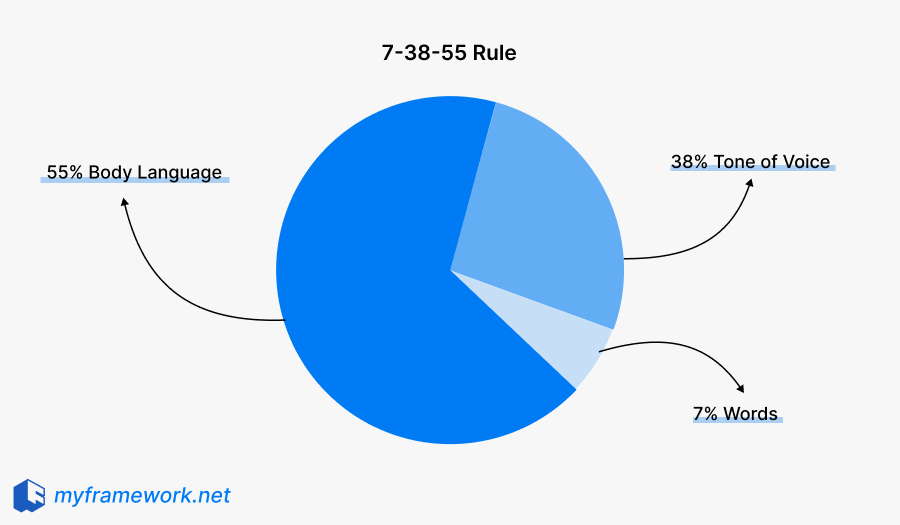
This rule helps us understand why tone and body language matter in communication. It is widely used in public speaking, leadership, and daily conversations.
Advertisement
Core Concept of the 7-38-55 Rule
7-38-55 Rule is about how people understand emotions in face-to-face communication. They will judge your communication based on:
- 7% – Words: The actual words we actually say
- 38% – Tone of Voice: How we say the words, including pitch, speed, and volume
- 55% – Body Language: Facial expressions, gestures, and posture
This means that when words and nonverbal signals do not match, people trust nonverbal cues more.
For example, if someone says, "I'm fine" but looks upset and speaks with a shaky voice, we believe their body language and tone, not just the words.