Communication
The Rule of Suspense: How to Keep Your Audience Engaged
Reveal your points step by step.
Applications
Framework Card
The Rule of Suspense
- Goal
- Prevent audience "checkout" by building anticipation throughout the speech.
- Flow
- Sequencing → Curiosity → Memory
- Best For
- Presentations; Meetings
Why Attention Fades So Easily
Great communicators know how to keep people curious. They build anticipation instead of revealing everything at once.
This is what we call the Rule of Suspense in communication.
What this framework is
The Rule of Suspense is a simple but powerful communication method that helps you keep your audience engaged by sharing your points one at a time. The core concept of this technique is simple and straight:
Instead of listing all your ideas upfront, you reveal them step by step. Each point becomes a small discovery, giving your audience a reason to stay focused.
When someone says, “I have three ideas to share. They are A, B, and C,” the listener’s curiosity disappears instantly because they already know what’s coming.
But when the speaker says, “I have three ideas to share. The first is…,” the audience starts to anticipate what the next one will be.
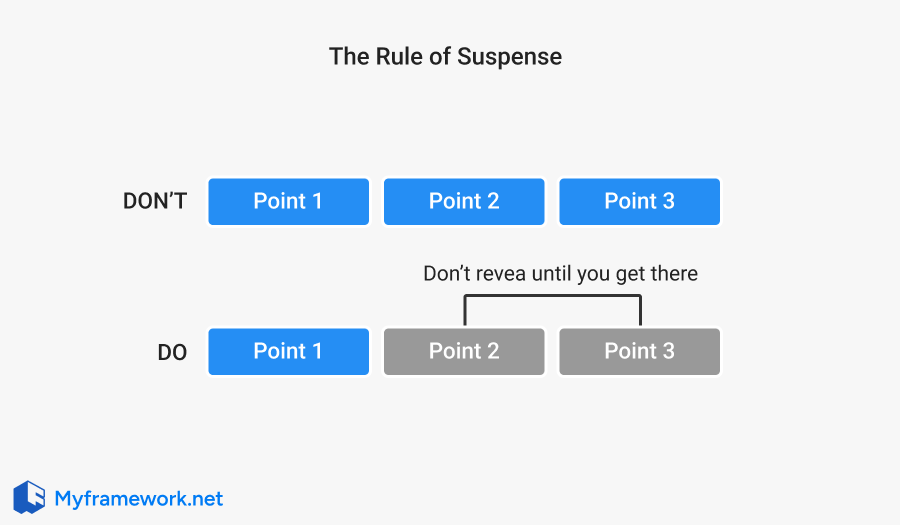
This creates momentum and keeps the listener invested.
Advertisement
Core Concept of the Rule
At its heart, the Rule of Suspense is about sequencing and curiosity.
- Sequence matters. Presenting points one at a time allows each idea to stand on its own. The listener can absorb, react, and reflect before moving to the next part.
- Curiosity drives attention. When people do not know what’s next, their brains stay alert. It’s the same principle that keeps us watching movies or reading stories until the end.
- Emotional engagement builds memory. Suspense creates a small emotional gap between what we know and what we want to know. Filling that gap makes information more memorable and persuasive.
This method is widely used in storytelling, sales, and presentations because it mirrors how human attention naturally works.