The Rule of Suspense: Reveal Points One at a Time
The Rule of Suspense helps you reveal points one at a time, with a small honest gap and a pause to absorb each beat, instead of announcing the whole list up front. It is a pacing pattern for a sequence you already have, not a trick that guarantees attention.
Framework Card
- Name:
- The Rule of Suspense
- Goal:
- Reveal points one at a time, with a small honest gap and time to absorb each beat, so a sequence stays followable instead of being previewed as a closed list.
- Flow:
- Sequential delivery → Cognitive gap → Temporal pacing
- Best For:
- Talks that die after “I have three points: A, B, and C”; Meetings where colleagues jump ahead of the reasoning; Teaching a short sequence that needs each idea to land
Why it matters
A familiar opening kills the rest of the talk: “I have three ideas. They are planning, teamwork, and feedback.” The listener now knows the map. Each later sentence is a recap. People start answering email.
The same three ideas can be delivered as “I learned three things. The first is about planning.” The room still has a reason to stay for the second and third. That is the whole method: do not close the list before the first point has landed.
The Rule of Suspense is not a thriller. It does not ask you to hide a decision a board needs in the first minute. It asks you not to dump a closed inventory when the job is to walk people through a sequence.
What it is
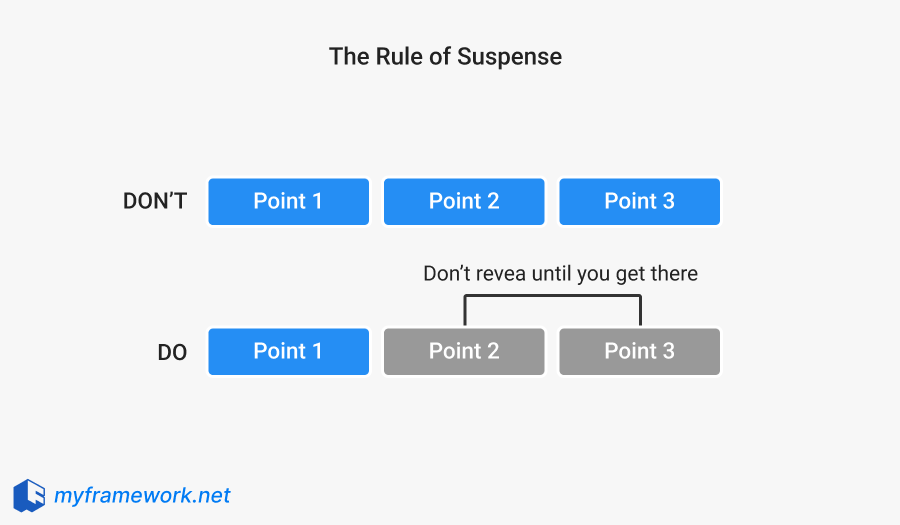
The Rule of Suspense is three operating moves used together:
- Sequential delivery. Present points one at a time. Each idea should be able to stand on its own.
- Cognitive gap. Leave a small, honest unknown: listeners know there is a next point, not what it is.
- Temporal pacing. Pause long enough for absorption before the next reveal.
Production copy contrasts two openings. Listing A, B, and C up front removes the gap. Saying “the first is…” keeps it. The method is that contrast, not a claim about movies or the brain as a scientific finding.
If the occasion requires the conclusion first (a two-minute recommendation, a written pyramid), this sequence is the wrong tool.
How it works
A useful pass is order and pause, not a cliffhanger script.
1. Sequential delivery
Order the points you already have. Deliver the first completely enough to stand alone. Do not open with a table of contents that names every later point.
2. Cognitive gap
Tell the audience that more is coming if that is true. Do not name the remaining items. Keep the hold-back small and honest. Withholding a number the group must decide today is delay, not suspense.
3. Temporal pacing
Leave a beat. A question, a short example, or silence. Then reveal the next point. Stacking three punchlines in one breath is still a list.
Resolve the sequence. Do not end on a teaser that never arrives.
How it compares
When another lens fits better, or when you need a complementary view, these frameworks do different jobs. They are not interchangeable labels for the same question.
| Framework | What it helps you see | How it differs from the Rule of Suspense |
|---|---|---|
| PREP Framework | Point, Reason, Example, restated Point | Starts with the claim. This method withholds the remaining list. |
| Pyramid Principle | Governing thought, then grouped support | Answer-first architecture for memos and talks |
| SCQA Framework | Situation, Complication, Question, Answer | Narrative that earns the answer, not a paced inventory of points |
| Peak-End Rule | How memory weights peak and ending | A memory finding, not a reveal sequence |
| AIDMA Model | Attention, Interest, Desire, Memory, Action | Marketing path to action, not spoken pacing |
The Rule of Suspense is the lens for sequenced reveals with a small gap. Other methods help when the question is the answer first, a proposal path, memory of an episode, or a funnel.
When to Use This Framework
- Executive updates. Insights can be walked through rather than front-loaded as a closed agenda of conclusions.
- Team meetings. Colleagues jump to the last slide. Sequencing the reasoning can keep them on the current step.
- Talks and teaching. Each idea needs a beat of its own before the next arrives.
Example
A concrete example makes the structure easier to reuse when you are under uncertainty.
Example: Project retrospective that dumps the lessons
Less useful: “Three lessons: planning, teamwork, and feedback.”
More useful: “I took three lessons from this project. The first is about planning.” After that point lands, the speaker continues to teamwork, then feedback.
Implication: The content did not change. The preview did. Listeners still hear three lessons. They do not get the map in sentence one.
Example: Staff meeting that needs a decision now
A finance lead has five minutes. Leadership must approve a cutoff date. Opening with a sequenced mystery around the date would waste the window. The Rule of Suspense is the wrong sequence. A point-first answer (the date, then why, then one example) fits better.
Implication: Suspense is for a walkable list. It is not a way to hide a required decision.
Takeaway
What the Rule of Suspense can help with
- Stopping a closed preview that kills curiosity
- Letting each point stand before the next arrives
- Pacing a short spoken or taught sequence
- Distinguishing honest gaps from withheld decisions
What the Rule of Suspense cannot replace
- Point-first answers. PREP and the Pyramid Principle put the conclusion first. Many briefings need that.
- Proposal narrative. SCQA sets situation and tension, then the question and the answer.
- Memory of an episode. The Peak-End Rule describes how people remember peaks and endings. It is not a reveal sequence.
- A marketing funnel. AIDMA (attention, interest, desire, memory, action) is a path to action, not delivery pacing.
- Substance. Sequencing cannot replace a thin idea. Artificial cliffhangers frustrate people.
Honest scope: the framework structures how a short sequence is revealed. It does not replace answer-first methods, and it should not be sold as a way to master public speaking.
Frequently asked questions
No. If the audience needs the answer now, lead with it. Suspense is for walking a sequence, not for delaying a decision.
An ordered set of points, each delivered so it can stand alone, a small honest gap before the next, and a resolved last point. If the output is “keep them curious” with no sequence, you do not have the method yet.
Those methods put the conclusion first. This method does not preview the remaining points. Use them for different jobs.
No number in this package is a law. A short sequence is easier to pace. Do not treat “three to five” as research.
You can pace section headers. Most memos still need the governing thought first (Pyramid). Do not force a mystery novel onto a decision document.