Leadership & Management
Leadership Success Model: Balance Personal, Team and Organization
Define the success of leadership via team engaged, personal satisfaction, and organizational success.
Applications
Framework Card
Leadership Success Model
- Goal
- Achieve "Fulfillment & Actualization" by balancing the three critical dimensions of leadership.
- Best For
- Leadership Diagnosis; Executive Coaching
What Defines an Effective Leader
Leaders today face a range of challenges that can hinder their success. Often, the path to effective leadership feels unclear.
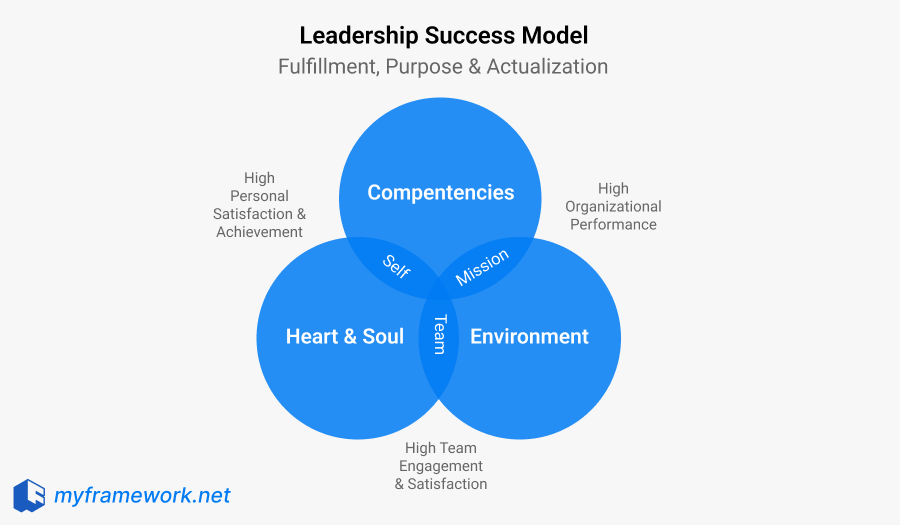
Paul Byrne developed the Leadership Success Model to provide a simple yet powerful framework to guide leaders. This model highlights the balance of three core elements: Competencies, Heart & Soul, and Environment. These elements work together to support leaders in achieving success.
What this framework is
The model consists of three interconnected circles.
- Competencies
- Heart & Soul
- Environment
Core Concept of the Leadership Success Model
Competencies
The first circle refers to the skills and knowledge required to be an effective leader.
These include technical abilities, problem-solving skills, strategic thinking, and the ability to inspire and manage teams. Leaders must continuously improve their competencies to handle the demands of their roles.
Without strong competencies, a leader may struggle to gain respect and lead effectively.
Key capabilities:
- Creativity
- Innovation
- Risk & courage
- Decision making
- Conflict resolution
- Time management
- Resilience
- Communication
- Problem-solving
- Collaboration
- Adaptability
- Emotional intelligence
Heart & Soul
This encompasses a leader’s emotional intelligence, values, and character. With heart and soul in mind, a leader has the ability to empathize with others, act with integrity, and build trust.
This circle is about the inner qualities that drive a leader's behavior, such as passion, resilience, and authenticity, and these can create positive, inspiring environments that encourage loyalty and motivation among their teams.
Key capabilities:
- Emotional energy & kindness
- Gratitude & appreciation
- Healthy relationships
- Overcoming fears
- Connections
- Forgiveness
- Giving
Environment
Environment refers to the external factors that influence leadership success. This includes organizational culture, team dynamics, and the broader societal and economic context in which a leader operates.
A leader’s success is often shaped by how well they adapt to and leverage the environment. A positive environment can support and enhance a leader’s competencies and emotional connection with their team, while a challenging environment requires a leader to be more adaptable and resourceful.
Key capabilities:
- Providing opportunity
- Caring and supporting
- Delivering feedback
- Leading by example
- Providing for needs
- Recognizing efforts
- Promoting growth
- Fostering trust