Leadership Success Model: Competencies, Heart and Soul, Environment
The Leadership Success Model helps you diagnose a leadership strain as an imbalance among Competencies, Heart and Soul, and Environment. It is a three-circle fit picture used on this site. It is not a fulfillment guarantee and not Goleman’s five EQ skills.
Framework Card
- Name:
- Leadership Success Model
- Goal:
- Diagnose a leadership strain as an imbalance among Competencies, Heart and Soul, and Environment, then name which circle is the constraint.
- Flow:
- Competencies → Heart and Soul → Environment
- Best For:
- A leader who works hard and still loses influence; Coaching when craft is strong and trust is not; Checking whether a hire's style fits this culture
Why it matters
A leader can be exhausted and still lose the room. The story is often “try harder.” The missing split is whether the constraint is craft, inner and relational ground, or a context that punishes the style they have.
This model exists to name that split. It does not score success. It asks which circle the case actually points to.
What it is
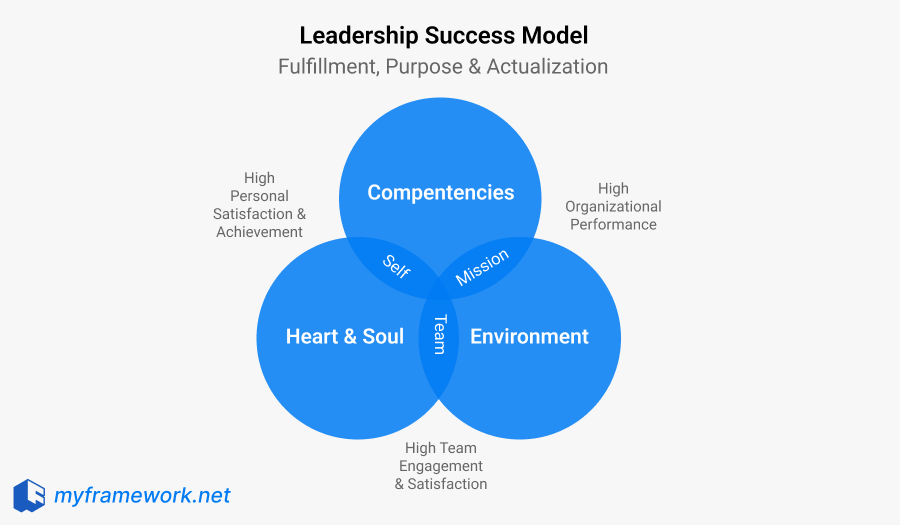
Three circles:
Competencies: leadership craft: decisions, conflict talk, technical enough judgment, adaptability as skill.
Heart and Soul: empathy, integrity, trust, self-awareness, the inner ground people experience in the room.
Environment: culture, team dynamics, the stage of the company, support and feedback around the role.
Production copy talks about equilibrium and fulfillment. Keep equilibrium as “no circle is silently missing.” Drop actualization as an outcome promise. This is a teaching model on this site, not a canonical academic named theory with a single founder you must cite.
Sub-bullets in older copy (innovation, resilience, and so on) are examples inside a circle, not a required inventory.
How it works
1. Competencies
What craft is evidenced. Do not confuse a missing skill with a missing value.
2. Heart and Soul
What the room experiences of integrity, empathy, and self-awareness. Use scenes, not slogans.
3. Environment
What the context rewards and punishes. A strong circle two can still fail in a hostile system.
4. Name the imbalance
State which circle is the constraint and whether development or a context change is the honest implication. Do not emit a generic leadership-action essay.
How it compares
| Framework | What it helps you see | How it differs |
|---|---|---|
| Goleman Emotional Intelligence Model | Five EQ competencies | Skill list. This model is three fit circles. |
| Situational Leadership | Style vs follower readiness | A different contingency. |
| Three Circles of Influence | Control, influence, concern | Agency sort, not leadership-fit circles. |
This model is the lens for Competencies, Heart and Soul, and Environment. Other methods help when the question is EQ skills, style-readiness, or agency.
When to Use This Framework
- Diagnosis. A leader is failing the job despite hours and experience.
- Coaching. Craft is visible. Influence or trust is not.
- Hire fit. You are checking style against this company’s stage and culture.
- Culture clash. Behavior that worked elsewhere is punished here.
Example
A concrete example makes the structure easier to reuse when you are under uncertainty.
Example: Expert IC promoted, team goes quiet
Competencies look strong (architecture decisions). Heart and Soul: they skip one-on-ones and treat disagreement as error. Environment: a culture that expects coaching from managers.
Implication: The constraint is not more technical training. It is circle two in this environment. Goleman could then name a skill. This model’s job was the split.
Example: Values-strong leader in a freeze culture
Heart and Soul reads as honest. Competencies are adequate. Environment: a parent company that punishes visible conflict.
Implication: Development will not fix a freeze. Naming Environment prevents a fake coaching plan.
Takeaway
What this model can help with
- Splitting craft, inner/relational ground, and context
- Explaining stall despite effort
- Hire and culture-fit conversations
- Avoiding “try harder” as the only diagnosis
What this model cannot replace
- Goleman Emotional Intelligence Model. Five practice competencies.
- Situational Leadership. Style vs follower readiness.
- Fiedler’s contingency model. A different contingency logic.
- Three Circles of Influence. Control, influence, concern.
- A 360 product or a fulfillment program.
Honest scope: the model structures a three-circle diagnosis. It should not be sold as actualization.
Frequently asked questions
No. Goleman names five skills. This model asks which of three circles is the constraint.
No. Use the three circles. Sub-bullets are examples.
Sometimes you change how you operate in it. Sometimes the honest output is that the fit is wrong. The model should not hide that.
No. That is a slogan this page does not use.