Marketing
Research Funnel Model: How to Conduct User Research on a Zero Budget
Understand users with clarity, even when resources are tight.
Applications
Framework Card
Research Funnel Model
- Goal
- Match your question to the stage so you collect decision-ready insight without wasting time.
- Best For
- Project Kickoff; Roadmap Planning
Introduction
Struggling to Do User Research with Limited Resources? You are not alone. Many product managers, designers, and indie developers face this common challenge.
When you're not a professional researcher, it’s hard to know how deep to go, how to break the research into stages, and who the results are for. As a result, people often throw all research activities together—only to end up with no real insight or actionable decisions.
What this framework is
Jane Austin, a well-known design leader, introduced a simple but powerful model to solve this problem: the Research Funnel.
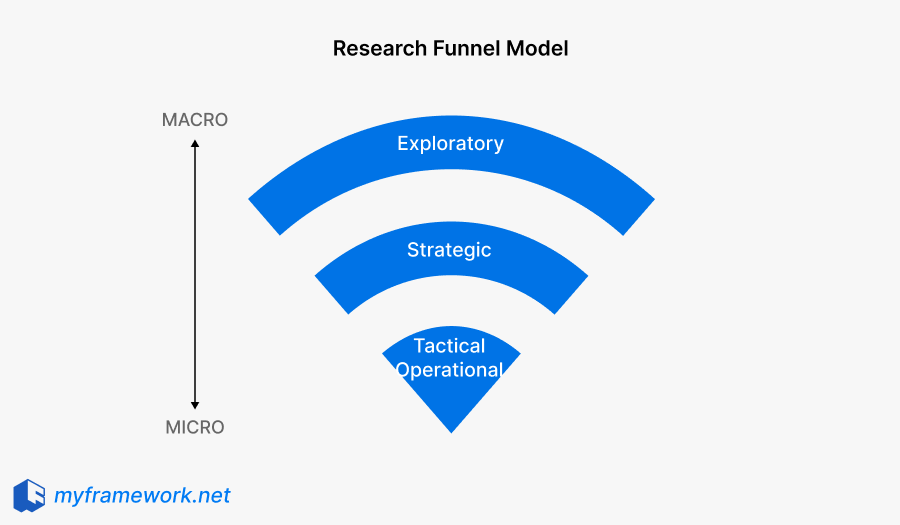
This model helps you structure your research based on how close you are to the problem, so you can make better use of your time, energy, and findings.
Advertisement
Three Levels of the Research Funnel
The Research Funnel breaks all user research into three categories, arranged from broad discovery to detailed validation. The idea is to match your research method to your current goal.
Exploratory Research: Find the Direction
When you only have a rough idea of the domain or user pain points, exploratory research helps you uncover what really matters.
This stage is about understanding the context.
- Methods: In-depth interviews, open-ended conversations, field observation.
- When to use: You have limited knowledge of your users and want to explore what problems exist.
- Example: A developer working on a children’s coding tool talked to 10 parents before building the product. He discovered the core issue was not the content itself but the parents’ lack of guidance skills. This changed his direction from building a question bank to focusing on parent-friendly support tools.
Strategic Research: Set the Direction
Once you’ve decided to build something, you need to define your priorities and target audience. Strategic research helps you make those choices.
- Methods: User personas, need clustering, pain point ranking.
- When to use: You know what product you want to build, but you're unclear on what features or users to focus on first.
- Example: A designer preparing to build an MVP for a SaaS tool interviewed startup founders. He learned that automation features were more important than visual chart design. So, he prioritized building auto-reports rather than dashboard beautification.
Tactical/Operational Research: Fine-Tune the Details
When your product is in development or already launched, research can help you improve the experience and validate ideas.
- Methods: Usability testing, A/B testing, heatmap analysis.
- When to use: You’re refining details or solving specific performance issues.
- Example: After launching a product, a developer noticed poor user conversion. He watched 10 new users use the app and saw most got stuck during registration. By simplifying the registration page, conversion increased by 40%.