Personal Development
CBT Framework: Mastering Your Mind’s Operating System
It’s not the situation that causes your emotions — it’s how you think about it.
Applications
No application mappings are available for this framework yet.
Framework Card
CBT Framework
- Goal
- Replace automatic negative thoughts with accurate, constructive thinking.
- Flow
- Thoughts ↔ Emotions ↔ Behaviors
- Best For
- Imposter Syndrome Root Causes; Cognitive-Driven Anxiety and Stress
Why Do We Struggle with Negative Emotions?
Have you ever had moments like these?
- You try your best, but still wonder: “Am I just not good enough?”
- One small mistake makes you feel like a total failure.
- You want to change, but you keep delaying, and days go by.
These feelings are more than just mood swings. Often, they come from the way we think.
What this framework is
The CBT Framework, also known as Cognitive Behavioural Therapy (ABC Model also belongs to this), is a simple and practical framework that helps you understand the link between your thoughts, emotions, and behaviors.
It was developed in the 1960s by psychiatrist Aaron T. Beck, and it’s widely used today in therapy, coaching, and self-help.
Instead of forcing yourself to “stay positive,” CBT teaches you how to notice and shift the thoughts that shape your emotions. It’s not about ignoring reality — it’s about understanding how your thinking patterns affect how you feel and act.
Advertisement
Thoughts, Emotions, Behaviors – All Connected
At the heart of CBT is one simple idea:
It’s not the situation that causes your emotions — it’s how you think about it.
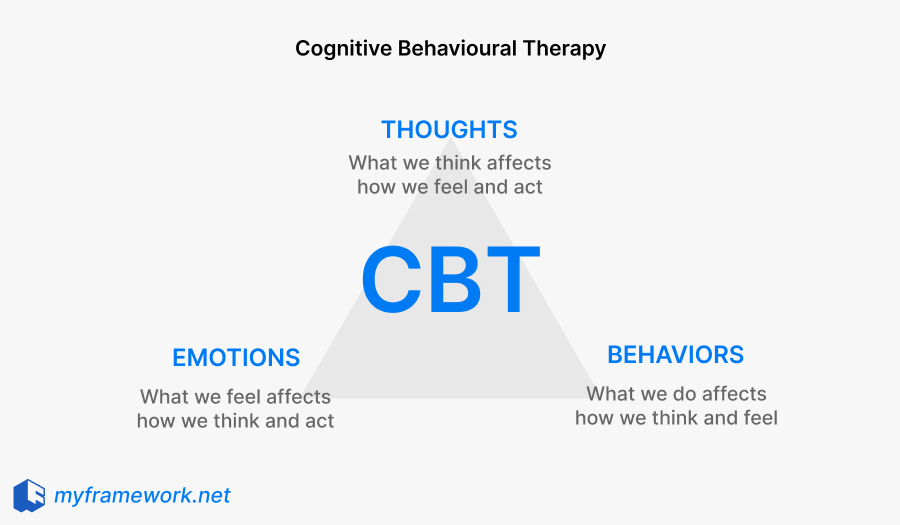
CBT focuses on the triangle of:
- Thoughts (what you tell yourself)
- Emotions (how you feel)
- Behaviors (what you do)
These three parts influence each other. Let’s take a closer look:
Thoughts
These are the messages you say to yourself, often automatically.
Negative thoughts can become patterns, especially when repeated.
Emotions
Your feelings are shaped by how you interpret events. Harsh thoughts can lead to anxiety, shame, or sadness.
Behaviors
How you act is often a result of how you feel. If you think you can’t do anything right, you might avoid challenges or give up easily.
By learning to recognize and question unhelpful thoughts, you can change how you feel and respond.