Productivity & Execution
Four Quarters Method: Reset Your Day, Not Tomorrow
Helps you stay productive, maintain focus, and manage your energy across the entire day.
Applications
Framework Card
Four Quarters Method
- Goal
- Recover focus quickly and maintain momentum across a full day.
- Flow
- Morning → Midday → Afternoon → Evening
- Best For
- Recovering from a bad start; Managing uneven energy
Why This Matters
Life and work have become harder nowadays.
We all have days like this: it started well but went off track halfway through. A stressful morning meeting, a missed deadline, or a small mistake can make the rest of the day feel wasted.
What this framework is
Don't blame yourself; the problem is not losing focus. We can control it better via a method called the Four Quarters Method.
Created by author Gretchen Rubin, this method offers a simple yet powerful way to regain control of your day in real time.
Advertisement
How the framework works
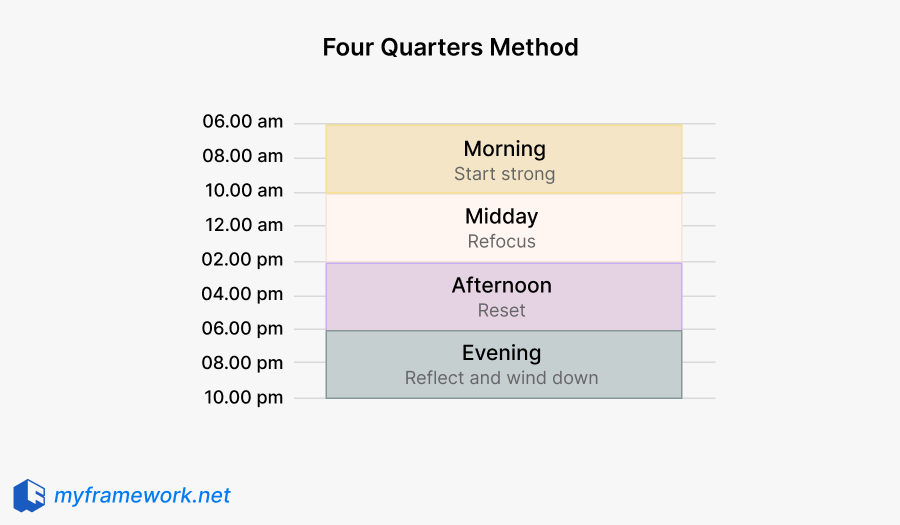
The Four Quarters Method divides a day (especially a typical working day) into 4 segments, each with its own goal and mindset.
Morning (6 AM – 12 PM): Start Strong
Focus on the most important and creative tasks. This is your high-energy zone where deep work matters most.
Midday (12 PM – 2 PM): Refocus
Take a short break, eat well, and reorganize your plan. Use this time to reset your priorities for the second half of the day.
Afternoon (2 PM – 6 PM): Reset
Shift to secondary or collaborative tasks. It’s a good time for meetings, teamwork, or follow-ups that need moderate energy.
Evening (After 6 PM): Reflect and Wind Down
Review what went well, note what can improve, and prepare for tomorrow. This reflection prevents burnout and helps you close the day with clarity.