Pixar Storytelling Formula: One Change, Told as Six Beats
The Pixar Storytelling Formula helps you tell one change as a six-beat causal story: who existed, what they did every day, what broke the routine, what followed because of that, what finally resolved it, and what stayed different. It is a story spine, not a proof that the audience will agree.
Framework Card
- Name:
- Pixar Storytelling Formula
- Goal:
- Tell one change as a six-beat causal story: baseline, routine, disruption, consequences, resolution, and lasting after-state.
- Flow:
- Once upon a time → Every day → Until one day → Because of that → Until finally → And ever since that day
- Best For:
- Explaining a strategy or product pivot as a sequence; Recounting how a team left a stuck operating pattern; Teaching a lesson from one failed or recovered experiment
Why it matters
A change can be real and still land as a pile of slides. A team lists the old roadmap, the new roadmap, and three metrics. Listeners nod. They still cannot say why Tuesday made Thursday inevitable.
Stories fail in the opposite way too. Someone starts with a climax, or braids three plots, or invents a turning point because the real work was messy. The audience hears drama. They do not hear a sequence they can test.
The Pixar spine is a habit of putting one change in causal order so the after-state is earned. It does not make the change feel “inevitable.” It makes the chain visible.
What it is
The Pixar Storytelling Formula is a six-beat teaching spine, widely associated with Pixar story notes (often credited to Emma Coats). It is used in writing rooms and later in business talks as a way to walk one actor through one break in routine.
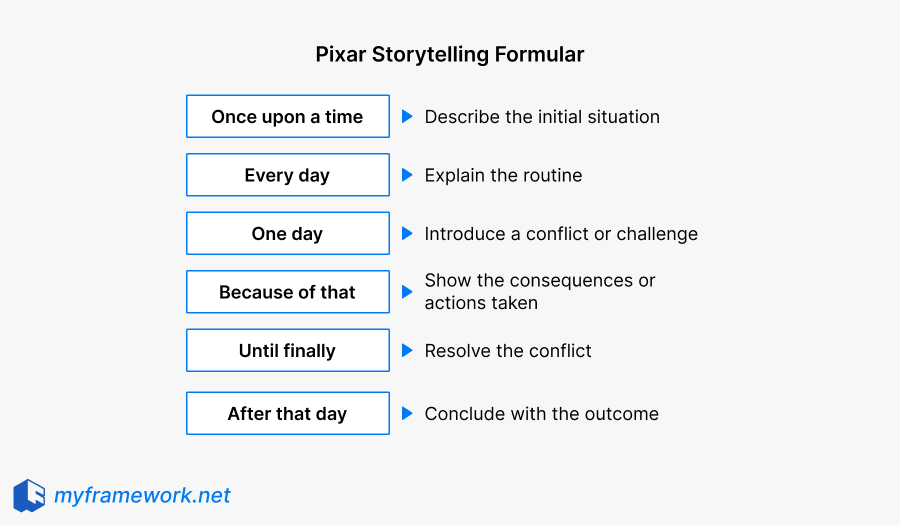
The beats are: once upon a time (the world and the actor), every day (the stable pattern), until one day (the disruption), because of that (consequences, which may repeat), until finally (the turning action), and ever since that day (the lasting after-state).
The formula does not assign archetypal roles, does not set up a consulting question, and does not evidence a personal competency. It sequences a change.
How it works
A useful pass is one plot and visible causality, not a poster that says “once upon a time.”
1. Once upon a time
Name the actor and the world in a few lines. A product line, a support team, a founder and a first customer. If you cannot name who the story is about, stop.
2. Every day
Show the repeating pattern that later becomes unsustainable. Keep it short. The routine exists so the disruption has contrast.
3. Until one day
Name the break: a churn spike, a regulation, a launch that failed, a customer who left. Do not invent a cleaner incident than the case has.
4. Because of that
Walk the consequences in order. Each beat should depend on the one before it. If a new topic appears, it is a second story. This beat may repeat.
5. Until finally
State the turning action or decision that resolved the tension. If the case has no resolution yet, say so. Do not write a fake climax.
6. And ever since that day
Name what stayed different: a new operating rule, a killed feature, a weekly review that did not exist before. Without an after-state, you still have a sequence of events, not a closed spine.
How it compares
When another lens fits better, or when you need a complementary view, these frameworks do different jobs. They are not interchangeable labels for the same question.
| Framework | What it helps you see | How it differs from the Pixar spine |
|---|---|---|
| SCQA Framework | Situation, complication, question, then answer | Sets up a question. Pixar walks a causal change without that Q-A pair. |
| Hero's Journey | Departure, trials, return | Archetypal stages. Pixar is six teaching beats for one change. |
| StoryBrand Framework | Customer as hero, brand as guide | A brand script. Pixar is not a positioning canvas. |
| STAR Method | Situation, Task, Action, Result | Evidences a competency in one past incident. Pixar evidences a causal change. |
| PREP Framework | Point, reason, example, restated point | A short opinion. Pixar is a plot. |
| Freytag's Pyramid | Exposition through denouement | Dramatic structure for a full narrative. Pixar is a shorter teaching spine. |
The Pixar Storytelling Formula is the lens for one change in causal beats. Other methods help when the question is a consulting setup, a myth, a brand role, or a competency story.
When to Use This Framework
- A strategy or product pivot. The audience knows the new plan and still asks why the old plan died.
- A team that left a stuck pattern. Daily work changed after a specific break, and you need that break on the table.
- A lesson from one experiment. A failed or recovered attempt has a before, a shock, and a new normal.
Example
A concrete example makes the structure easier to reuse when you are under uncertainty.
Example: A pricing page that stopped converting
A two-person product team treats every homepage rewrite as a new beginning. Conversion is down. They want a “story” for the board.
They pick one change: the day they moved from one price to three tiers.
- Once upon a time: a single monthly price and a short FAQ.
- Every day: prospects booked a demo after one sales call.
- Until one day: a larger buyer asked for seats, SSO, and a cheaper starter tier.
- Because of that: the team split the page into three plans. Demo volume rose. Self-serve stalled because the middle tier was vague.
- Until finally: they killed the vague middle tier and wrote one sentence on who each remaining plan is for.
- Ever since: demo-qualified leads are fewer, and self-serve starts complete more often.
Implication: The board did not get a Pixar brand. They got a causal account of one pricing change. Inventing a 40 percent lift would have been a different, dishonest story.
Example: A support team that stopped treating every ticket as equal
A six-person support lead wants to explain why billing and login now have a dedicated engineer hour.
- Baseline: one shared queue. Routine: first in, first out. Disruption: a week when login failures blocked checkout. Consequences: overtime, then a temporary war room, then a written severity rule. Resolution: a standing hour for billing and login. After-state: how-to tickets wait in a twice-weekly clinic.
Implication: The spine earned the new rule from a named break. It did not prove that every team should copy the clinic.
Takeaway
What the Pixar Storytelling Formula can help with
- Putting one change in an order a listener can replay
- Making the disruption and the after-state explicit
- Catching a talk that is all climax or all background
- Separating a consequence from a new, unrelated topic
What the Pixar Storytelling Formula cannot replace
- Question-then-answer setup. SCQA frames a problem as situation, complication, question, then answer. The Pixar spine does not ask a consulting question.
- Myth structure. The Hero's Journey uses departure, trials, and return. Six teaching beats are not that map.
- Brand as guide. StoryBrand casts the customer as hero. This spine casts one change, which may not be a customer journey.
- Competency evidence. STAR needs Situation, Task, Action, and Result for what you owned. A change story can hide personal ownership.
- A license to invent an ending. Some work is still mid-consequence. The honest close is to say the after-state is not known yet.
Honest scope: the formula structures a causal change story. It does not replace the methods above, and it should not be sold as a buy-in guarantee.
Frequently asked questions
No. It is a teaching spine popularized from Pixar story notes. Films use many structures. The six beats are a way to test whether one change has a before, a break, a chain, and an after.
You can compress two consequences into one sentence. Removing the causal link leaves a list of events. The audience will not see why the resolution was required.
SCQA sets up a question and then answers it. STAR evidences what you owned in one incident. The Pixar spine sequences a change so the after-state is earned.
Say so in the last beat. “We are still in the because-of-that” is an honest after-state. Inventing a climax is not.
No. It makes the chain inspectable. Agreement is a separate decision.