Self-Us-Now: Story of Self, Us, and Now
The Self-Us-Now Framework helps you build a public narrative in three stories: why you are called (Self), who you are with (Us), and what this moment requires (Now). It is Marshall Ganz’s teaching from community organizing. It is not a product plot and not a promise that the room will act.
Framework Card
- Name:
- Self-Us-Now
- Goal:
- Connect a personal calling, a shared group identity, and a timed ask so a public narrative can move listeners toward collective action.
- Flow:
- Story of Self → Story of Us → Story of Now
- Best For:
- Advocacy and campaign talks that need participation; Organizing trainings that teach public narrative; Leadership remarks that must end in a concrete ask
Why it matters
Many talks explain the issue and then ask for help. The audience understands the facts. They still sit. The missing piece is rarely another slide of data. It is the bridge from one person’s reason to a shared “we,” and from that “we” to a choice that exists this week.
The other failure is a long personal story that never becomes ours. People feel for the speaker and leave with no identity and no next step.
Self-Us-Now is a way to put calling, shared identity, and a timed ask in order. It does not replace the relationships organizing needs. It gives the speech a spine those relationships can use.
What it is
Self-Us-Now is public narrative. Marshall Ganz developed the teaching while training organizers.
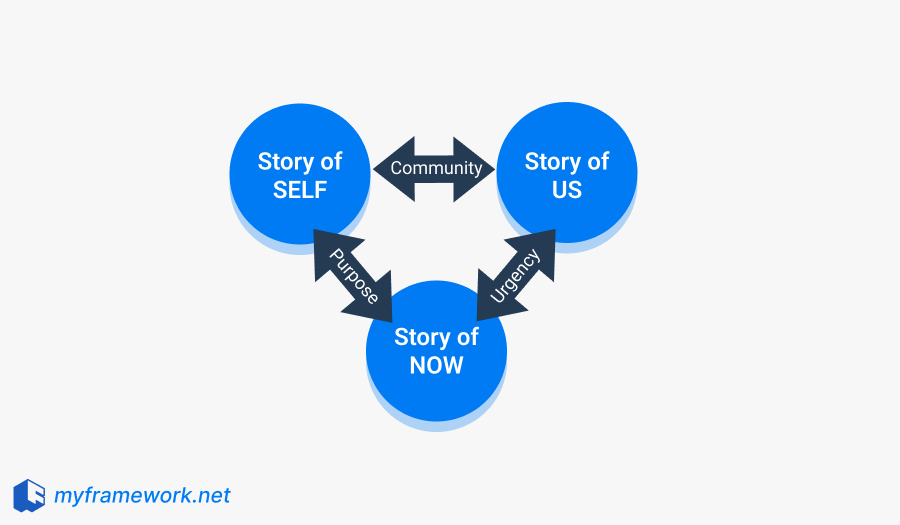
Story of Self is a specific experience that shows a value and why the speaker is in this work.
Story of Us names a shared history, challenge, or value so the audience is not a row of spectators.
Story of Now states what is at stake in this window and what people can do.
The method is a sequence, not a mood. Passion without Us is a memoir. “We” without evidence is a slogan. Now without a doable act is adrenaline.
Self-Us-Now does not put the customer in a brand hero seat, does not walk twelve mythic stages, and does not open with “once upon a time.” Those are other story jobs.
How it works
A useful Self-Us-Now pass is three linked stories, not three adjectives.
1. Story of Self
Pick one moment that reveals a value. Sensory detail helps; a resume does not. The point is why you are called to this issue, not how hard your life has been.
2. Story of Us
Name the shared ground: a neighborhood, a workplace, a prior fight, a value the room already holds. Use “we” only when you can point to that ground. If the audience’s story differs from yours, join through the value, not through a fake identical biography.
3. Story of Now
State the choice in this window and the act people can take (a vote, a shift, a petition, a donation, a meeting). Contrast action and inaction only with facts you have. Do not invent a countdown.
Time spent on each story can vary by room. There is no required 30/40/30 split.
How it compares
When another lens fits better, or when you need a complementary view, these frameworks do different jobs. They are not interchangeable labels for the same question.
| Framework | What it helps you see | How it differs from Self-Us-Now |
|---|---|---|
| StoryBrand | Customer as hero of a brand story | Product plot. Self-Us-Now is a public ask, not a brand script. |
| Hero’s Journey | Individual transformation stages | One person’s change. Self-Us-Now needs a collective Now. |
| Pixar Storytelling Formula | Once upon a time / until / because of that | Fictional plot beats. Not a campaign narrative. |
| Innovation Story Framework | How a product or change is narrated | Offering story. Not organizing. |
The Self-Us-Now Framework is the lens for public narrative that ends in a group act. Other methods help when the question is brand, mythic transformation, plot, or product change.
When to Use This Framework
- Campaign and advocacy talks. Voters, members, or neighbors need more than a policy list.
- Organizing trainings. New leaders need a repeatable way to tell why they are here and what “we” will do.
- Leadership remarks that must end in participation. A kickoff or fundraiser that currently dies as inspiration.
Example
A concrete example makes the structure easier to reuse when you are under uncertainty.
Example: Local housing campaign
A candidate wants turnout on an affordable-housing vote. Policy slides have not moved volunteers.
- Self: Growing up, the family moved twice in one school year when rent jumped. The value is stability, not a full childhood memoir.
- Us: Neighbors in the same district now spend more than a third of income on rent. That is the shared condition, not a claim that every listener had the same childhood.
- Now: The council votes next month. The ask is two evening shifts on the phone bank this week.
Implication: The speech can be checked. Self is a scene. Us is a local fact. Now is a date and a shift. Inventing a “housing crisis poll” the campaign does not have would be a different, weaker choice.
Example: Workplace safety petition
A warehouse steward needs signatures this Friday.
- Self: The steward’s parent missed a year of work after a preventable lift injury.
- Us: This site has had three recordable strains this quarter. People on the floor already know the pace.
- Now: The petition goes to the safety committee Friday. The ask is a signature and one coworker brought to the table at lunch.
Implication: The story is still Self, Us, Now. It is not a brand hero plot and not a Hero’s Journey. The ask is small enough to do this week.
Takeaway
What Self-Us-Now can help with
- Sequencing a public narrative so calling, shared identity, and a timed ask stay connected
- Shortening a memoir that never becomes “we”
- Making an ask that is carried by story rather than by volume
What Self-Us-Now cannot replace
- A brand plot with the customer as hero. StoryBrand is for product messaging, not organizing.
- An individual transformation myth. The Hero’s Journey follows one person’s change. Self-Us-Now ends in a group act.
- A once-upon-a-time plot. The Pixar Storytelling Formula sequences fictional beats. Public narrative is not that formula.
- An innovation product story. The Innovation Story Framework narrates a change in an offering. It is not a public ask.
- Ongoing organizing. A speech does not replace relationships, lists, or follow-up.
Honest scope: Self-Us-Now structures a public narrative. It should not be sold as proven mobilization.
Frequently asked questions
A specific Self that reveals a value, an Us the audience can recognize, and a Now with a doable act in a real window. If any of the three is only an adjective, you do not have the method yet.
Not by itself. Self exists to explain the call. Extra hardship that never reaches Us or Now is a memoir.
Join through a shared value or a shared current condition. Do not invent a matching biography.
It can appear in a workplace when the job is collective action (a petition, a vote, a drive). It is a poor fit for a product launch plot or a status update.
You can shorten Self and Us. Skipping them entirely leaves an ask with no identity. That is a different speech.